From the "Moralia" vol. 1 "How the Young Man Should Study Poetry"...
"For, in the account of Aphrodite, he teaches those who will pay attention that vulgar music, coarse songs, and stories treating of vile themes, create licentious characters unmanly lives, and men that love luxury, soft living, intimacy with women...thus admirably indicating the duty of musicians and poets to take the subjects of their compositions from the lives of those who are discreet and sensible."
Friday, December 30, 2011

Sunday, December 25, 2011
ears stopped with wax...

"in the art of poetry there is much that is pleasant and nourishing for the mind of a youth, but quite as much that is disturbing and misleading, unless in the hearing of it he have proper oversight.
It deserves therefore our consideration, whether we shall put young men into Epicurus’s boat, — wherein, having their ears stopped with wax, as those of the men of Ithaca were, they shall be obliged to sail by and not so much as touch at poetry, — or rather keep a guard on them, so as to oblige their judgments by principles of right reason to use it aright, and preserve them from being seduced to their hurt by that which affords them so much delight. For neither did Lycurgus, the valiant son of Dryas (as Homer /2/ calls him) act like a man of sound reason in the course which he took to reform his people that were much inclined to drunkenness, by travelling up and down to destroy all the vines in the country; whereas he should have ordered that every vine should have a well of water near it, that (as Plato saith) the drunken deity might be reduced to temperance by a sober one. For water mixed with wine takes away the hurtful spirits, while it leaves the useful ones in it. Neither should we cut down or destroy the Muses’ vine, poetry; but where we perceive it luxuriates and grows wild through an ungoverned appetite of applause, there ought we to prune away or keep under the fabulous and theatrical branches thereof; and where we find any of the Graces linked to any of the Muses, — that is, where the lusciousness and tempting charms of language are not altogether barren and unprofitable, — there let us bring in philosophy to incorporate with it."
sufficiently fortified...
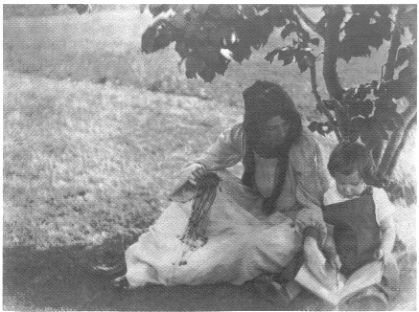
"Wherefore we are not only to govern their appetites in the delights of eating and drinking, but also (and much more) to inure them to a like temperance in reading and hearing, that, while they make use of pleasure as a sauce, they may pursue that which is wholesome and profitable in those things which they read. For neither can a city be secure if but one gate be left open to receive the enemy, though all the rest be shut; nor a young man safe, though he be sufficiently fortified against the assaults of all other pleasures, whilst he is without any guard against those of the ear. Yea, the nearer the commerce is betwixt the delights of that sense and those of the mind and reason, by so much the more, when he lies open on that side, is he apt to be debauched and corrupted thereby. Seeing therefore we cannot (and perhaps would not if we could) debar young men of the size of my Soclarus and thy Cleander altogether from the reading of poets, yet let us keep the stricter guard upon them, as those who need a guide to direct them in their reading more than in their walks."
Saturday, October 22, 2011
base men...

" It should be the general rule to keep the young away from any association with base men; for they carry away something of their badness. This duty Pythagoras29 also has enjoined in the form of allegories which I shall now quote and explain. For they contribute no small influence towards the acquisition of virtue. For example:
E"Do not taste of black-tails;"30 that, "Do not spend your time with men of black character, because of their malevolence."
"Do not step over the beam of a balance"; that is, one should give greatest heed to justice and not transgress it.
"Do not sit on a peck measure"; as much as to say that we should avoid idleness and have forethought for providing our daily bread.
"Do not give your hand to everybody"; instead of, "Do not make friends too readily."
"Do not wear a tight ring"; means that one should live his life unhampered, and not subject it to any bond.
"Do not poke a fire with steel";31 instead of, p61"Do not provoke an angry man." Indeed, it is wrong to do so, and we should yield to men who are in a temper.
"Do not eat your heart"; as much as to say, "Do not injure your soul by wasting it with worries."
F"Abstain from beans"; means that a man should keep out of politics, for beans were used in earlier times for voting upon the removal of magistrates from office.32
"Do not put food into a slop-pail"; signifies that it is not fitting to put clever speech into a base mind. For speech is the food of thought, and baseness in men makes it unclean.
"Do not turn back on reaching the boundaries"; that is, when people are about to die and see the boundary of their life close at hand, they should bear all this with serenity and not be faint-hearted.
I return to the subject suggested at the beginning of the chapter. As I said there, the young should be kept away from every sort of base men, and most of all from flatterers. 13Let me repeat here what I say over and over again to many fathers: There is no class of persons more pernicious than flatterers, nor any that more surely and quickly gives youth a nasty tumble. They utterly ruin both fathers and sons, bringing to sorrow the old age of those and the youth of these, and dangling pleasure as an irresistible lure to get their advice taken. To sons who are to inherit wealth fathers commend sobriety, flatterers drinking to excess; fathers commend self-restraint, flatterers profligacy; fathers p63frugality, flatterers extravagance; fathers industry, flatterers indolence, Bsaying, "A life is but a moment. We must live, not merely exist.33 Why should we give a thought to your father's threats? He's an old twaddler with one foot already in the grave, and before long we'll take his coffin on our shoulders and carry him out." Another of them posts a drab in the young man's path, or prostitutes a married woman for him, and spoils and wastes the father's provision for old age. Detestable is their whole tribe, pretenders of friendship, without a vestige of honest speech, flatterers of the rich but despisers of the poor, addressing themselves with instinctive art to the young, grinning broadly when their patrons laugh, spurious claimants to any spirit, and bastard members of human life, subsisting at the beck and nod of the wealthy; Cfree-born by freak of fortune, but slaves by choice. Whenever they are not treated with insult, they feel themselves insulted because then they do not fulfil the purpose for which they are kept. So if any father is concerned for the good upbringing of his children, he must drive away these detestable creatures, and quite as much must he drive away schoolmates who show depravity, for these also are capable of corrupting the most likely natures."
a word is deeds shadow...

"Moreover, one's sons are to be kept from foul language; for, according to Democritus,21 "A word is a deed's shadow." 10Then, too, proper measures must be taken to ensure that they shall be tactful and courteous in their address; for nothing is so deservedly disliked as tactless characters. Besides, children may avoid getting themselves disliked by their associates if they do not prove totally unyielding in discussions. For it is a fine thing to understand, not only how to gain the victory, but also how to submit to defeat, in cases where victory is injurious; for there is really such a thing as a "Cadmean victory."22 As a witness of this I may quote Euripides the wise, who says:
BWhen of two speakers one is growing wroth,
Wise is he that yields in argument.
We must now lay down some rules of conduct which the young should follow no less but even more than those previously given. These are: To practise the simple life, to hold the tongue in check, to conquer anger, to control the hands. We must consider the importance of each of these; and they will be more intelligible if based on examples.
So, to begin with the last, some men by putting their hands to wrongful gains have upset the good repute of their earlier lives. CWitness the case of Gylippus,24 the Spartan, who was forced into exile because he had secretly unsewed the bags of money.
p49 Again, an unruffled temper is certainly the mark of a wise man. Thus Socrates once, when a bold and impudent youth had kicked him, observed that the bystanders were so indignant and so violently moved as to wish to foul up the offender; but he only said: "If an ass had kicked me, should you have thought it proper to kick him in return?" That youth, however, did not by any means get off scot-free, but as everybody jeered at him, and nicknamed him "Kicker," he ended by hanging himself.
And when Aristophanes brought out the Clouds, and heaped all manner of abuse upon Socrates in every possible way, one of those who had been present said to Socrates, "Are you not indignant, Socrates, that he used you as he did in the play?" D"No indeed," he replied; "when they break a jest upon me in the theatre I feel as if I were at a big party of good friends." What Archytas of Tarentum and Plato did will be seen to be closely akin to this. For Archytas, on his return from the war (where he had been general) found his land gone to waste. He summoned his overseer and said, "You should be sorry for this, if I were not in too great a temper." And Plato, provoked at a gluttonous and impudent slave, called his sister's son, Speusippus, and said as he withdrew, "Beat this fellow, for I am too much provoked." But it may be urged that such actions are difficult and hard to imitate. I know that myself. EBut the effort must be made, by employing the actions of such men as standards as far as possible, to abate a great part of our unbridled and furious temper; for in other respects also we are not comparable with them either in p51experience or magnanimous. Yet we, no less than they, feeling ourselves to be the high priests of God's mysteries and torch-bearers of wisdom, do attempt, so far as lies in our power, to imitate and to get a little taste of such conduct for ourselves.
The control of the tongue, then, still remains to be discussed of the topics I suggested. If anybody has the notion that this is a slight and insignificant matter, he is very far from the truth. For timely silence is a wise thing, and better than any speech. FAnd this is the reason, as it appears to me, why the men of olden time established the rites of initiation into the mysteries, that we, by becoming accustomed to keep silence there, may transfer that fear which we learned from the divine secrets to the safe keeping of the secrets of men. For, again, nobody was ever sorry because he kept silent, but hundreds because they talked. Again, the word unspoken cannot possibly be recalled. I have heard of countless men who have fallen into the greatest misfortunes through intemperate speech. 11Of these I shall mention one or two as typical and omit the rest. When Ptolemy Philadelphus married his sister Arsinoë, Sotades25 said,
'Tis wrong for you to try to spur that mare,
and thereafter he rotted in prison for many years; and so suffered condign punishment for his untimely talking, and to make other men laugh he sorrowed a long time himself. A story to match and couple with this, and much more dreadful, is what the sophist Theocritus said and suffered. Alexander p53had bidden the Greeks to make ready crimson robes Bso thatº on his return he might offer a sacrifice of thanksgiving for his victory in the war against the barbarians, and all the states had to pay a poll-tax in money, when Theocritus remarked, "Before this I used to be in doubt, but now I know for a certainty that this is Homer's 'Crimson Death.' "26 And thereby he made an enemy of Alexander. And Antigonus, king of the Macedonians, who was blind of one eye, he drove to immoderate anger by reproaching him with his disfigurement. For Antigonus sent his chief cook, Eutropion, who had been an officer in his army, to Theocritus, and insisted that Theocritus should come to him and engage in discussion. When Eutropion delivered his message to Theocritus, coming several times for the purpose, the latter said, "I know very well that you want to serve me up raw to your Cyclops," twitting the one for being disfigured and the other for being now a cook. "Then you shall not keep your head on," said Eutropion, "but you shall pay the penalty for this reckless talk and madness of yours." He thereupon reported the remark to the king, who sent and had Theocritus put to death.
But besides all this, we should, as a most sacred duty, accustom children to speak the truth. For lying is fit for slaves only, and deserves to be hated of all men, and even in decent slaves it is not to be condoned.
a storehouse of learning...

"Above all, the memory of children should be trained and exercised; for this is, as it were, a storehouse of learning; and it is for this reason that the mythologists have made Memory the mother of the Muses, thereby intimating by an allegory that there is nothing in the world like memory for creating and fostering. This, then, is to be trained in either case, whether one's children be naturally gifted with a good memory, or, on the contrary, forgetful. For we shall thus strengthen nature's generous endowment, and thus fill out her deficiency; and while the first class of children will excel others, the second class will excel their former selves. The saying of Hesiod20 is admirably put:
If even small upon the small you place
FAnd do this oft, the whole will soon be great.
Nor should parents forget that those branches of instruction which involve memory make no small contribution, not merely to education, but also to the practical activities of life; for the memory of past activities serves as a pattern of good counsel for the future."
rebukes and praises...

"This also I assert, that children ought to be led to honourable practices by means of encouragement and reasoning, and most certainly not by blows or ill-treatment, for it surely is agreed that these are fitting rather for slaves than for the free-born; for so they grow numb and shudder at their tasks, partly from the pain of the blows, partly from the degradation. Praise and reproof are more helpful for the free-born than any sort of ill-usage, 9since the praise incites them toward what is honourable, and reproof keeps them from what is disgraceful.
But rebukes and praises should be used alternately and in a variety of ways; it is well to choose some time when the children are full of confidence to put them to shame by rebuke, and then in turn to cheer them up by praises, and to imitate the nurses, who, when they have made their babies cry, in turn offer them the breast for comfort. Moreover in praising them it is essential not to excite and puff them up, for they are made conceited and spoiled by excess of praise."
Return
Subscribe to:
Posts (Atom)