Wednesday, July 27, 2011

dreaming of Octavian...

from the Life of Cicero-the rise of Octavian...

"After this, Philip, who had married the mother, and Marcellus, who had married the sister of the young Caesar, came with the young man to Cicero and made a compact that Cicero should give Caesar the influence derived from his eloquence and political position, both in the senate and before the people, and that Caesar should give Cicero the security to be derived from his wealth and his armed forces. For already the young man had about him many of the soldiers who had served under the elder Caesar. It was thought, too, that there was a stronger reason why Cicero so readily accepted the young man's friendship. For it would appear that while Pompey and Caesar were still living Cicero dreamed that someone invited the sons of the senators to the capitol, on the ground that Jupiter was going to appoint one of their number ruler of Rome; and that the citizens eagerly ran and stationed themselves about the temple, while the youths, in their purple-bordered togas, seated themselves there in silence. Suddenly the door of the temple opened, and one by one the youths rose and walked round past the god, who reviewed them all and sent them away sorrowing. But when this young Caesar advanced into his presence the god stretched out his hand and said: "O Romans, ye shall have an end of civil wars when this youth has become your ruler." By such a dream as this, they say, Cicero had impressed upon him the appearance of the youth, and retained it distinctly, but did not know him.96 The next day, however, as he was going down to the Campus Martius, the youths, who had just finished exercising there, were coming away, and the youth of his dream was seen by Cicero for the first time, and Cicero, amazed, inquired who his parents were. Now, his father was Octavius, a man of no great prominence, but his mother was Attia, a daughter of Caesar's sister. For this reason Caesar, who had no children of his own, willed his property and his family name to him. After this, it is said, Cicero took pains to converse with the youth when they met, and the youth welcomed his kind attentions; and indeed it happened that he was born during Cicero's consulship."

philosophy...

from the Life of Cicero...

"After this, when the government had been changed to a monarchy, Cicero abstained from public affairs and devoted his time to those of the young men who wished to study philosophy, and mainly from his intimacy with these, since they were of the highest birth and standing, he was once more very influential in the state. He made it his business also to compose and translate philosophical dialogues, and to render into Latin the several terms of dialectics and natural philosophy; for he it was, as they say, who first, or principally, provided Latin names for "phantasia," "synkatathesis," "epokhe," and "katalepsis," as well as for "atomon," "ameres," "kenon," and many others like these, contriving partly by metaphors and partly by new and fitting terms to make them intelligible and familiar. His facility in verse-making, too, he employed to divert himself. It is said, indeed, that when he applied himself to such work, he would make five hundred verses in a night.

During this time, then, he lived for the most part at his country-seat in Tusculum, and he used to write to his friends that he was living the life of Laertes, either jesting, as was his wont, or because his ambition filled him with a desire for public activity and made him dissatisfied with the turn things had taken."

more humbled...

from the Life of Cicero on his banishment...

"But as soon as it was known that he had fled, Clodius caused a vote of banishment to be passed upon him, and issued an edict that all men should refuse him fire and water and that no man should give him shelter within five hundred miles of Italy. Now, most men paid not the slightest heed to this edict out of respect for Cicero, and escorted him on his way with every mark of kindness; but at Hipponium, a city of Lucania, which is now called Vibo, Vibius, a Sicilian, who had profited much from Cicero's friendship and pity by being made prefect of engineers during p165his consulship, would not receive him in his house, but sent him word that he would assign him his country-place for residence; and Caius Vergilius, the praetor of Sicily, who had been on most intimate terms with Cicero, wrote him to keep away from Sicily. Disheartened at this treatment, he set out for Brundisium, and from there tried to cross to Dyrrhachium with a fair breeze, but since he met a counter-wind at sea he came back the next day, and then set sail again. It is said, too, that after he had put in at Dyrrhachium and was about to land, there was an earthquake accompanied by a violent convulsion of the sea. Wherefore the soothsayers conjectured that his exile would not be lasting, since these were signs of change. But although many people visited him out of goodwill, and the Greek cities vied with one another in sending him deputations, still, he passed his time for the most part in dejection and great grief,looking off towards Italy like a disconsolate lover, while in his spirit he became very petty and mean by reason of his misfortune, and was more humbled than one would have expected in a man who had enjoyed so lofty a discipline as his. And yet he often asked his friends not to call him an orator, but a philosopher, because he had chosen philosophy as an occupation, but used oratory merely as an instrument for attaining the needful ends of a political career. But public opinion has great power to wash away reason, like a dye, from the soul of man, and by force of familiar association to impress the feelings of the vulgar on those who engage in political life, unless one is right well on his guard when he engages himself in things external, and is resolved to participate only in the things themselves, and not in the feelings attendant upon them."

excessive delight in the praise of others...

from the life of Cicero...

"He was appointed quaestor at a time when grain was scarce, and had the province of Sicily allotted to him, where he annoyed people at first by compelling them to send grain to Rome. But afterwards they found him careful, just, and mild, and honoured him beyond any governor they had ever had. Moreover, when large numbers of young men from Rome, of illustrious and noble families, were accused of lack of discipline and courage in the war and sent up for trial to the praetor of Sicily, Cicero pleaded their cause brilliantly and won the day. While he was journeying to Rome, then, highly elated over these successes, he had a laughable experience, as he tells us. In Campania, namely, he fell in with an eminent man whom he deemed his friend, and asked him what the Romans were saying and thinking about his achievements, supposing that he had filled the whole city with the name and fame of them; but his friend said: "Where, pray, have you been, Cicero, all this while?" At that time, then, as he tells us, he was altogether disheartened, seeing that the story of his doings had sunk into the city as into a bottomless sea, without any visible effect upon his reputation; but afterwards he reasoned with himself and abated much of his ambition, convinced that the fame towards which he was emulously struggling was a thing that knew no bounds and had no tangible limit. However, his excessive delight in the praise of others and his too passionate desire for glory remained with him until the very end, and very often confounded his saner reasonings."

later in his career...

" So at this time Cicero had the greatest power in the state, but he made himself generally odious, not by any base action, but by continually praising and magnifying himself, which made him hateful to many. For there could be no session either of senate or assembly or court of justice in which one was not obliged to hear Catiline and Lentulus endlessly talked about. Nay, he even went so far as to fill his books and writings with these praises of himself; and he made his oratory, which was naturally very pleasant and had the greatest charm, irksome and tedious to his hearers, since this unpleasant practice clung to him like a fatality. But nevertheless, although he cherished so strong an ambition, he was free from envying others, since he was most ungrudging in his encomiums upon his predecessors and contemporaries, as may be gathered from his writings."

malicious...

from the Life of Cicero...

 "But it is said that he too, no less than Demosthenes, was weak in his delivery, and therefore sought with care to imitate now Roscius the comedian, and now Aesop the tragedian. This Aesop, they tell us, was once acting in a theatre the part of Atreus planning to take vengeance on Thyestes, when one of the assistants suddenly ran across the scene, and the actor, losing control of himself in the intensity of his passion, smote him with his sceptre and laid him dead. Now, Cicero's delivery contributed not a little to his persuasive power. Moreover, of those orators who were given to loud shouting he used to say jestingly that they were led by their weakness to resort to clamour as cripples were to mount upon a horse. And his readiness to indulge in such jests and pleasantry was thought indeed to be a pleasant characteristic of a pleader; but he carried it to excess and so annoyed many and got the reputation of being malicious."

Tuesday, July 26, 2011

the man who holds the cup...

from the life of Demothenes...a hard worker but not immune to bribery...

" Not long afterwards Harpalus came out of Asia to Athens. He had run away from Alexander, because he was conscious that his prodigality had led him into criminal practices, and because he was afraid of his master, who was now become harsh to his friends. But after he had taken refuge with the Athenian people and put himself in their hands with his ships and his treasures, the other orators at once fixed their longing eyes upon his wealth, came to his aid, and tried to persuade the Athenians to receive and save the suppliant. But Demosthenes, in the beginning, counselled them to drive Harpalus away, and to beware lest they plunge the city into war upon an unnecessary and unjust ground; a few days afterwards, however, while they were making an inventory of the treasure, Harpalus saw that Demosthenes was eyeing with pleasure a cup of barbarian make, with a keen appreciation of its fashion and of the ornamental work upon it. He therefore bade him poise it in his hand and see how heavy the gold was. And when Demosthenes was amazed at its weight and asked how much it would amount to, Harpalus smiled and said, "For you it will amount to twenty talents;" and as soon as night was come he sent him the cup with the twenty talents. Now, Harpalus was skilful in detecting the character of a man who had a passion for gold, by means of the look that spread over his face and the glances of his eyes. For Demosthenes could not resist, but was overcome by the p63bribe, and now that he had, as it were, admitted a garrison into his house, promptly went over to the side of Harpalus. Next day, after swathing his neck carefully in woollen bandages, he went forth into the assembly; and when he was urged to rise and speak, he made signs that his voice was ruined. The wits, however, by way of raillery, declared that the orator had been seized overnight, not with an ordinary quinsy, but with a silver quinsy. And afterwards, when the whole people learned that he had been bribed, and would not permit him, when he wished it, to have a hearing and make his defence, but were angry and raised a tumult against him, someone rose and said jokingly: "Men of Athens, will you not listen to the man who holds the cup?"

the product of toil...

From the Life of Demosthenes...Beginning with a suit to recover his inheritance, T. trains himself as an orator...

They devised many evasions and new trials, but Demosthenes, after practising himself in these exercises, as Thucydides says, not without toil and danger, won his cause, although he was able to recover not even a small fraction of his patrimony. However, he acquired sufficient practice and confidence in speaking, and got a taste of the distinction and power that go with forensic contests, and therefore essayed to come forward and engage in public matters. 2 And just as Laomedon the Orchomenian — so we are told — practised long-distance running by the advice of his physicians, to ward off some disease of the spleen, and then, after restoring his health in this way, entered the great games and became one of the best runners of the long course, so Demosthenes, after applying himself to oratory in the first place for the sake of recovering his private property, by this means acquired ability and power in speaking, and at last in public business, as it were in the great games, won the first place among the citizens who strove with one another on the bema.

And yet when he first addressed the people he was interrupted by their clamours and laughed at for his inexperience, since his discourse seemed to them confused by long periods and too harshly and immoderately tortured by formal arguments. He had also, as it would appear, a certain weakness of voice and indistinctness of speech and shortness of breath which disturbed the sense of what he said by disjoining his sentences. And finally, when he had forsaken the assembly and was wandering about dejectedly in the Piraeus, Eunomus the Thriasian, who was already a very old man, caught sight of him and upbraided him because, although he had a style of speaking which was most like that of Pericles, he was throwing himself away out of weakness and lack of courage, neither facing the multitude with boldness, nor preparing his body for these forensic contests, but suffering it to wither away in slothful neglect.

At another time, too, they say, when he had been rebuffed by the people and was going off homewards disconcerted and in great distress, Satyrus the actor, who was a familiar acquaintance of his, followed after and went indoors with him. Demosthenes lamented to him that although he was the most laborious of all the orators and had almost used up the vigour of his body in this calling, he had no favour with the people, but debauchees, sailors, and illiterate fellows were listened to and held the bema, while he himself was ignored.  "You are right, Demosthenes, " said Satyrus, "but I will quickly remedy the cause of all this, if you will consent to recite off-hand for me some narrative speech from Euripides or Sophocles." Demosthenes did so, whereupon Satyrus, taking up the same speech after him, gave it such a form and recited it with such appropriate sentiment and disposition that the appeared to Demosthenes to be quite another. Persuaded, now, how much of ornament and grace action lends to oratory, he considered it of little or no use for a man to practise declaiming if he neglected the delivery and disposition of his words. After this, at all, he built a subterranean study, which, in fact, was preserved in our time, and into this he would descend every day without exception in order to form his action and cultivate his voice, and he would often remain there even for two or three months together, shaving one side of his head in order that shame might keep him from going abroad even though he greatly wished to do so.

Nor was this all, but he would make his interviews, conversations, and business with those outside, the foundation and starting point for eager toil. For as soon as he parted from his associates, he would go down into his study, and there would go over his transactions with them in due order, and the arguments used in defence of each course.  And still further, whatever speeches he chanced to hear delivered he would take up by himself and reduce to propositions and periods, and he would introduce all sorts of corrections and changes of expression into the speeches made by others against himself, or, contrariwise, by himself against others. Consequently it was thought that he was not a man of good natural parts, but that his ability and power were the product of toil. And there would seem to be strong proof of this in the fact that Demosthenes was rarely heard to speak on the spur of the moment, but though the people often called upon him by name as he sat in the assembly, he would not come forward unless he had given thought to the question and was prepared to speak upon it.  For this, many of the popular leaders used to rail at him, and Pytheas, in particular, once told him scoffingly that his arguments smelt of lamp-wicks. To him, then, Demosthenes made a sharp answer. "Indeed," said he, "thy lamp and mine, O Pytheas, are not privy to the same pursuits." To the rest, however, he made no denial at all, but confessed that his speeches were neither altogether unwritten, nor yet fully written out.  Moreover, he used to declare that he who rehearsed his speeches was a true man of the people: for such preparation was a mark of deference to the people, whereas heedlessness of what the multitude will think of his speech marks a man of oligarchical spirit, and one who relies on force rather than on persuasion. Another circumstance, too, is made a proof of his lack of courage for an emergency, namely, that when he was interrupted by the clamours of the people, Demades often rose and spoke off-hand in his support, but he never rendered such a service to ..

For his bodily deficiencies he adopted the exercises which I shall describe, as Demetrius the Phalerian tells us, who says he heard about them from Demosthenes himself, now grown old. The indistinctness and lisping20 in his speech he used to correct and drive away by taking pebbles in his mouth and then reciting speeches. His voice he used to exercise by discoursing while running or going up steep places, and by reciting speeches or verses at a single breath. Moreover, he had in his house a large looking-glass, and in front of this he used to stand and go through his exercises in declamation."

my hometown...

from the "Life of Demosthenes" on hometowns...

"The author of the encomium upon Alcibiades for his victory in the chariot-race at Olympia, whether he was Euripides, as the prevailing report has it, or some other, says, Sosius, that the first requisite to man's happiness is birth in "a famous city"; but in my opinion, for a man who would enjoy true happiness, which depends for the most part on character and disposition, it is no disadvantage to belong to an obscure and mean city, any more than it is to be born of a mother who is of little stature and without beauty. For it were laughable to suppose that Iulis, which is a little part of the small island of Ceos, and Aegina, which a certain Athenian was urgent to have removed as an eye-sore of the Piraeus, should breed good actors and poets, but should never be able to produce a man who is just, independent, wise, and magnanimous. The arts, indeed, since their object is to bring business or fame, naturally pine away in obscure and mean cities; but virtue, like a strong and hardy plant, takes root in any place, if she finds there a generous nature and a spirit that shuns no labour. Wherefore we also, if we fail to live and think as we ought, will justly attribute this, not to the smallness of our native city, but to ourselves.

However, when one has undertaken to compose a history based upon readings which are not readily accessible or even found at home, but in foreign countries, for the most part, and scattered about among different owners, for him it is really necessary, first and above all things, that he should live in a city which is famous, friendly to the liberal arts, and populous, in order that he may have all sorts of books in plenty, and may by hearsay and enquiry come into possession of all those details which elude writers and are preserved with more conspicuous fidelity in the memories of men. He will thus be prevented from publishing a work which is deficient in many, and even in essential things. But as for me, I live in a small city, and I prefer to dwell there that it may not become smaller still; and during the time when I was in Rome and various parts of Italy I had no leisure to practise myself in the Roman language, owing to my public duties and the number of my pupils in philosophy. It was therefore late and when I was well on in years that I began to study Roman literature. And here my experience was an astonishing thing, but true. For it was not so much that by means of words I came to a complete understanding of things, as that from things I somehow had an experience which enabled me to follow the meaning of words. But to appreciate the beauty and quickness of the Roman style, the figures of speech, the rhythm, and the other embellishments of the language, while I think it a graceful accomplishment and one not without its pleasures, still, the careful practice necessary for attaining this is not easy for one like me, but appropriate for those who have more leisure and whose remaining years still suffice for such pursuits."
from the "Comparison of Timoleon and Aemilius...

"It is, however, worthy of admiration in Aemilius that, although he had subdued so great a kingdom, he did not add one drachma to his substance, nor would he touch or even look upon the conquered treasure; and yet he made many liberal gifts to others."

taught by these wounds...

from the Life of Aemilius on his triumph...

"As soon as it was day the voting began, and the first tribe was voting against the triumph, when knowledge of the matter was brought down to the rest of the people and the senate. The multitude, deeply grieved at the indignity offered to Aemilius, could only cry out against it in vain; but the most prominent senators, with shouts against the ignominy of the thing, exhorted one another to attack the bold license of the soldiers, which would proceed to any and every deed of lawlessness and violence if nothing were done to prevent their depriving Aemilius Paulus of the honours of his victory. Then pushing their way through the throng and going up to the Capitol in a body, they told the tribunes to put a stop to the voting until they could finish what they wished to say to the people. All voting stopped, silence was made, and one who had slain twenty-three foes in single combat, Marcus Servilius, a man of consular dignity, came forward and said that he knew now better than ever before how great a commander Aemilius Paulus was, when he saw how full of baseness and disobedience the army was which he had used in the successful accomplishment of such great and fair exploits; and he was amazed that the people, while exulting in triumphs over Illyrians and Ligurians, begrudged itself the sight of the king of Macedonia taken alive and the glory of Alexander and Philip made spoil by Roman arms. "For is it not a strange thing," said he, "that when an unsubstantial rumour of victory came suddenly and prematurely to the city, you sacrificed to the gods and prayed that this report might speedily be verified before your eyes; but now that your general is come with his real victory, you rob the gods of their honour, and yourself of your joy in it, as though afraid to behold the magnitude of his successes, or seeking to spare the feelings of your enemy? And yet it were better that out of pity towards him, and not out of envy towards your general, the triumph should be done away with. But," said he, "to such great power is malice brought by you that a man without a wound to show, and whose person is sleek from delicate and cowardly effeminacy, dares to talk about the conduct of a general and his triumph to us who have been taught by all these wounds to judge the valour and the cowardice of generals." And with the words he parted his garment and displayed upon his breast an incredible number of wounds. Then wheeling about, he uncovered some parts of his person which it is thought unbecoming to have naked in a crowd, and turning to Galba, said: "Thou laughest at these scars, but I glory in them before my fellow-citizens, in whose defence I got them, riding night and day without ceasing.  But come, take these people off to their voting; and I will come down and follow along with them all, and will learn who are base and thankless and prefer to be wheedled and flattered in war rather than commanded."

This speech, they tell us, so rebuffed the soldiery and changed their minds that the triumph was voted to Aemilius by all the tribes."

what goes up...

from the "Life of Aemilius"...

" Accordingly, having most confidence in Nasica, he called for him; but since Nasica was not there, after bewailing his misfortune and carefully weighing the necessity under which he lay, he gave himself into the power of Gnaeus, thus making it most abundantly clear that his avarice was a less ignoble evil than the love of life that was in him, and that led him to deprive himself of the only thing which Fortune cannot take away from the fallen, namely, pity. For when at his request he was brought to Aemilius, Aemilius saw in him a great man whose fall was due to the resentment of the gods and his own evil fortune, and rose up and came to meet him, accompanied by his friends, and with tears in his eyes; but Perseus, a most shameful sight, after throwing himself prone before him and then clasping his knees, broke out into ignoble cries and supplications. These Aemilius could not abide and would not hear; but looking upon him with a distressed and sorrowful countenance, said: "Why, wretched man, dost thou free Fortune from thy strongest indictment against her, by conduct which will make men think that thy misfortunes are not undeserved, and that thy former prosperity, rather than thy present lot, was beyond thy deserts? And why dost thou depreciate my victory, and make my success a meagre one, by showing thyself no noble or even fitting antagonist for Romans? Valour in the unfortunate obtains great reverence even among their enemies, but cowardice, in Roman eyes, even though it meet with success, is in every way a most dishonourable thing."

Notwithstanding his displeasure, he raised Perseus up, gave him his hand, and put him in charge of Tubero, while he himself drew his sons, his sons-in‑law, and of the other officers especially the younger men, into his tent, where for a long time he sat in silent communion with himself, so that all wondered. Then he began to discourse of Fortune and of human affairs, saying: "Is it, then, fitting that one who is mortal should be emboldened when success comes to him, and have high thoughts because he has subdued a nation, or a city, or a kingdom? or should his thoughts dwell rather on this reversal of fortune, which sets before the warrior an illustration of the weakness that is common to all men, and teaches him to regard nothing as stable or safe? For what occasion have men to be confident, when their conquest of others gives them most cogent reason to be in fear of Fortune, and when one who exults in success is thrown, as I am, into great dejection by reflecting upon the allotments of Fate, which take a circling course, and fall now upon some and now upon others? Or, when the succession of Alexander, who attained the highest pinnacle of power and won the greatest merit, has fallen in the space of a single hour and has been put beneath your feet, or when you see kings who but just now were surrounded by so many myriads of infantry and thousands of cavalry, receiving from their enemy's hands the food and drink requisite for the day, can you suppose that we ourselves have any guarantee from Fortune that will avail against the attacks of time? Abandon, then, young men, this empty insolence and pride of victory, and take a humble posture as you confront the future, always expectant of the time when the Deity shall at last launch against each one of you his jealous displeasure at your present prosperity." Many such words were uttered by Aemilius, we are told, and he sent the young men away with their vainglorious insolence and pride well curbed by his trenchant speech, as by a bridle."

lacerated by his misfortunes...

from the Life of Aemilius...

" But Perseus was away in flight from Pydna to Pella, since practically all his horsemen came safely off from the battle. But when his footmen overtook his horsemen, and, abusing them as cowards and traitors, tried to push them from their horses and fell to beating them, the king, afraid of the tumult, turned his horse out of the road, drew his purple robe round and held it in front of him, that he might not be conspicuous, and carried his diadem in his hands. And in order that he might also converse with his companions as he walked, he dismounted from his horse and led him along. But of these companions, one pretended that he must fasten a shoe that had become loose, another that he must water his horse, another that he himself wanted water to drink, and so they gradually lagged behind and ran away, because they had more fear of his cruelty than of the enemy. For he was lacerated by his misfortunes, and sought to turn the responsibility for his defeat away from himself and upon everybody else."

cowardly sacrifices from cowards...

from the "Life of Aemilius" the war with the Macedonians...

"As the attack began, Aemilius came up and found that the Macedonian battalions had already planted the tips of their long spears in the shields of the Romans, who were thus prevented from reaching them with their swords.  And when he saw that the rest of the Macedonian troops also were drawing their targets from their shoulders round in front of them, and with long spears set at one level were withstanding his shield-bearing troops, and saw too the strength of their interlocked shields and the fierceness of their onset, amazement and fear took possession of him, and he felt that he had never seen a sight more fearful; often in after times he used to speak of his emotions at that time and of what he saw.  But then, showing to his soldiers a glad and cheerful countenance, he rode past them without helmet or breastplate. The king of the Macedonians, on the other hand, according to Polybius, as soon as the battle began, played the coward and rode back to the city, under pretence of sacrificing to Heracles, a god who does not accept cowardly sacrifices from cowards, nor accomplish their unnatural prayers. For it is not in the nature of things that he who makes no shot should hit the mark exactly, or that he who does not hold his ground should win the day, or, in a word, that he who does nothing should be successful in what he does, or that a wicked man should be prosperous. But the god listened to the prayers of Aemilius, who kept wielding his spear as he prayed for might and victory,f and fought as he invited the god to fight with him."

faithful in small things...

from the "Life of Aemilius"...

"For he did not practise pleading private cases in the courts, and refrained altogether from the salutations and greetings and friendly attentions to which most men cunningly resorted when they tried to win the favour of the people by becoming their zealous servants; not that he was naturally incapable of either, but he sought to acquire for himself what was better than both, namely, a reputation arising from valour, justice, and trustworthiness. In these virtues he at once surpassed his contemporaries.

At all events, when he sued for the first of the high offices in the state, the aedileship, he was elected over twelve competitors, all of whom, we are told, afterwards became consuls. Moreover, when he was made one of the priests called Augurs, whom the Romans appoint as guardians and overseers of the art of divination from the flight of birds and from omens in the sky, he so carefully studied the ancestral customs of the city, and so thoroughly understood the religious ceremonial of the ancient Romans, that his priestly function, which men had thought to be a kind of honour, sought merely on account of the reputation which it gave, was made to appear one of the higher arts, and testified in favour of those philosophers who define religion as the science of the worship of the gods. For all the duties of this office were performed by him with skill and care, and he laid aside all other concerns when he was engaged in these, omitting nothing and adding nothing new, but ever contending even with his colleagues about the small details of ceremony, and explaining to them that, although the Deity was held to be good-natured and slow to censure acts of negligence, still, for the city at least it was a grievous thing to overlook and condone them; for no man begins at once with a great deed of lawlessness to disturb the civil polity, but those who remit their strictness in small matters break down also the guard that has been set over greater matters."

reason and philosophy...

From the "Life of Timoleon" on the killing of his brother the tyrant...

"The deed having been noised abroad, the most influential Corinthians applauded Timoleon for his hatred of baseness and greatness of soul, in that, although a kindly man and fond of his family, he had nevertheless set his country before his family, and honour and justice before expediency; for when his brother was fighting valiantly for his country, Timoleon had saved his life, but after he had plotted against her and enslaved her, Timoleon had slain him. However, those who were unable to live in a democracy and were accustomed to pay court to men in power, while they pretended to rejoice at the death of the tyrant, still, by their abuse of Timoleon as the perpetrator of an impious and abominable deed, drove him into despondency. And now he learned that his mother was angry with him and uttered dreadful reproaches and fearful imprecations against him, and went to plead his cause with her; but she could not endure to see his face, and closed her house against him. Then indeed he became altogether a prey to grief and disordered in mind, and determined to starve himself to death;  but his friends would not suffer this, and brought all manner of entreaty and constraint to bear upon him, so that he made up his mind to live by himself, apart from the world. So he gave up all public life, and for a long while did not even return to the city, but spent his time wandering in great distress of mind among the most desolate parts of the country.

So true is it that the purposes of men, unless they acquire firmness and strength from reason and philosophy for the activities of life, are unsettled and easily carried away by casual praise and blame, being forced out of their native reckonings. For it would seem that not only our action must be noble and just, but the conviction also from which our action springs must be abiding and unchangeable, in order that we may be satisfied with what we are about to do, and that mere weakness may not make us dejected over actions which have once been accomplished, when the fair vision of the Good fades away; just as gluttons who devour cloying viands with the keenest appetite are very soon sated and then disgusted with them. For repentance makes even the noble action base; whereas the choice which springs from a wise and understanding calculation does not change, even though its results are unsuccessful."

history as a mirror...

From the Life of Timoleon, this on why Plutarch writes the "Lives"...

"I began the writing of my "Lives" for the sake of others, but I find that I am continuing the work and delighting in it now for my own sake also, using history as a mirror and endeavouring in a manner to fashion and adorn my life in conformity with the virtues therein depicted. For the result is like nothing else than daily living and associating together, when I receive and welcome each subject of my history in turn as my guest, so to speak, and observe carefully "how large he was and of what mien," and select from his career what is most important and most beautiful to know.

"And oh! what greater joy than this canst thou obtain,"

and more efficacious for moral improvement? Democritus says we ought to pray that we may be visited by phantoms which are propitious, and that from out the circumambient air such only may encounter us as are agreeable to our natures and good, rather than those which are perverse and bad, thereby intruding into philosophy a doctrine which is not true, and which leads astray into boundless superstitions. But in my own case, the study of history and the familiarity with it which my writing produces, enables me, since I always cherish in my soul the records of the noblest and most estimable characters, to repel and put far from me whatever base, malicious, or ignoble suggestion my enforced associations may intrude upon me, calmly and dispassionately turning my thoughts away from them to the fairest of my examples. Among these were Timoleon the Corinthian and Aemilius Paulus, whose Lives I have now undertaken to lay before my readers; the men were alike not only in the good principles which they adopted, but also in the good fortune which they enjoyed in their conduct of affairs, and they will make it hard for my readers to decide whether the greatest of their successful achievements were due to their good fortune or their wisdom."

thy evil genius...

From the Life of Brutus...

" When they were about to cross over from Asia, Brutus is said to have had a great sign. He was naturally wakeful, and by practice and self-restraint had reduced his hours of sleep to few, never lying down by day, and by night only when he could transact no business nor converse with any one, since all had gone to rest. At this time, however, when the war was begun and he had in his hands the conduct of a life and death struggle, and was anxiously forecasting the future, he would first doze a little in the evening after eating, and then would spend the rest of the night on urgent business. But whenever he had fully met the demands of such p207business in shorter time, he would read a book until third watch, at which hour the centurions and tribunes usually came to him. Once, accordingly, when he was about to take his army across from Asia, it was very late at night, his tent was dimly lighted, and all the camp was wrapped in silence. Then, as he was meditating and reflecting, he thought he heard some one coming into the tent. He turned his eyes towards the entrance and beheld a strange and dreadful apparition, a monstrous and fearful shape standing silently by his side. Plucking up courage to question it, "Who art thou," said he, "of gods or men, and what is thine errand with me?" Then the phantom answered "I am thy evil genius, Brutus, and thou shalt see me at Philippi." And Brutus, undisturbed, said: "I shall see thee."

When the shape had disappeared, Brutus called his servants; but they declared that they had neither heard any words nor seen any apparition, and so he watched the night out. As soon as it was day, however, he sought out Cassius and told him of the apparition. Cassius, who belonged to the school of Epicurus, and was in the habit of taking issue on such topics with Brutus, said: "This is our doctrine, Brutus, that we do not really feel or see everything, but perception by the senses is a pliant and deceitful thing, and besides, the intelligence is very keen to change and transform the thing perceived into any and every shape from one which has no real existence. An impression on the senses is like wax, and the soul of man, in which the plastic material and the plastic power alike exist, can very easily shape p209and embellish it at pleasure. This is clear from the transformations which occur in dreams, where slight initial material is transformed by the imagination into all sorts of emotions and shapes. The imagination is by nature in perpetual motion, and this motion which it has is fancy, or thought. In thy case, too, the body is worn with hardships and this condition naturally excites and perverts the intelligence. As for genii, it is incredible either that they exist, or, if they do exist, that they have the appearance or the speech of men, or a power that extends to us. For my part, I could wish it were so, in order that not only our men-at‑arms, and horses, and ships, which are so numerous, but also the assistance of the gods might give us courage, conducting as we do the fairest and holiest enterprises." With such discourse did Cassius seek to calm Brutus."

a worthy husband...

from the Life of Brutus on the stress of having decided to kill Caesar...

"Now Brutus, since he had made the foremost men of Rome for dignity, family, and virtue, dependent on himself, and since he understood all the danger involved, in public tried to keep his thoughts to himself and under control; but at home, and at night, he was not the same man. Sometimes, in spite of himself, his anxious thoughts would rouse him out of sleep, and sometimes, when he was more than ever immersed in calculation and beset with perplexities, his wife, who slept by his side, perceived that he was full of unwonted trouble, and was revolving in his mind some difficult and complicated plan.

Porcia, as has been said, was a daughter of Cato, and when Brutus, who was her cousin, took her to wife, she was not a virgin; she was, however, still very young, and had by her deceased husband a little son whose name was Bibulus. A small book containing memoirs of Brutus was written by him, and is still extant. Porcia, being of an affectionate nature, fond of her husband, and full of sensible pride, did not try to question her husband about his secrets until she had put herself to the following test. She took a little knife, such as barbers use to cut the finger nails, and after banishing all her attendants from her chamber, made a deep gash in her thigh, so that there was a copious flow of blood, and after a little while violent pains and chills and fever followed from the wound. Seeing that Brutus was disturbed and greatly distressed, in the height of her anguish she spoke to him thus: "Brutus, I am Cato's daughter, and I was brought into thy house, not, like a mere concubine, to share thy bed and board merely, but to be a partner in thy joys, and a partner in thy troubles. Thou, indeed, art faultless as a husband; but how can I show thee any grateful service if I am to share neither thy secret suffering nor the anxiety which craves a loyal confidant? I know that woman's nature is thought too weak to endure a secret; but good rearing and excellent companionship go far towards strengthening the character, and it is my happy lot to be both the daughter of Cato and the wife of Brutus. Before this I put less confidence in these advantages, but now I know that I am superior even to pain." Thus having spoken, she showed him her wound and explained her test; whereupon Brutus, amazed, and lifting his hands to heaven, prayed that he might succeed in his undertaking and thus show himself a worthy husband of Porcia. Then he sought to restore his wife."

training and culture...

from the Life of Brutus...

"Marcus Brutus was a descendant of that Junius Brutus whose bronze statue, with a drawn sword in its hand, was erected by the ancient Romans on the Capitol among those of the kings, in token that he was most resolute in dethroning the Tarquins. But that Brutus, like the tempered steel of swords, had a disposition which was hard by nature and not softened by letters, so that his wrath against the tyrants drove him upon the dreadful act of slaying his sons; whereas this Brutus, of whom I now write, modified his disposition by means of the training and culture which philosophy gives, and stimulated a nature which was sedate and mild by active enterprises, and thus seems to have been most harmoniously attempered for the practice of virtue...

There was practically no Greek philosopher with whom Brutus was unacquainted or unfamiliar, but he devoted himself particularly to the disciples of Plato. 3 To the New and Middle Academy, as they are called, he was not very partial, but clung to the Old. He was therefore always an admirer of Antiochus of Ascalon, whose brother Aristus he had made his friend and housemate, a man who in learning was inferior to many philosophers, but who in good sense and gentleness vied with the foremost"

tyrants and masters...

From the Life of Dion...

"Now, there was a certain Sosis, a man whose baseness and impudence gave him renown in Syracuse, where it was thought that abundance of liberty could only be shown by such license of speech as his. This man, with hostile designs upon Dion, first rose in an assembly and roundly abused the Syracusans for not comprehending that they had merely exchanged a stupid and drunken tyrant for a watchful and sober master; and having thus declared himself an open enemy of Dion, he left the assembly. Next, on the following day he was see running p75through the city naked, his head and face covered with blood, as though he were trying to escape pursuit. In this condition he dashed into the assembly and told the people there that he had been set upon by Dion's mercenaries, and showed them his head and its wounds. He found many to share his resentment and take sides with him against Dion, who, they said, was committing dire acts of tyranny, if by murder and peril of life he sought to rob the citizens of their free speech. However, although the assembly had become confused and tumultuous, Dion came forward and showed in his own defence that Sosis was a brother of one of the body-guards of Dionysius, and had been induced by him to raise confusion and faction among the citizens, since there was no safety for Dionysus except in their mutual distrust and dissension. At the same time, too, the physicians examined the wound of Sosis and discovered that it had been made by razure rather than by a downright blow. For the blows of a sword, by reason of its weight, make wounds that are deepest in the middle, but that of Sosis was shallow all along, and intermittent, as would be natural if he stopped his work on account of pain, and then began it again. Besides, certain well known persons brought a razor to the assembly, and stated that as they were walking along the street, Sosis met them, all bloody, and declaring that he was running away from Dion's mercenaries, by whom he had just been wounded; at once, then, they ran after them, and found no one, but saw a razor lying under a hollow rock in the quarter from which Sosis had been seen to come."

the way of virtue...

from the Life of Dion...

" In addition to all his other favours, Dionysius ordered his treasurers to give Dion whatever he asked, although they were to tell Dionysius on the same day what they had given. But though Dion was even before of a lofty character, magnanimous, and manly, he advanced still more in these high qualities when, by some divine good fortune, Plato came to Sicily. This was not of man's devising, but some heavenly power, as it would seem, laying far in advance of the time a foundation for the liberty of Syracuse, and devising a subversion of tyranny, brought Plato from Italy to Syracuse and made Dion his disciple. Dion was then quite young, but of all the companions of Plato he was by far the quickest to learn and the readiest to answer the call of virtue, as Plato himself has written,6 and as events testify. For though he had been reared in habits of submission under a tyrant, and though he was fully accustomed to a life that was subservient and timorous, as well as to ostentatious service at court and vulgar luxury and a regimen that counts pleasures and excesses as the highest good, nevertheless, as soon as he got a taste of a rational philosophy which led the way to virtue, his soul was speedily on fire; from his own ready obedience to the call of higher things, that the same arguments would have a like persuasive force with Dionysius, he earnestly set to work and at last brought it to pass that the tyrant, in a leisure hours, should meet Plato and hear him discourse."

Monday, July 25, 2011

ill-boding specters..

from the "Life of Dion"...

"Moreover, the fortunes of the two men, which were the same in what befell them rather than in what they elected to do, make their lives alike. For both were cut off untimely, without being able to achieve the objects to which they had determined to devote the fruits of their many and great struggles. But the most wonderful thing of all was that Heaven gave to both an intimation of their approaching death, by the visible appearance to each alike of an ill-boding spectre. And yet there are those who deny such things and say that no man in his right mind was ever visited by a spectre or an apparition from Heaven, but that little children and foolish women and men deranged by sickness, in some aberration of spirit or distemper of body, have indulged in empty and strange imaginings, because they had the evil genius of superstition in themselves. But if Dion and Brutus, men of solid understanding and philosophic training and not easily cast down are overpowered by anything that happened to them, were so affected by a spectre that they actually told others about it, I do not know but we shall be compelled to accept that most extraordinary doctrine of the oldest times, that mean and malignant spirits, in envy of good men and opposition to their noble deeds, try to confound and terrify them, causing their virtue to rock and totter, in order that they may not continue erect and inviolate in the path of honour and so attain a better portion after death than the spirits themselves. But this subject must be reserved for discussion elsewhere..."

one training school...

from the "Life of Dion"

"If it be true, then, O Sossius Senecio,as Simonides says, that Ilium "is not wroth with the Corinthians" for coming up against her with the Achaeans, because the Trojans also had Glaucus, who sprang from Corinth, as a zealous ally, so it is likely that neither Romans nor Greeks will quarrel with the Academy, since they fare alike in this treatise containing the lives of Dion and Brutus, for Dion was an immediate disciple of Plato, while Brutus was nourished on the doctrines of Plato. Both therefore set out from one training-school, as it were, to engage in the greatest struggles. And we need not wonder that, in the performance of actions that were often kindred and alike, they bore witness to the doctrine of their teacher in virtue, that wisdom and justice must be united with power and good fortune if public careers are to take on beauty as well as grandeur. For as Hippomachus the trainer used to declare that he could recognize his pupils from afar even though they were but carrying meat from the market-place, so it is natural that the principles of those who have been trained alike should permeate their actions, inducing in these a similar rhythm and harmony along with their propriety."

sacrifice of all virtues...

This from the "Comparison of Pelopidas and Marcellus"

"I cannot, indeed, applaud the death of either of them, nay, I am distressed and indignant at their unreasonableness in the final disaster. And I admire Hannibal because, in battles so numerous that one would weary of counting them, he was not even wounded. I am delighted, too, with Chrysantes, in the "Cyropaedia,"who though his blade was lifted on high and he was about to smite an enemy, when the trumpet sounded a retreat, let his man go, and retired with all gentleness and decorum. Pelopidas, however, was somewhat excusable, because, excited as he always was by an opportunity for battle, he was now carried away by a generous anger to seek revenge. For the best thing is that a general should be victorious and keep his life, "but if he must die," he should "conclude his life with valour," as Euripides says; for then he does not suffer death, but rather achieves it. And besides his anger, Pelopidas saw that the consummation of his victory would be the death of the tyrant, and this not altogether unreasonably invited his effort; for it would have been hard to find another deed of prowess with so fair and glorious a promise. But Marcellus, when no great need was pressing, and when he felt none of that ardour which in times of peril unseats the judgment, plunged heedlessly into danger, and died the death, not of a general, but a mere skirmisher or scout, having cast his five consulates, 318his three triumphs, and the spoils and trophies which he had taken from kings, under the feet of Iberians and Numidians who had sold their lives to the Carthaginians. And so it came to pass that these very men were loath to accept their own success, when p531a Roman who excelled all others in valour, and had the greatest influence and the most splendid fame, was uselessly sacrificed among the scouts of Fregellae.

 This, however, must not be thought a denunciation of these men, but rather an indignant and outspoken protest in their own behalf against themselves and their valour, to which they uselessly sacrificed their other virtues, in that they were unsparing of their lives; as if their death affected themselves alone, and not rather their countries, friends, and allies."

Friday, July 22, 2011

an instrument of peace...

from Life of Marcellus on Roman Triumphs...

"But when the enemies of Marcellus opposed his triumph, because something still remained to be done in Sicily and a third triumph would awaken jealousy, he consented of his own accord to conduct the complete and major triumph to the Alban mount, but to enter the city in the minor triumph; this is called "eua" by the Greeks, and "ova" by the Romans. In conducting it the general does not mount upon a four-horse chariot, nor wear a wreath of laurel, nor have trumpets sounding about him; but he goes afoot with shoes on, accompanied by the sound of exceeding many flutes, and wearing a wreath of myrtle, so that his appearance is unwarlike and friendly rather than terrifying. And this is the strongest proof to my mind that in ancient times the two triumphs were distinguished, not by the magnitude, but by the manner, of the achievements which they celebrated. 3 For those who won the mastery by fighting and slaying their enemies celebrated, as it would seem, that martial and terrible triumph, after wreathing their arms and their men with abundant laurel, just as they were wont to do when they purified their armies with lustral rites; while to those generals who had had no need of war, but had brought everything to a good issue by means of conference, persuasion, and argument, the law awarded the privilege of conducting, like a paean of thanksgiving, this unwarlike and festal procession. For the flute is an instrument of peace, and the myrtle is a plant of Aphrodite, who more than all the other gods abhors violence and wars. And this minor triumph is called "ova," not from the Greek "euasmos," as most think (since they conduct the major triumph also with songs and cries of "eua!"), but the name has been wrested by the Greeks into conformity with their speech, since they are persuaded that something of the honour has to do with Dionysus also, whom they call Euius and Thriambus. This, however, is not the true explanation; but it was the custom for commanders, in celebrating the major triumph, to sacrifice an ox, whereas in the minor triumph they sacrificed a sheep. Now, the Roman name for sheep is "ova," and from this circumstance the lesser triumph is called ova. And it is worth our while to notice that the Spartan lawgiver appointed his sacrifices in a manner opposite to that of the Romans. For in Sparta a returning general who had accomplished his plans by cunning deception or persuasion, sacrificed an ox; he who had won by fighting, a cock. For although they were most warlike, they thought an exploit accomplished by means of argument and sagacity greater and more becoming to a man than one achieved by violence and valour. How the case really stands, I leave an open question."
Archimedes...

From the Life of Marcellus on Archimedes...

"And yet Archimedes possessed such a lofty spirit, so profound a soul, and such a wealth of scientific theory, that although his inventions had won for him a name and fame for superhuman sagacity, he would not consent to leave behind him any treatise on this subject, but regarding the work of an engineer and every art that ministers to the needs of life as ignoble and vulgar, he devoted his earnest efforts only to those studies the subtlety and charm of which are not affected by the claims of necessity. These studies, he thought, are not to be compared with any others; in them the subject matter vies with the demonstration, the former supplying grandeur and beauty, the latter precision and surpassing power. For it is not possible to find in geometry more profound and difficult questions treated in simpler and purer terms. Some attribute this success to his natural endowments; others think it due to excessive labour that everything he did seemed to have been performed without labour and with ease. For no one could by his own efforts discover the proof, and yet as soon as he learns it from him, he thinks he might have discovered it himself; so smooth and rapid is the path by which he leads one to the desired conclusion. And therefore we may not disbelieve the stories told about him, how, under the lasting charm of some familiar and domestic Siren, he forgot even his food and neglected the care of his person; and how, when he was dragged by main force, as he often was, to the place for bathing and anointing his body, he would trace geometrical figures in the ashes, and draw lines with his finger in the oil with which his body was anointed, being possessed by a great delight, and in very truth a captive of the Muses. And although he made many excellent discoveries, he is said to have asked his kinsmen and friends to place over the grave where he should be buried a cylinder enclosing a sphere, with an inscription giving the proportion by which the containing solid exceeds the contained."

But what most of all afflicted Marcellus was the death of Archimedes. For it chanced that he was by himself, working out some problem with the aid of a diagram, and having fixed his thoughts and his eyes as well upon the matter of his study, he was not aware of the incursion of the Romans or of the capture of the city. Suddenly a soldier came upon him and ordered him to go with him to Marcellus. This Archimedes refused to do until he had worked out his problem and established his demonstration, whereupon the soldier flew into a passion, drew his sword, and dispatched him. Others, however, say that the Roman came upon him with drawn sword threatening to kill him at once, and that Archimedes, when he saw him, earnestly besought him to wait a little while, that he might not leave the result that he was seeking incomplete and without demonstration; but the soldier paid no heed to him and made an end of him. There is also a third story, that as Archimedes was carrying to Marcellus some of his mathematical instruments, such as sun-dials and spheres and quadrants, by means of which he made the magnitude of the sun appreciable to the eye, some soldiers fell in with him, and thinking that he was carrying gold in the box, slew him. However, it is generally agreed that Marcellus was afflicted at his death, and turned away from his slayer as from a polluted person, and sought out the kindred of Archimedes and paid them honour."

Thursday, July 21, 2011

a good time to die...

From the Life of Pelopidas...

"And when the body was to be carried forth for burial, the most reverend of the Thessalians came and begged the Thebans for the privilege of giving it burial themselves. And one of them said: "Friends and allies, we ask of you a favour which will be an honour to us in our great misfortune, and will give us consolation. We men of Thessaly can never again escort a living Pelopidas on his way, nor pay him worthy honours of which he can be sensible; but if we may be permitted to compose and adorn his body with our own hands and give it burial, you will believe, we are persuaded, that this calamity is a greater one for Thessaly than for Thebes. For you have lost only a good commander; but we both that and freedom. For how shall we have the courage to ask another general from you, when we have not returned Pelopidas?" This request the Thebans granted."

a fortunate time to die?

"For the death of men in the hour of their triumph is not, as Aesop used to say, most grievous, but most blessed, since it puts in safe keeping their enjoyment of their blessings and leaves no room for change of fortune."

the lives of others...

from the Life of Pelopidas...

"But now the Lacedaemonians made peace with all the other Greeks and directed the war against the Thebans alone Cleombrotus their king invaded Boeotia with a force of two thousand men-at‑arms and a thousand horse; a new peril confronted the Thebans, since they were openly threatened with downright dispersion; and an unprecedented fear reigned in Boeotia. It was at this time that Pelopidas, on leaving his house, when his wife followed him on his way in tears and begging him not to lose his life, said: "This advice, my wife, should be given to private men; but men in authority should be told not to lose the lives of others."

a divine desire...

From the Life of Pelopidas...on the friendship of Pelopidas and Epaminondas...

"They were also fitted by nature for the pursuit of every excellence, and in like measure, except that Pelopidas delighted more in exercising the body, Epaminondas in storing the mind, so that the one devoted his leisure hours to bodily exercise and hunting, the other to lectures and philosophy. Both had many claims upon the world's esteem, but wise men consider none of these so great as the unquestioned good will and friendship which subsisted between them from first to last through all their struggles and campaigns and civil services. For if one regards the political careers of Themistocles and Aristides, or of Cimon and Pericles, or of Nicias and Alcibiades, which were so full of mutual dissensions, envyings, and jealousies, and then turns his eyes upon the honour and kindly favour which Pelopidas showed Epaminondas, he will rightly and justly call these men colleagues in government and command rather than those, who ever strove to get the better of one another rather than of the enemy. And the true reason for the superiority of the Thebans was their virtue, which led them not to aim in their actions at glory or wealth, which are naturally attended by bitter envying and strife; on the contrary, they were both filled from the beginning with a divine desire to see their country become most powerful and glorious in their day and by their efforts, and to this end they treated one another's successes as their own."

low value on life...

from the Life of Pelopidus:

"Cato the Elder, when certain persons praised a man who was inconsiderately rash and daring in war, told them there was a difference between a man's setting a high value on valour and his setting a low value on life; and his remark was just. At any rate, there was a soldier of Antigonus who was venturesome, but had miserable health and an impaired body. When the king asked him the reason for his pallor, the man admitted that it was a secret disease, whereupon the king took compassion on him and ordered his physicians, if there was any help for him, to employ their utmost skill and care. Thus the man was cured; but then the good fellow ceased to court danger and was no longer a furious fighter, so that even Antigonus rebuked him and expressed his wonder at the change. The man, however, made no secret of the reason, but said: "O King, it is thou who hast made me less daring, by freeing me from those ills which made me set little value on life." On these grounds, too, as it would seem, a man of Sybaris said it was no great thing for the Spartans to seek death in the wars in order to escape so many hardships and such a wretched life as theirs. But to the Sybarites, who were dissolved in effeminate luxury, men whom ambition and an eager quest of honour led to have no fear of death naturally seemed to hate life; whereas the virtues of the Lacedaemonians gave them happiness alike in living or dying, as the following elegy testifies: These, it says, died,

"not deeming either life or death honourable in themselves,
But only the accomplishment of them both with honour."

For neither is a man to be blamed for shunning death, if he does not cling to life disgracefully, nor to be praised for boldly meeting death, if he does this with contempt of life. For this reason Homer always brings his boldest and most valiant heroes into battle well armed and equipped; and the Greek lawgivers punish him who casts away his shield, not him who throws down his sword or spear, thus teaching that his own defence from harm, rather than the infliction of harm upon the enemy, should be every man's first care, and particularly if he governs a city or commands an army."

a dead man does not bite...

from "Pompey", the advisors of Ptolemy decide Pompey's fate...

"The opinions of the other counsellors were so far divergent that some advised to drive Pompey away, and others to invite him in and receive him. But Theodotus, making a display of his powerful speech and rhetorical art, set forth that neither course was safe for them, but that if they received Pompey, they would have Caesar for an enemy and Pompey for a master; while if they rejected him, Pompey would blame them for casting him off, and Caesar for making him continue his pursuit; the best course, therefore, was to send for the man and put him to death, for by doing so they would gratify Caesar and have nothing to fear from Pompey. To this he smilingly added, we are told, "A dead man does not bite."

how noble every task...

From "Pompey"...this on his flight following his defeat by Caesear...

"But Pompey, when he had gone a little distance from the camp, gave his horse the rein, and with only a few followers, since no one pursued him, went quietly away, indulging in such reflections as a man would naturally make who for four and thirty years had been accustomed to conquer and get the mastery in everything, and who now for the first time, in his old age, got experience of defeat and flight; he thought how in a single hour he had lost the power and glory gained in so many wars and conflicts, 2 he who a little while ago was guarded by p307such an array of infantry and horse, but was now going away so insignificant and humbled as to escape the notice of the enemies who were in search of him. After passing by Larissa, he came to the Vale of Tempe, and there, being thirsty, he threw himself down on his face and drank of the river; then, rising up again, he went on his way through Tempe, and at last came down to the sea. 3 There he rested for the remainder of the night in a fisherman's hut. At early dawn he went aboard a river-boat, taking with him such of his followers as were freemen, but bidding his servants to go back to Caesar and to have no fear. Then he coasted along until he saw a merchant-ship of goodly size about to put to sea, the master of which was a Roman who, though not intimately acquainted with Pompey, nevertheless knew him by sight; his name was Peticius. 4 This man, as it happened, had dreamed the night before that Pompey, not as he had often seen him, but humble and downcast, was addressing him. He was just telling this dream to his shipmates, as men who are at leisure are wont to make much of such matters, 5 when suddenly one of the sailors told him that he saw a river-boat rowing out from the shore, and some men in it waving their garments and stretching out their hands towards them. Peticius, accordingly, turned his attention in that direction, and at once recognised Pompey, as he had seen him in his dream; then, smiting his head, he ordered the sailors to bring the little boat alongside, and stretching out his hand, hailed Pompey, already comprehending from his garb the change of fortune which the man had suffered. 6 Wherefore, without waiting for argument or entreaty, he took Pompey on board, and also all whom Pompeyº wished to have with him (these were the two Lentuli p309and Favonius), and set sail; and shortly after, seeing Deiotarus the king hurrying out from shore, they took him on board also. Now, when it was time for supper and the master of the ship had much such provision for them as he could, Favonius, seeing that Pompey, for lack of servants, was beginning to take off his own shoes, ran to him and took off his shoes for him, and helped him to anoint himself. 7 And from that time on he continued to give Pompey such ministry and service as slaves give their masters, even down to the washing of his feet and the preparation of his meals, so that any one who beheld the courtesy and the unfeigned simplicity of that service might have exclaimed:

"Ah, yes! to generous souls how noble every task!"

Monday, July 18, 2011

the gentle life...

from the Life of Pompey...

"The war was therefore brought to an end and all piracy driven from the sea in less than three months, and besides many other ships, Pompey received in surrender ninety which had brazen beaks. The men themselves, who were more than twenty thousand in number, he did not once think of putting to death; and yet to let them go and suffer them to disperse or band together again, poor, warlike, and numerous as they were, he thought was not well. 3 Reflecting, therefore, that by nature man neither is nor becomes a wild or an unsocial creature, but is transformed by the unnatural practice of vice, whereas he may be softened by new customs and a change of place and life; also that even wild beasts put off their fierce and savage ways when they partake of a gentler mode of life, he determined to transfer the men from the sea to land, and let them have a taste of gentle life by being accustomed to dwell in cities and to till the ground. 4 Some of them, therefore, were received and incorporated into the small and half-deserted cities of Cilicia, which acquired additional territory; and after restoring the city of Soli, which had lately been devastated by Tigranes, the king of Armenia, Pompey settled many there. To most of them, however, he gave as residence Dyme in Achaea, which was then bereft of men and had much good land"

left behind...

From life of Pompey (see Mithridates Mule for similar event)
" But Pompey, who was on horseback, was attacked by a tall man who fought on foot; when they came to close quarters and were at grips, the strokes fell upon each other's hands, but not with like result, for Pompey was merely wounded, whereas he lopped off the hand of his opponent. Then, when more foes rushed upon him together, his troops being now routed, he made his escape, contrary to all expectation, by abandoning to the enemy his horse, which had golden head-gear and ornamented trappings of great value. They fought with one another over the division of these spoils, and so were left behind in the pursuit."

rising sun...

Young Pomey, desiring a Triumph at a young age speaks boldly to Sulla, who desires to keep it from happening. The boldness of the statement changed Sulla's mind...


"Pompey, however, was not cowed, but bade Sulla reflect that more worshipped the rising than the setting sun, intimating that his own power was on the increase, while that of Sulla was on the wane and fading away"

giving and receiving...

From the Life of Pompey...

Pompey was personally agreeable because he knew "the art of giving without arrogance and of receiving without loss of dignity.

the first of virtues...

from Agesilaus...

"...justice was the first of virtues; for valor was of no used unless justice attended it, and if all men should be just, there would be no need of valor."

and this:

"He lost still more reputation by offering to take a command under Tachos the Egyptian. For it was thought unworthy that man who had been judged noblest and best in Hellas, and who had filled the world with his fame, should furnish a rebel against the Great King, a mere Barbarian, with his person, his name, and his fame, and take money for him, rendering the service of a hired captain of mercenaries. For even if, now that he was past eighty years of age and his whole body was disfigured with wounds, he had taken up again his noble and conspicuous leadership in behalf of the freedom of the Hellenes, his ambition would not have been altogether blameless, as men thought. For honourable action has its fitting time and season; nay, rather, it is the observance of due bounds that constitutes an utter difference between honourable and base actions. 3 Agesilaüs, however, paid no heed to these considerations, nor did he think any public service beneath his dignity; it was more unworthy of him, in his opinion, to live an idle life in the city, and to sit down and wait for death. Therefore he collected mercenaries with the money which Tachos sent him, embarked them on transports, and put to sea, accompanied by thirty Spartan counsellors, as formerly."

Thursday, July 14, 2011

a little creative tension...

from the "Life of Agesilaus"

 "Natural philosophers are of the opinion that, if strife and discord should be banished from the universe, the heavenly bodies would stand still, and all generation and motion would cease in consequence of the general harmony. And so the Spartan lawgiver seems to have introduced the spirit of ambition and contention into his civil polity as an incentive to virtue, desiring that good citizens should always be somewhat at variance and in conflict with one another, and deeming that complaisance which weakly yields without debate, which knows no effort and no struggle, to be wrongly called concord. And some think that Homer also was clearly of this mind; for he would not have represented Agamemnon as pleased when Odysseus and Achilles were carried away into abuse of one another with "frightful words," if he had not thought the general interests likely to profit by the mutual rivalry and quarrelling of the chieftains. This principle, however, must not be accepted without some reservations; for excessive rivalries are injurious to states, and productive of great perils."

Wednesday, July 13, 2011

melancholy...

"And Aristotle, when he sets forth that great natures, like those of Socrates and Plato and Heracles, have a tendency to melancholy, writes also that Lysander, not immediately, but when well on in years, was a prey to melancholy."

its all about the hair...

This from the "Life of Lysander"

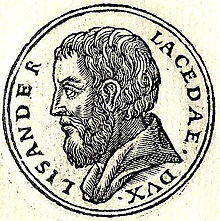
"The treasury of the Acanthians at Delphi bears this inscription: "Brasidas and the Acanthians, with spoil from the Athenians."For this reason many think that the marble figure standing within the edifice, by the door, is a statue of Brasidas. But it really represents Lysander, with his hair very long, after the ancient custom, and growing a generous beard. For it is not true, as some state, that because the Argives, after their great defeat, shaved their heads for sorrow, the Spartans, in contrary fashion, let their hair grow long in exultation over their victory; nor was it because the Bacchiadae, when they fled from Corinth to Lacedaemon, looked mean and unsightly from having shaved their heads, that the Spartans, on their part, became eager to wear their hair long; but this custom also goes back to Lycurgus. And he is reported to have said that a fine head of hair makes the handsome more comely to look upon, and the ugly more terrible."

Saturday, July 9, 2011

the imaginative part of the soul...

From the Life of Coriolanus"

"But the Roman people showed more plainly, when they were set free from the war, the greatness of their fear and peril while it lasted. For as soon as those who manned the walls descried the Volscians drawing their forces off, every temple was thrown open, and the people crowned themselves with garlands and offered sacrifices as if for victory. But the joy of the city was most apparent in the honour and loving favour which both the senate and the whole people bestowed upon the women, declaring their belief that the city's salvation was manifestly due to them. When, however, the senate passed a decree that whatsoever they asked for themselves in the way of honour or favour, should be furnished and done for them by the magistrates, they asked for nothing else besides the erection of a temple of Women's Fortune, the expense of which they offered to contribute of themselves, if the city would undertake to perform, at the public charge, all the sacrifices and honours, such as are due to the gods. The senate commended their public spirit, and erected the temple and its image at the public charge, but they none the less contributed money themselves and set up a second image of the goddess, and this, the Romans say, as it was placed in the temple, uttered some such words as these: "Dear to the gods, O women, is your pious gift of me."

These words were actually uttered twice, as the story runs, which would have us believe what is difficult of belief and probably never happened. For that statues have appeared to sweat, and shed tears, and exude something like drops of blood, is not impossible; since wood and stone often contract a mould which is productive of moisture, and cover themselves with many colours, and receive tints from the atmosphere; and there is nothing in the way of believing that the Deity uses these phenomena sometimes as signs and portents. It is possible also that statues may emit a noise like a moan or a groan, by reason of a fracture or a rupture, which is more violent if it takes place in the interior. But that articulate speech, and language so clear and abundant and precise, should proceed from a lifeless thing, is altogether impossible; since not even the soul of man, or the Deity, without a body duly organized and fitted with vocal parts, has ever spoken and conversed. But where history forces our assent with numerous and credible witnesses, we must conclude that an experience different from that of sensation arises in the imaginative part of the soul, and persuades men to think it sensation; as, for instance, in sleep, when we think we see and hear, although we neither see nor hear. However, those who cherish strong feelings of good-will and affection for the Deity, and are therefore unable to reject or deny anything of this kind, have a strong argument for their faith in the wonderful and transcending character of the divine power. For the Deity has no resemblance whatever to man, either in nature, activity, skill, or strength; nor, if He does something that we cannot do, or contrives something that we cannot contrive, is this contrary to reason; but rather, since he differs from us in all points, in His works most of all is He unlike us and far removed from us. But most of the Deity's powers, as Heracleitus says, "escape our knowledge through incredulity."

Friday, July 8, 2011

softening of the nature...

Bits from the "Life of Coriolanus"

"Verily, among all the benefits which men derive from the favour of the Muses, none other is so great as that softening of the nature which is produced by culture and discipline, the nature being induced by culture to take on moderation and cast off excess"

and on the day following a battle in which Marcius had distinguished himself...

"On the following day, when Lartius had come up, and the rest of the army was assembled before the consul, Cominius mounted the rostra, and after rendering to the gods the praise that was their due for such great successes, addressed himself to Marcius. In the first place, he rehearsed with praise his astonishing exploits, some of which he had himself beheld in battle, while to others Lartius bore witness. Then, out of the abundant treasures and the many horses and prisoners that had been taken, he ordered him to choose out a tenth, before any distribution to the rest of the army; and besides all this, he presented him with a horse, duly caparisoned, as a prize of valour. After the Romans had applauded this speech, Marcius came forth and said that he accepted the horse, and was delighted p141with the praises of the consul, but that he declined the rest, holding it to be pay, not honour, and would be content with his single share of the booty.  "But I do ask one special favour," he said, "and beg that I may receive it. I had a guest-friend among the Volscians, a man of kindliness and probity. This man is now a prisoner, and from wealth and happiness is reduced to subjection. Since, then, many evils have befallen him, let me at least free him from one, that of being sold into bondage.
At such words as these still louder shouts greeted Marcius, and he found more admirers of his superiority to gain than of the bravery he had shown in war. 4 For the very ones who secretly felt a certain jealous envy of him for his conspicuous honours, now thought him worthy of great rewards because he would not take them; and they were more delighted with the virtue which led him to despise such great rewards, than with the exploits which made him worthy of them. For the right use of wealth is a fairer trait than excellence in arms; but not to need wealth is loftier than to use it."

Thursday, July 7, 2011

bold and caustic reasonings...

This from the Life of Alcibiades on the influence of Socrates:

"For there is no man whom Fortune so envelops and compasses about with the so‑called good things of life that he cannot be reached by the bold and caustic reasonings of philosophy, and pierced to the heart"

Wednesday, July 6, 2011

hay on the horns...

bits from the life of Crassus:

"Concealment is just what deeds of fear need, wheras light is an enemy to them.

"He made very many changes in his political views, and was neither a steadfast friend nor an implacable enemy, but readily abandoned both his favours and his resentments at the dictates of his interests, so that, frequently, within a short space of time, the same men and the same measures found in him both an advocate and an opponent. 9 And he had great influence, both from the favours which he bestowed and the fear which he inspired, but more from the fear. At any rate, Sicinnius, who gave the greatest annoyance to the magistrates and popular leaders of his day, when asked why Crassus was the only one whom he let alone and did not worry, said that the man had hay on his horn. Now the Romans used to coil hay about the horn of an ox that gored, so that those who encountered it might be on their guard"

Tuesday, July 5, 2011

reverence and good hope...

Life of Pericles (on what he learned from his teacher)

"These were not the only advantages Pericles had of his association with Anaxagoras. It appears that he was also lifted by him above superstition, that feeling which is produced by amazement at what happens in regions above us. It affects those who are ignorant of the causes of such things, and are crazed about divine intervention, and confounded through their inexperience in this domain; whereas the doctrines of natural philosophy remove such ignorance and inexperience, and substitute for timorous and inflamed superstition that unshaken reverence which is attended by a good hope"

Monday, July 4, 2011

aid from the Gods...

from the Life of Fabius Maximus...

After this, he began with the gods, which is the fairest of all beginnings, and showed the people that the recent disaster was due to the neglect and scorn with which their general had treated religious rites, and not to the cowardice of those who fought under him. He thus induced them, instead of fearing their enemies, to propitiate and honour the gods. It was not that he filled them with superstition, but rather that he emboldened their valour with piety, allaying and removing the fear which their enemies inspired, with hopes of aid from the gods...

By thus fixing the thoughts of the people upon their relations with Heaven, Fabius made them more cheerful regarding the future. But he himself put all his hopes of victory in himself, believing that Heaven bestowed success by reason of wisdom and valour, and turned his attentions to Hannibal"

acquiescence and optimism...

from the Life of Pericles...

"acquiesce in the present without fault-finding, remember the past with thankfulness, and meet the future without fear or suspicion, with their hopes cheerful and bright."