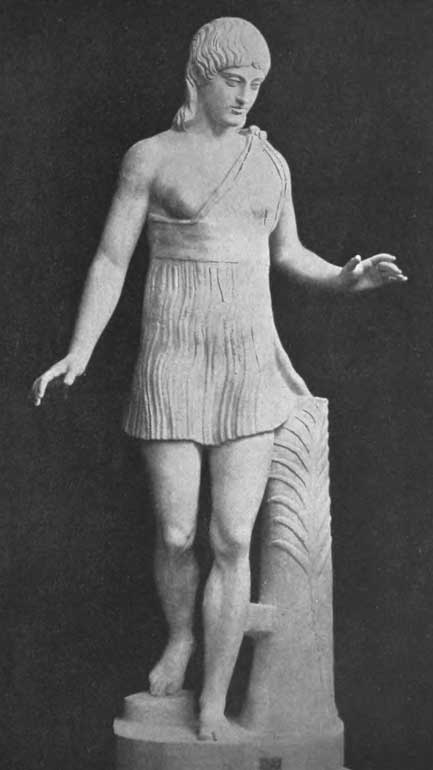
From The Life of Tiberius Gracchus
"Now that we have duly finished the first part of our story, we have to contemplate fates no less tragic than those of Agis and Cleomenes in the lives of the Roman couple, Tiberius and Caius, which we set in parallel. They were sons of Tiberius Gracchus, who, although he had been censor at Rome, twice consul, and had celebrated two triumphs, derived his more illustrious dignity from his virtue. 2 Therefore, after the death of the Scipio who conquered Hannibal, although Tiberius had not been his friend, but actually at variance with him, he was judged worthy to take Scipio's daughter Cornelia in marriage. We are told, moreover, that he once caught a pair of serpents on his bed, and that the soothsayers, after considering the prodigy, forbade him to kill both serpents or to let both go, but to decide the fate of one or the other of them, declaring also that the male serpent, if killed, would bring death to Tiberius, and the female, to Cornelia. 3 Tiberius, accordingly, who loved his wife, and thought that since she was still young and he was older it was more fitting that he should die, killed the male serpent, but let the female go. A short time afterwards, as the story goes, he died, leaving Cornelia with twelve children by him."
...which is just a highfalutin way of saying, "bits I really like in reading Plutarch"
Tuesday, August 30, 2011
virtue cannot be outraged by fortune...
From the Life of Cleomenes...
But Ptolemy, when he learned of these things, gave orders that the body of Cleomenes should be flayed and hung up, and that his children, his mother, and the women that were with her, should be killed. p1393 Among these women was the wife of Panteus, most noble and beautiful to look upon. The pair were still but lately married, and their misfortunes came upon them in the hey-day of their love. Her parents, indeed, would not permit her to sail away with Panteus immediately, although she wished to do so, but shut her up and kept her under constraint; 4 a little later, however, she procured herself a horse and a small sum of money, ran away by night, made all speed to Taenarum, and there embarked upon a ship bound for Egypt. She was conveyed to her husband, and with him bore their life in a strange life without complaint and chiefly. She it was who now took the hand of Cratesicleia as she was led forth by the soldiers, held up her robe for her, and bade her be of good courage. And Cratesicleia herself was not one whit dismayed at death, but asked one favour only, that she might die before the children died. 5 However, when they were come to the place of execution, first the children were slain before her eyes, and then Cratesicleia herself was slain, making but this one cry at sorrows so great: "O children, whither are ye gone?" Then the wife of Panteus, girding up her robe, vigorous and stately woman that she was, ministered to each of the dying women calmly and without a word, and laid them out for burial as well as she could. 6 And finally, after all were cared for, she arrayed herself, let down her robes from about her neck, and suffering no one besides the executioner to come near or look upon her, bravely met her end, and had no need of anyone to array or cover up her body after death. Thus her decorum of spirit attended her in death, and she maintained to the end that watchful care of her body which she had set over it in life.
So, then, Sparta, bringing her women's tragedy into emulous competition with that of her men, showed the world that in the last extremity Virtue cannot be outraged by Fortune. And a few days afterwards those who were keeping watch upon the body of Cleomenes where it hung, saw a serpent of great size coiling itself about the head and hiding away the face so that no ravening bird of prey could light upon it. 2 In consequence of this, the king was seized with superstitious fear, and thus gave the women occasion for various rites of purification, since they felt that a man had been taken off who was of a superior nature and beloved of the gods. And the Alexandrians actually worshipped him, coming frequently to the spot and addressing Cleomenes as a hero and a child of the gods; but at last the wiser men among them put a stop to this 3 by explaining that,
the end of Cleomenes...
From the Life of Cleomenes...
"Well, then, as Ptolemy the son of Chrysermus was coming out of the palace, three of them straightway fell upon him and slew him; and as another Ptolemy, who had the city in his charge, was driving towards them in a chariot, they rushed to meet him, scattered his servants and mercenaries, dragged him from his chariot, and slew him. 5 Then they proceeded to the citadel, purposing to break open the prison and avail themselves of the multitude of prisoners. But the guards were too quick for them and barred the way securely, so that Cleomenes, baffled in this attempt also, roamed up and down through the city, not a man joining with him but everybody filled with fear and flying from him. 6 So, then, he desisted from his attempt, and saying to his friends, "It is no wonder, after all, that women rule over men who run away from freedom," he called upon them all to die in a manner worthy of their king and their past achievements. So Hippitas first, at p137his own request, was smitten down by one of the younger men, then each of the others calmly and cheerfully slew himself, except Panteus, the man who led the way in the capture of Megalopolis.25 7 He had once been the king's favourite, because in his youth he was most fair, and in his young manhood most amenable to the Spartan discipline; and now his orders were to wait until the king and the rest of the band were dead, and then to die himself. 823At last all the rest lay prostrate on the ground, and Panteus, going up to each one in turn and pricking him with his sword, sought to discover whether any spark of life remained. When he pricked Cleomenes in the ankle and saw that his face twitched, he kissed him, and then sat down by his side; at last the end came, and after embracing the king's dead body, he slew himself upon it.
38 Such, then, was the end of Cleomenes, who had been for sixteen years king of Sparta, and had shown himself the man whom I have described. The report of his death spread over the entire city, and Cratesicleia, although she was a woman of noble spirit, lost her composure in view of the magnitude of her misfortunes, and throwing her arms about the children of Cleomenes, wailed and lamented. 2 But the elder of the two boys, forestalling all prevention, sprang away and threw himself headlong from the roof; he was badly injured, but did not die, and was taken up crying out resentfully because he was not permitted to end his life."
filled with great respect...
From the Life of Cleomenes...
"Such were the words of Therycion, and to them Cleomenes replied: "It is the easiest possible step thou urgest, wretched man, and one that any man might take, this dying; and dost thou think thyself brave when thou art making a flight more shameful than the one preceding it? 5 Better men than we have given in to their enemies before this, having been betrayed by Fortune or overwhelmed by numbers. But he who in the face of toils and hardships, or of the censorious judgments of men, gives up the fight, p123is vanquished by his own weakness. For a self-inflicted death ought to be, not flight from action, but an action in itself. For it is shameful to die, as well as to live, for one's self alone. And yet it is to this that thou now invitest me in thine eagerness to be rid of present troubles, though beyond that thou wilt effect nothing that is honourable or useful. 6 I, however, think it right that neither thou nor I should abandon our hopes for our country; when these abandon us, death will be very easy if we wish it."
To this Therycion made no reply, but as soon as he got an opportunity to leave Cleomenes, he turned aside along the sea-beach and slew himself.
But Cleomenes, putting to sea from Aegialia, landed in Libya, and travelled through the King's country to Alexandria. After coming into the presence of Ptolemy, at first he met with only ordinary and moderate kindness from him; but when he had given proof of his sentiments and shown himself to be a man of good sense, and when, in his daily intercourse, his Laconian simplicity retained the charm which a free spirit imparts, while he in no wise brought shame upon his noble birth or suffered the blows of Fortune to bow him down, but showed himself more winning than those whose conversation sought only to please and flatter, 2 then Ptolemy was filled with great respect for him, and deeply repented that he had neglected such a man and abandoned him to Antigonus, who had thereby won great glory and power. Ptolemy therefore sought to regain Cleomenes by honours and kindnesses, and kept encouraging him with assurances that he would send him back to Greece with ships and treasure and restore p125him to his kingdom. 3 He also gave him an annual pension of twenty-four talents. With this money Cleomenes maintained himself and his friends in a simple and modest manner, and spent the greater part in good offices and contributions to the refugees from Greece who were in Egypt."
Sunday, August 28, 2011
this frail body...
From the Life of Cleomenes...
"Such was the result of his expedition, and he was leading his army home, when, as it was already evening and he was near Tegea, messengers from Sparta came with tidings of a fresh and even greater calamity, the death of his wife. It was because of her that even in his most successful campaigns he could not endure to the end, but would p99continually be coming home to Sparta, out of love for Agiatis and in supreme devotion to her. 2 Of course, then, he was smitten with grief, as was natural for a young man who had lost a most beautiful and most sensible wife, but he did not allow his suffering to shame or betray the loftiness of his thought or the greatness of his spirit. He maintained his usual speech, dress, and bearing, 815gave the customary orders to his captains, and took thought for the safety of Tegea. 3 Next morning he returned to Sparta, and after duly mourning his loss with his mother and children at home, he at once engaged in the measures which he planned for the public good.
Now, Ptolemy the king of Egypt promised him aid and assistance, but demanded his mother and his children as hostages. For a long time, therefore, he was ashamed to tell his mother, and though he often went to her and was at the very point of letting her know, he held his peace, so that she on her part became suspicious and enquired of his friends whether there was not something which he wished to impart to her but hesitated to do so. 4 Finally, when Cleomenes plucked up courage to speak of the matter, his mother burst into a hearty laugh and said: "Was this the thing which thou wast often of a mind to tell me but lost thy courage? Make haste, put me on board a vessel, and send this frail body wheresoever though thinkest it will be of most use to Sparta, before old age destroys it sitting idly here."
the weakness of human nature...
from the Life of Cleomenes...
"This ruined the cause of Greece, at a time when she was still able in some way or other to recover from her grievous plight and escape Macedonian greed and insolence. For Aratus (whether it was through distrust and fear of Cleomenes, or because he envied the king his unlooked for success, and thought it a terrible thing after three and thirty years of leadership to have his own fame and power stripped from him by an upstart of a young man, 2 and the authority taken over in a cause which he himself had built up and controlled for so long a time), in the first place tried to force the Achaeans aside and hinder their purpose; but when they paid no heed to him in their consternation at the daring spirit of Cleomenes, but actually saw justice in the demands of the Lacedaemonians, who were seeking to restore the Peloponnesus to its ancient status, 3 Aratus took a step which would have been unmeet for any Greek to take, but was most shameful for him and most unworthy of his career as soldier and statesman. For he invited Antigonus into Greece and filled the Peloponnesus with Macedonians, whom he himself had driven out of Peloponnesus when, as a young man, he delivered Acrocorinthus from their power11 — he who had incurred the suspicion and hostility of all the reigning kings, and of this very Antigonus had p85said countless evil things in the commentaries which he left behind him. 4 And still, though he had incurred many hardships and dangers in behalf of Athens, as he says himself, in order that the city might be set free from its garrison of Macedonians, he afterwards brought these Macedonians, under arms, into his own country and into his own home; aye, even into the apartments of his women;12 812but he would not consent that the man who was a descendant of Heracles and king of Sparta, and was seeking to bring back its ancient polity, now like a decadent melody, back again to that restrained and Dorian law and life which Lycurgus had instituted, should be entitled leader of Sicyon and Tritaea. 5 Instead of this, to avoid the Spartan barley-bread and short-cloak, and the most dreadful of the evils for which he denounced Cleomenes, namely, abolition of wealth and restoration of poverty, he cast himself and all Achaea down before a diadem, a purple robe, Macedonians, and oriental behests. And that he might not be thought to obey Cleomenes, he offered sacrifices to Antigonus and sang paeans himself, with a garland on his head, in praise of a man who was far gone with consumption.
6 I write this, however, not with any desire to denounce Aratus, for in many ways he was a true Greek and a great one, but out of pity for the weakness of human nature, which, even in characters so notably disposed towards excellence, cannot produce a nobility that is free from blame."
a teacher...
From the Life of Cleomenes...
"In all these matters Cleomenes was himself a teacher. His own manner of life was simple, plain, and no more pretentious than that of the common man, and it was a pattern of self-restraint for all. This gave him a great advantage in his dealings with the other Greeks. For when men had to do with the other kings, they were not so much awed by their wealth and extravagance as they were filled with loathing for their haughtiness and pomp as they gave offensive and harsh answers to their auditors; 2 but when men came to Cleomenes, who was a real as well as a titled king, and then saw no profusion of purple robes or shawls about him, and no array of couches and litters; when they saw, too, that he did not make the work of his petitioners grievous and slow by employing a throng of messengers and door-keepers or by requiring written memorials, but came in person, just as he happened to be dressed, to answer the salutations of his visitors, conversing at length with those who needed his services and devoting time cheerfully and kindly to them, they were charmed and completely won over, and declared that he alone was a descendant of Heracles.
3 His usual supper was held in a room which had only three couches, and was very circumscribed and Spartan; but if he was entertaining ambassadors or guest-friends, two more couches would be brought in, and the servants would make the table a trifle more brilliant, not with sauces or sweetmeats, but with more generous dishes and a kindlier wine. And indeed he censured one of his friends, when he heard p79that in entertaining guest-friends he had set before them the black soup and barley-bread of the public mess-tables; "for," said he, "in these matters and before foreigners we must not be too strictly Spartan." 4 After the table had been removed, a tripod would be brought in on which were a bronze mixer full of wine, two silver bowls holding a pint apiece, and drinking cups of silver, few all told, from which he who wished might drink; but no one had a cup forced upon him. Music there was none, nor was any such addition desired; for Cleomenes entertained the company himself by his conversation, now asking questions, now telling stories, and his discourse was not unpleasantly serious, but had a sportiveness that charmed and was free from rudeness. 5 For the hunt which all the other kings made for men, ensnaring them with gifts and bribes and corrupting them, Cleomenes considered unskilful and unjust. In his eyes it was the noblest method, and one most fit for a king, to win over his visitors and attach them to himself by an intercourse and conversation which awakened pleasure and confidence. For he felt that a hireling differed from a friend in nothing except that the one was captured by a man's character and conversation, the other by a man's money."
the ancient discipline...
From the Life of Cleomenes...
"If, then, it had been possible without bloodshed to rid Sparta of her imported curses, namely luxury and extravagance, and debts and usury, and those elder evils than these, namely, poverty and wealth, he would have thought himself the most fortunate king in the world to have cured the disease of his country like a wise physician, without pain; but as it was, he said, in support of the necessity that had been laid upon him, he could cite Lycurgus, who, though he was neither king nor magistrate, but a private person attempting to act as king, proceeded with an armed retinue into the market-place, so that Charillus the king took fright and fled for refuge to an altar. 5 That king, however, Cleomenes said, since he was an excellent man and a lover of his country, speedily concurred in the measures of Lycurgus and accepted p73the change of constitution; still, as a matter of fact Lycurgus by his own acts bore witness to the difficulty of changing a constitution without violence and fear. To these, Cleomenes said, he had himself resorted with the greatest moderation, for he had but put out of the way the men who were opposed to the salvation of Sparta. 6 For all the rest, he said, the whole land should be common property, debtors should be set free from their debts, and foreigners should be examined and rated, in order that the strongest of them might be made Spartan citizens and help to preserve the state by their arms. "In this way," he said, "we shall cease to behold Sparta the booty of Aetolians and Illyrians through lack of men to defend her."
11 After this, to begin with, Cleomenes himself placed his property in the common stock, as did MegistonoĂŒs his step-father and every one of his friends besides; next, all the rest of the citizens did the same, and the land was parcelled out. Cleomenes also assigned a portion of land to each man who had been exiled by him, and promised to bring them all home after matters had become quiet. 2 Then he filled up the body of citizens with the most promising of the free provincials, and thus raised a body of four thousand men-at‑arms, whom he taught to use a long pike, held in both hands, instead of a short spear, and to carry their shields by a strap instead of by a fixed handle. Next he devoted himself to the training of the young men and to the "agoge," or ancient discipline, most of the details of which Sphaerus, who was then in Sparta, helped him in arranging. And quickly was the proper system of bodily training and public messes resumed, a few out of necessity, but most with a willing spirit, subjecting themselves to the old Spartan regime with all its simplicity. 3 And yet, desiring to give the name of absolute power a less offensive sound, he associated with himself in royal power his brother Eucleidas. And this was the only time when the Spartans had two kings from the same house.
temples of fear...
From the Life of Cleomenes...
"Now, the Lacedaemonians have temples of Death, Laughter, and that sort of thing, as well as of Fear. And they pay honours to Fear, not as they do to the powers which they try to avert because they think them baleful, but because they believe that fear is the chief support of their civil polity. 2 For this reason, too, when the ephors enter upon their office, as Aristotle says, they issue a proclamation commanding all men to shave their moustaches, and to obey the laws, that these may not be severe upon them. They insist upon the shaving of the moustache, I think, in order that they may accustom the young men to obedience in the most trifling matters. 3 And the men of old, in my opinion, did not regard bravery as a lack of fear, but as fear of reproach and dread of disgrace. For the men who feel most dread of the laws have most courage in p69facing their enemies; and those shun death least who most fear ill fame. 4 Therefore it has been well said:6
". . . for where dread is, there also is reverence."
And Homer says:7
"Revered art thou by me, dear father-in‑law, and dreaded too;"
and
"Without a word, in dread of their leaders."8
For by the multitude reverence is most apt to be felt towards those whom they also fear. For this reason, too, the Lacedaemonians erected a temple to Fear alongside the mess-hall of the ephors, after they had endowed this magistracy with almost absolute powers."
idleness and pleasure...
From the Life of Cleomenes...
" Of course, then, the condition of the city was not pleasing to him. The citizens had been lulled to sleep by idleness and pleasure; the king was willing to let all public business go, provided that no one thwarted his desire for luxurious living in the midst of his wealth; the public interests were neglected, while every man was eagerly intent upon his own private gain; and as for practice in arms, self-restraint of the young, hardiness, and equality, it was even dangerous to speak of these now that Agis was dead and gone.
2 It is said also that Cleomenes studied philosophy when he was still a stripling, after Sphaerus of Borysthenis had made a voyage to Sparta and busied himself sedulously there with the youth and young men. Sphaerus had become one of the leading disciples of Zeno of Citium, and it would appear that he admired the manly nature of Cleomenes and increased the fires of his high ambition. 3 For Leonidas of old, as we are told, when asked what manner of poet he thought Tyrtaeus to be, replied; "A good one to inflame the souls of young men." And indeed they were filled with divine inspiration by his poems, and in battle were prodigal of their lives. However, for great and impetuous natures the Stoic doctrines are somewhat misleading and dangerous, although when they permeate a deep and gentle character, they redound most to its proper good.
3 But at the death of Leonidas2 Cleomenes came to the throne, and saw that the citizens were by that time altogether degenerate. The rich neglected the common interests for their own private p55pleasure and aggrandizement; the common people, because of their wretched state at home, had lost all readiness for war and all ambition to maintain the ancient Spartan discipline; and he himself, Cleomenes, was king only in name, 2 while the whole power was in the hands of the ephors. He therefore at once determined to stir up and change the existing order of things, and as he had a friend, Xenares, who had been his lover (or inspirer, as the Spartans say), he would make trial of his sentiments by inquiring in detail what sort of a king Agis had been, and in what way and with what assistants he had entered upon the course of action so fatal to him. At first Xenares was quite glad to recall those matters, 806and rehearsed the events at length and in detail; 3 but when it was apparent that Cleomenes took an unusual interest in the story, and was profoundly stirred by the innovations of Agis, and wished to hear about him over and over again, Xenares rebuked him angrily, calling him unsound in mind, and finally stopped visiting and conversing with him. To no one, however, did he tell the reason of their variance, but merely said that Cleomenes understood it."
Saturday, August 27, 2011
cease weeping...
from the life of Agis (on his death)...
"Now Agis spent most of his time in the sanctuary, but was wont to go down from time to time to his bath. There, then, they determined to seize him, when he was outside the sanctuary. So they waited till he had finished his bath, and then came to meet him with friendly greetings, and walked along with him, conversing and jesting with him after the manner of youthful comrades. 2 But at a certain point the road branched off towards the prison, and when they were come to that place, Amphares, by virtue of his office, laid hands on Agis and said: "I shall lead thee, Agis, to the ephors, to answer for thy measures of state"; and Damochares, who was tall and robust, threw his cloak about the king's neck and dragged him along. 3 Others pushed him along from behind, as had been agreed, and since he had no helper but was without a friend, they thrust him into the prison. At once Leonidas was at hand with a large band of mercenaries and surrounded the prison, while the ephors went in to Agis. After sending for those of the senators who were of the same mind as themselves, as though the king were to have a trial, the ephors ordered Agis to defend his conduct of affairs. 4 The young king laughed at their dissimulation, whereupon Amphares threatened that he would rue the day and be punished for his temerity; but another ephor, as p45though plainly offering Agis a way of escape from the charges against him, asked him if he had done what he did under compulsion from Lysander and AgesilaĂŒs. 5 And when Agis answered that he had suffered compulsion from no one, but that in admiration and imitation of Lycurgus he had adopted the same public policy as his, the same ephor asked again if he repented of what he had done. But the young king declared that he had no repentance for what he had most excellently planned, and would not have, even if he saw that he was to suffer the extremest penalty. So they condemned him to death, and ordered the officers to lead him into the "Dechas," as it was called. 6 This is a chamber of the prison in which they strangle those who are under sentence of death. But Damochares, when he saw that the officers did not dare to lay hands on Agis, and likewise that even the mercenaries who were there shrank from the deed and were loth to do it, feeling as they did that 804it was contrary to the laws of God and man to lay hands upon the person of a king, heaped threats and abuse upon them and himself dragged Agis into the chamber of death. 7 For already many people were aware of the arrest, and there was a noisy throng at the door and many torches, and the mother and grandmother of Agis were there, with cries and prayers that the king of the Spartans should have a hearing and a trial before the citizens. For this reason especially the ephors hastened on the king's execution, believing that he would be taken out of their hands in the night if the concourse should increase.
20 Agis, then, on his way to the halter, saw one of the officers shedding tears of sympathy for him. "My man," said he, "cease weeping; for even though I am put to death in this lawless and unjust manner, I have the better of my murderers." And saying these words, he offered his neck to the noose without hesitation. 2 But Amphares went to the door of the prison, where Agesistrata fell at his feet in an appeal to his friendship and intimacy. Amphares lifted her up and assured her that Agis was not to suffer violence or death; and he bade her, if she wished, go in to her son. And when Agesistrata begged that her mother might go in with her, Amphares said there was nothing to prevent. 3 So he admitted both the women, and after ordered the door of the prison to be locked again, delivered Archidamia first to the executioners. She was now a very aged woman, and had lived all her days in very high repute among her countrywomen. After she had been put to death, Amphares ordered Agesistrata to enter the chamber of execution. 4 So she went in, and when she saw her son lying dead upon the ground, and her mother's dead body still hanging in the noose, with her own hands she helped the officers to take her down, laid her body out by the side of Agis, and composed and covered it. Then, embracing her son and kissing his face, she said: "My son, it was thy too great regard for others, and thy gentleness and humanity, which has brought thee to ruin, us as well." 5 Then Amphares, who stood at the door and saw and heard what she did and said, came in and said angrily to her: "If, then, thou hast been of the same mind as thy son, thou shalt suffer the same fate." And Agesistrata, as she rose to present her neck to the p49noose, said: "My only prayer is that this may bring good to Sparta."
21 When tidings of the sad event had been carried to the city and the three bodies were carried forth for burial, the fear felt by the citizens was not so strong as to prevent them from manifesting sorrow over what had been done, and hatred for Leonidas and Amphares. It was thought that nothing more dreadful or heinous had been done in Sparta since the Dorians had dwelt in Peloponnesus. 2 For against a king of the Lacedaemonians, as it seems, not even their enemies would willingly raise their hands if they met him in battle, but they would spare him, out of fear and reverence for his dignity. And for this reason, although there had been many conflicts between Lacedaemonians and other Greeks, only one Spartan king had been slain up to the time of Philip of Macedon, namely, Cleombrotus, who was smitten by a spear at Leuctra.17 The Messenians, however, say that Theopompus also fell in battle, at the hands of Aristomenes; but the Lacedaemonians deny this, and say that their king was only wounded. 3 This matter may be disputed; but Agis was certainly the first king of Sparta to be put to death by the ephors. And yet he had chosen a line of conduct that was noble and worthy of Sparta, and was of an age in which men are usually pardoned for their errors, and his friends could with more justice blame him than his enemies, because he spared the life of Leonidas, and, most mild and gentle man that he was, put faith in his other foes."
avarice...
from the Life of Agis...
"Thus the enterprise of the kings was making good progress and no one tried to oppose or hinder them, when one man, AgesilaĂŒs, upset and ruined everything. He allowed a most shameful disease of avarice to wreck a most noble and most truly Spartan plan. 2 For since he was an exceedingly large owner of valuable land, but owed huge sums of money, being unable to pay his debts and unwilling to give up his lands, he persuaded Agis that if both his projects should be carried through at the same time the resulting convulsion in the state would be great; but that if the men of property should first be won over by a remission of their debts, they would afterwards accept the distribution of land contentedly and quietly. 3 This was also the opinion of Lysander, who was deceived in like manner by AgesilaĂŒs. So they caused mortgages (the Spartans call them "klaria," or allotment pledges) to be brought into the market-place, heaped them altogether, and set fire to them. As the flames rose, the men of wealth and the lenders of money went away with heavy hearts; but AgesilaĂŒs, as if in mockery of them, declared that his eyes had never seen a brighter or purer flame than that.
4 And now the multitude demanded also that the land should at once be divided, and the kings gave orders that this should be done; but AgesilaĂŒs would always interpose some obstacle or make some excuse, and so consumed time until it became the duty of Agis to head a military expedition, when the Achaeans, who were their allies, sent p33for aid from Sparta. For the Aetolians were expected to invade Peloponnesus by way of Megara; and Aratus, the general of the Achaeans, in an effort to prevent this, was assembling a force and wrote a letter to the ephors.
14 These at once sent out Agis, who was exalted in spirit by the ambition and ardour of the soldiers under him. For being young men for the most part and poor, and having now immunity from their debts and absolution, and expecting that they would receive allotments of land if they returned from the expedition, their devotion to Agis was astonishing. 2 And they were a spectacle to the cities as they marched through the Peloponnesus without doing any injury, without rudeness, and almost without noise, so that the other Greeks were amazed and asked themselves what must have been the discipline of a Spartan army under the command of the great AgesilaĂŒs, or the famous Lysander, or Leonidas of old, since towards a stripling who was almost the youngest of the whole army so great reverence and fear were felt by his soldiers. 3 And indeed the young man himself, owing to his simplicity, his love of hardships, and the pride he took in clothing and arming himself with no more splendour than a common soldier, won the admiration and devotion of the multitudes; for to the rich, certainly, his innovating ways were not pleasing, owing to a fear that they might prove a disturbing force and set a bad example among the common people everywhere."
in behalf of virtue...
From the Life of Agis...
"Agis, therefore, thinking it a noble achievement, as it was, to equalize and restore to full numbers the body of citizens, began to sound the inclinations of people. The young men, as he found, quickly and beyond his expectations gave ear to him, and stripped themselves for the contest in behalf of virtue, like him casting aside their old ways of living as worn-out garments in order to attain liberty. 2 But most of the older men, since they were now far gone in corruption, feared and shuddered at the name of Lycurgus as if they had run away from their master and were being led back to him, 798and they upbraided Agis for bewailing the present state of affairs and yearning after the ancient dignity of Sparta. Lysander, however, the son of Libys, Mandrocleidas the son of Ecphanes, as well as AgesilaĂŒs, approved of the king's aspirations and supported him in them. 3 Lysander was in the highest repute among the citizens, and Mandrocleidas was the ablest Greek of his time in setting schemes on foot, and his sagacity and craft were mingled with daring; AgesilaĂŒs, who was the king's uncle on his mother's side, and a powerful orator, though otherwise effeminate and avaricious, was openly urged on and encouraged by his son p17Hippomedon, who had won fair fame in many wars, and had great influence because he stood in favour with the young men. 4 But what really induced AgesilaĂŒs to take part in the king's enterprise was the multitude of his debts, of which he hoped to rid himself by changing the constitution. As soon, then, as Agis had won over AgesilaĂŒs, he straightway sought with the aid of his uncle to persuade his mother, who was a sister of AgesilaĂŒs, and owing to the multitude of her retainers, friends, and debtors, had great influence in the state and took a large part in public affairs.
7 When she heard her son's plea, she was at first amazed, and tried to stop the young man from attempting what she thought was neither possible nor profitable; but AgesilaĂŒs tried to show her that the king's project would be feasible and its accomplishment advantageous, and the king himself besought his mother to contribute her wealth for the advancement of his ambition and glory. For in the matter of property, he said, he could not equal the other kings 2 (since the servants and slaves of the satraps and overseers of Ptolemy and Seleucus had larger possessions than all the kings of Sparta put together); but if in self-restraint, simplicity, and magnanimity he should surpass their luxury, and thereby establish equality and community of possession among the citizens, he would win the name and fame of a really great king. The women, lifted up by the young man's high ambition, were so changed in their purposes, and possessed, as it were, by so great an inspiration to take the noble course, 3 that they joined in urging and hastening on the projects of p19Agis, sent for their friends among the men and invited them to help, and held conference with the women besides, since they were well aware that the men of Sparta were always obedient to their wives, and allowed them to meddle in public affairs more than they themselves were allowed to meddle in domestic concerns.
Now, at this time the greater part of the wealth of Sparta was in the hands of the women, and this made the work of Agis a grievous and difficult one. 4 For the women were opposed to it, not only because they would be stripped of the luxury which, in the general lack of higher culture, made their lives seem happy, but also because they saw that the honour and influence which they enjoyed in consequence of their wealth would be cut off. 5 So they had recourse to Leonidas, and besought him, since he was an older man, to withstand Agis and hinder what he was trying to accomplish. Leonidas, accordingly, was desirous of aiding the rich, but he feared the people, who were eager for a revolution. He therefore made no open opposition to Agis, but secretly sought to damage his undertaking and bring it to nought by slandering him to the chief magistrates, declaring that he was purchasing a tyranny by offering to the poor the property of the rich, and by distribution of land and remission of debts was buying a large body-guard for himself, not many citizens for Sparta."
the ancient discipline...
from the Life of Agis...
" Agis, on the contrary, far surpassed in native excellence and in loftiness of spirit not only Leonidas, but almost all the kings who had followed the great AgesilaĂŒs. Therefore, even before he had reached his twentieth year, and although he had been reared amid the wealth and luxury of women, namely, his mother Agesistrata and his grandmother Archidamia (who were the richest people in Sparta), he at once set his face against pleasures. He put away from his person the adornments which were thought to p13befit the grace of his figure, laid aside and avoided every extravagance, prided himself on his short Spartan cloak, observed sedulously the Spartan customs in his meals and baths and general ways of living, and declared that he did not want the royal power at all unless by means of it he could restore the ancient laws and discipline."
image of virtue...
from the Life of Agis...
"Not without rhyme or reason is the supposition of some writers that the tale about Ixion — how it was the cloud that he embraced instead of Hera and begat from thence the Centaurs — has an application to lovers of glory. For such men, consorting with glory, which we may call an image of virtue, produce nothing that is genuine and of true lineage, but much that is bastard and monstrous, being swept now along one course and now along another in their attempts to satisfy desire and passion. The herdsmen of Sophocles say,1 in speaking of their flock:—
"Of these, indeed, though masters, we are yet the slaves,
And to them we must listen even though they're dumb."
2 And this, in truth, is the experience of public men who act in conformity with the desires and impulses of multitudes, making themselves attendants and slaves in order that they may be called popular leaders and rulers. For just as a ship's lookout, who sees what lies ahead before the ship's captain does, nevertheless turns to him for orders and does what he ordains, so the public man whose eyes are fixed on glory is a servant of the multitude, although he has the name of ruler.
p52 The man, indeed, whose goodness is complete and perfect will have no need at all of glory, except so far as glory gives him access to achievement by reason of the confidence men have in him; but a man who is still young and is fond of honours may be allowed to plume and exalt himself somewhat even upon glory, provided that glory is the outcome of noble deeds. For virtues, which are incipient and budding in the young, are confirmed in their proper development, as Theophrastus says, by the praises of men, and complete their growth under the incentive of pride. 2 But excess is everywhere harmful, and in the case of men who cherish political ambitions, it is deadly; for it sweeps them away into manifest folly and madness as they grasp after great power, when they refuse to regard what is honourable as glorious, but consider that what is glorious is good. Therefore, what Phocion said to Antipater, who demanded from him some dishonourable service, "Thou canst not have Phocion as thy friend and at the same time thy flatterer," this, or something akin to this, must be said to the multitude: 3 "Ye cannot have the same man as your ruler and your slave." Since in this case also one certainly can apply the fable of the serpent whose tail rebelled against its head and demanded the right 796to lead in turn instead of always following; so it took the lead, and by the folly of its progress got itself into mischief and lacerated the head, which was compelled, contrary to nature, to follow a part that had neither eyes nor ears. 4 This, as we see, has been the experience of many of the men whose whole political activity is directed towards the winning of popular favour; they made themselves dependent on the multitude, which is borne p7about at random, and then could neither recover themselves nor put a stop to the progress of disorder."
worn out with toils...
From the Life of Gaius Marius (on his death)
" But Marius himself, now worn out with toils, deluged, as it were, with anxieties, and wearied, could not sustain his spirits, which shook within him as he again faced the overpowering thought of a new war, of fresh struggles, of terrors known by experience to be dreadful, and of utter weariness. He reflected, too, that it was not Octavius or Merula in command of a promiscuous throng and a seditious rabble against whom he was now to run the hazard of war, but that the famous Sulla was coming against him, the man who had once ejected him from the country, and had now shut Mithridates up to the shores of the Euxine Sea. 3 Tortured by such reflections, and bringing into review his long wandering, his flights, and his perils, as he was driven over land and sea, he fell into a state of dreadful despair, and was a prey to nightly terrors and harassing dreams, wherein he would ever seem to hear a voice saying:—
"Dreadful, indeed, is the lions' lair, even though it be empty."41
And since above all things he dreaded the sleepless nights, he gave himself up to drinking-bouts and drunkenness at unseasonable hours and in a manner unsuited to his years, trying thus to induce sleep as a way of escape from his anxious thoughts. 4 And finally, when one came with tidings from the sea, fresh terrors fell upon him, partly because he feared the future, and partly because he was wearied to satiety by the present, so that it needed only a slight impulse to throw him into a pleurisy, as Poseidonius the philosopher relates, who says that he p595went in personally and conversed with Marius on the subjects of his embassy after Marius had fallen ill. 5 But a certain Caius Piso, an historian, relates that Marius, while walking about with his friends after supper, fell to talking about the events of his life, beginning with his earliest days, and after recounting his frequent reversals of fortune, from good to bad and from bad to good, said that it was not the part of a man of sense to trust himself to Fortune any longer; and after this utterance bade his friends farewell, kept his bed for seven days consecutively, and so died. 6 Some, however, say that his ambitious nature was completely revealed during his illness by his being swept into a strange delusion. He thought that he had the command in the Mithridatic war, and then, just as he used to do in his actual struggles, he would indulge in all sorts of attitudes and gestures, accompanying them with shrill cries and frequent calls to battle. 7 So fierce and inexorable was the passion for directing that war which had been instilled into him by his envy and lust of power. And therefore, though he had lived to be seventy years old, and was the first man to be elected consul for the seventh time, and was possessed of a house and wealth which would have sufficed for many kingdoms at once, he lamented his fortune, in that he was dying before he had satisfied and completed his desires.
46 Plato, however, when he was now at the point of death, lauded his guardian genius and Fortune because, to begin with, he had been born a man and not an irrational animal; again, because he was a Greek and not a Barbarian; and still again, because his birth had fallen in the times of Socrates. p5972 And indeed they say that Antipater of Tarsus, when he was in like manner near his end and was enumerating the blessings of his life, did not forget to mention his prosperous voyage from home to Athens, just as though he thought that every gift of a benevolent Fortune called for great gratitude, and kept it to the last in his memory, which is the most secure storehouse of blessings for a man. 3 Unmindful and thoughtless persons, on the contrary, let all that happens to them slip away as time goes on; therefore, since they do not hold or keep anything, they are always empty of blessings, but full of hopes, and are looking away to the future while they neglect the present. 4 And yet the future may be prevented by Fortune, while the present cannot be taken away; nevertheless these men cast aside the present gift of Fortune as something alien to them, while they dream of the future and its uncertainties. And this is natural. For they assemble and heap together the external blessings of life before reason and education have enabled them to build any foundation and basement for these things, and therefore they cannot satisfy the insatiable appetite of their soul.
5 So, then, Marius died, seventeen days after entering upon his seventh consulship. And immediately Rome was filled with great rejoicing and a confident hope that she was rid of a grievous tyranny; but in a few days the people perceived that they had got a new and vigorous master in exchange for the old one; such bitterness and cruelty did the younger Marius display, putting to death the best and most esteemed citizens. 6 He got the reputation of being bold and fond of danger in fighting his enemies, and p599in the beginning was called a son of Mars; but his deeds soon showed what he really was, and he was called instead a son of Venus. And finally he was shut up in Praeneste by Sulla, and after many vain attempts to save his life, when the city was captured and he could not escape, he slew himself.42
Gaius on the run...
From the Life of Gaius Marius (Gaius on the run)
"The Roman governor of Africa at this time was Sextilius, a man who had received neither good nor ill at the hands of Marius, but whom, as it was expected, pity alone would move to give him aid. Hardly, however, had Marius landed with a few companions, p577when an official met him, stood directly in front of him, and said: "Sextilius the governor forbids thee, Marius, to set foot in Africa; and if thou disobeyest, he declares that he will uphold the decrees of the senate and treat thee as an enemy of Rome." 4 When he heard this, Marius was rendered speechless by grief and indignation, and for a long time kept quiet, looking sternly at the official. Then, when asked by him what he had to say, and what answer he would make to the governor, he answered with a deep groan: "Tell him, then, that thou hast seen Caius Marius a fugitive, seated amid the ruins of Carthage." And it was not inaptly that he compared the fate of that city with his own reversal of fortune.
"Meanwhile Iampsas the king of Numidia, hesitating which course to take, did indeed treat the younger Marius and his party with respect, but always had some excuse for detaining them when they wished to go away, and clearly had no good end in view in thus postponing their departure. However, something occurred which, though not at all extraordinary, led to their escape. The younger Marius, that is, being a handsome fellow, one of the concubines of the king was pained to see him treated unworthily, and this feeling of compassion ripened into love. 6 At first, then, Marius repelled the woman's advances; but when he saw that there was no other way of escape for him and his friends, and that her behaviour was based on a genuine affection, he accepted her favours, whereupon she helped him in getting off,Âș and he ran away with his friends and made his escape to his father. After father and son had embraced one another, they walked along the sea-shore, and there they saw some scorpions fighting, which the elder p579Marius regarded as a bad omen. 7 At once, therefore, they boarded a fishing-boat and crossed over to the island of Cercina, which was not far distant from the mainland;f and scarcely had they put out from land when horsemen sent by the king were seen riding towards the spot whence they had sailed. It would seem that Marius never escaped a greater peril than this."
greed and ambition...
from the Life of Gaius Marius...
"But when the Italians had at last made their submission, and many persons at Rome were suing for the command in the Mithridatic war, with the aid of the popular leaders, contrary to all expectation the tribune Sulpicius, a most audacious man, brought Marius forward and proposed to make him pro-consul in command against Mithridates. The people were divided in opinion, some preferring Marius, and others called for Sulla and bidding Marius go to the warm baths at Baiae and look out for his health, since he was worn out with old age and rheums, as he himself said. 2 For at Baiae, near Cape Misenum, Marius owned an expensive house, which had appointments more luxurious and effeminate p557than became a man who had taken active part in so many wars and campaigns. This house, we are told, Cornelia bought for seventy-five thousand drachmas and not long afterwards Lucius Lucullus purchased it for two million five hundred thousand. So quickly did lavish expenditure spring up, and so great an increase in luxury did life in the city take on. 3 Marius, however, showing a spirit of keen emulation that might have characterized a youth, shook off old age and infirmity and went down daily into the Campus Martius, where he exercised himself with the young men and showed that he was still agile in arms and capable of feats of horsemanship, although his bulk was not well set up in his old age, but ran to corpulence and weight.
4 Some, then, were pleased to have him thus engaged, and would go down into the Campus and witness his emulation in competitive contests; but the better part were moved to pity at the sight of his greed and ambition, because, though he had risen from poverty to the greatest wealth and from obscurity to the highest place, he knew not how to set bounds to his good fortune, and was not content to be admired and enjoy quietly what he had, but as if in need of all things, and after winning triumphs and fame, 5 was setting out, with all his years upon him, for Cappadocia and the Euxine sea, to fight it out with ArchelaĂŒs and Neoptolemus, the satraps of Mithridates. And the justification for this which Marius offered was thought to be altogether silly; he said, namely, that he wished to take part personally in the campaign in order to give his son a military training."
third founder of Rome...
From the Life of Gaius Marius...
"Now, the enemy's property became the booty of the soldiers of Marius, but the spoils of battle, the standards, and the trumpets, were brought, we are told, to the camp of Catulus; and Catulus relied chiefly upon this as a proof that the victory was won by his men. Furthermore, a dispute for the honour of the victory arose among the soldiers, as was natural, and the members of an embassy from Parma were chosen to act as arbitrators. These men the soldiers of Catulus conducted among the dead bodies of the enemy, which were clearly seen to have been pierced by their javelins; for these could be known by the name of Catulus which had been cut into the shaft. 5 However, the entire success was attributed to Marius, both on account of his former victory and of his superior rank.28 Above all, the people hailed him as the third founder of Rome,29 that peril which he had averted from the city was not less than that of the Gallic invasion; and all of them, as they made merry at home with their wives and children, would bring ceremonial offerings of food and libations of wine to Marius as well as to the gods, and they were insistent that he alone should celebrate both triumphs. 6 Marius, however, would not do this, but celebrated his triumph with Catulus, wishing to show himself a man of moderation after a course of so great good fortune. Perhaps, too, he was afraid of the soldiers, who were drawn up and ready, in case Catulus were deprived of his honour, to prevent Marius also from celebrating a triumph."
dust...
from the LIfe of Gaius Marius...
"After the attack had begun, however, an experience befell Marius which signified the divine displeasure, according to Sulla. For an immense cloud of dust was raised, as was to be expected, and the two armies were hidden from one another by it, so that Marius, when he first led his forces to the attack, missed the enemy, passed by their lines of battle, and moved aimlessly up and down the plain for some time. Meanwhile, as chance would have it, the Barbarians engaged fiercely with Catulus, and he and his soldiers, among whom Sulla says he himself was posted, bore the brunt of the struggle. 4 The Romans were favoured in the struggle, Sulla says, by the heat, and by the sun, which shone in the faces of the Cimbri. For the Barbarians were well able to endure cold, and had been brought up in shady and chilly regions, as I have said.25 They were therefore undone by the heat; they sweated profusely, breathed with difficulty, and were forced to hold their shields before their faces. For the battle was fought after the summer solstice, which falls, by Roman reckoning, three days before the new moon of the month now called August,26 but then Sextilis. 5 Moreover, the dust, by hiding the enemy, helped to encourage the Romans. For they could not see from afar the great numbers of the foe, but each one of them fell at a run upon the man just over against him, and fought him hand to hand, without having been terrified by the sight of the rest of the host. And their bodies were so inured to toil and so thoroughly trained that not a Roman was observed to sweat or pant, in spite of the great heat and the run with which they p537came to the encounter. This is what Catulus is said to have written27 in extolling his soldiers."
no unmixed enjoyment...
From the Life of Gaius Marius...
"After the battle, Marius collected such of the arms and spoils of the Barbarians as were handsome, entire, and fitted to make a show in his triumphal procession; all the rest he heaped up on a huge pyre and set on foot a magnificent sacrifice. 2 The soldiers had taken their stand about the pyre in arms, with chaplets on their heads, and Marius himself, having put on his purple-bordered robe and girt it about him, as the custom was, had taken a lighted torch, held it up towards heaven with both hands, and was just about to set fire to the pyre, when some friends were seen riding swiftly towards him, and there was deep silence and expectancy on the part of all. 3 But when the horsemen were near, they leaped to the ground and greeted Marius, bringing him the glad news that he had been elected consul for the fifth time,23 and giving him letters to that effect. This great cause for rejoicing having been added to the celebration of their victory, the soldiers, transported with delight, sent forth a universal shout, accompanied by the clash and clatter of their arms, and after his officers had crowned Marius afresh with wreaths of bay, he set fire to the pyre and completed the sacrifice.
23 However, that power which permits no great successes to bring a pure and unmixed enjoyment, but diversifies human life with a blending of evil and of good — be it Fortune, or Nemesis, or Inevitable Necessity, within a few days brought to Marius tidings of his colleague Catulus, which, like a cloud in a calm and serene sky, involved Rome in another tempest of fear."
affair of the vultures...
From the Life of Gaius Marius...
"The affair of the vultures, however, which Alexander of Myndus relates, is certainly wonderful. Two vultures were always seen hovering about the armies of Marius before their victories, and accompanied p509them on their journeys, being recognized by bronze rings on their necks; for the soldiers had caught them, put these rings on, and let them go again; and after this, on recognizing the birds, the soldiers greeted them, and they were glad to see them when they set out upon a march, feeling sure in such cases that they would be successful."
Marian Mule...
From the Life of Gaius Marius...
"Setting out on the expedition, he laboured to perfect his army as it went along, practising the men in all kinds of running and in long marches, and compelling them to carry their own baggage and to prepare their own food. Hence, in after times, men who were fond of toil and did whatever was enjoined upon them contentedly and without a murmur, were called Marian mules. Some, however, think that this name had a different origin. 2 Namely, when Scipio was besieging Numantia,14 he wished to inspect p497not only the arms and the horses, but also the mules and the waggons, that every man might have them in readiness and good order. Marius, accordingly, brought out for inspection both a horse that had been most excellently taken care of by him, and a mule that for health, docility, and strength far surpassed all the rest. The commanding officer was naturally well pleased with the beasts of Marius and often spoke about them, so that in time those who wanted to bestow facetious praise on a persevering, patient, laborious man would call him a Marian mule."
fortitude...
From the Life of Gaius Marius...
6 Well, then, for his praetorship Marius got only moderate commendation. After his praetorship, however, the province of Farther Spain was allotted to him, and here he is said to have cleared away the robbers, although the province was still uncivilized in its customs and in a savage state, and robbery was at that time still considered a most honourable occupation by the Spaniards. But when he returned to political life, he had neither wealth nor eloquence, with which the magnates of the time used to influence the people. 2 Still, the very intensity of his assurance, his indefatigable labours, and his plain and simple way of living, won him a certain popularity among his fellow citizens, and his honours brought him increasing influence, so that he married into the illustrious family of the Caesars and became the husband of Julia, who was the aunt of that Caesar who in after times became greatest among the Romans, and in some degree, because of his relationship, made Marius his example, as I have stated in his Life.6
p4773 There is testimony both to the temperance of Marius, and also to his fortitude, of which his behaviour under a surgical operation is a proof. He was afflicted in both legs, as it would appear, with varicose veins, and as he disliked the deformity, he resolved to put himself into the physician's hands. Refusing to be bound, he presented to him one leg, and then, without a motion or a groan, but with a steadfast countenance and in silence, endured incredible pain under the knife. When, however, the physician was proceeding to treat the other leg, Marius would suffer him no further, declaring that he saw the cure to be not worth the pain.b
7 When Caecilius Metellus the consul was appointed commander-in‑chief for the war against Jugurtha,7 he took Marius with him to Africa in the capacity of legate. Here, in essaying great exploits and brilliant struggles, Marius was not careful, like the rest, to enhance the glory of Metellus and conduct himself in his interests; and deeming that he had not so much been called by Metellus to the office of legate as he was being introduced by Fortune into a most favourable opportunity as well as a most spacious theatre for exploits, he made a display of every sort of bravery. 2 And though the war brought many hardships, he neither shunned any great labour, nor disdained any that were small, but surpassed the officers of his own rank in giving good counsel and foreseeing what was advantageous, and vied with the common soldiers in frugality and endurance, thereby winning much goodwill among them. 3 For as a general thing it would seem that every man finds p479solace for his labours in seeing another voluntarily share those labours; this seems to take away the element of compulsion; and it is a most agreeable spectacle for a Roman soldier when he sees a general eating common bread in public, or sleeping on a simple pallet, or taking a hand in the construction of some trench or palisade. For they have not so much admiration for those leaders who share honour and riches with them as for those who take part in their toils and dangers, but have more affection for those who are willing to join in their toils than for those who permit them to lead an easy life.
4 By doing all these things and thereby winning the hearts of the soldiers, Marius soon filled Africa, and soon filled Rome, with his name and fame, and men in the camp wrote to those at home that there would be no end or cessation of the war against the Barbarian unless they chose Caius Marius consul.
Thursday, August 25, 2011
the death of Pyrrhus...
from the Life of Pyrrhus...
"But Pyrrhus, seeing the stormy sea that surged about him, took off the coronal with which his helmet was distinguished, and gave it to one of his companions; then, relying on his horse, he plunged in among the enemy who were pursuing p459him. Here he was wounded by a spear which pierced his breastplate — not a mortal, nor even a severe wound — and turned upon the man who had struck him, who was an Argive, not of illustrious birth, but the son of a poor old woman. 2 His mother, like the rest of the women, was at this moment watching the battle from the house-top, and when she saw that her son was engaged in conflict with Pyrrhus, she was filled with distress in view of the danger to him, and lifting up a tile with both her hands threw it at Pyrrhus. It fell upon his head below his helmet and crushed the vertebrae at the base of his neck, so that his sight was blurred and his hands dropped the reins. Then he sank down from his horse and fell near the tomb of Licymnius,40 unrecognised by most who saw him. 3 But a certain Zopyrus, who was serving under Antigonus, and two or three others, ran up to him, saw who he was, and dragged him into a door-way just as he was beginning to recover from the blow. And when Zopyrus drew an Illyrian short-sword with which to cut off his head, Pyrrhus gave him a terrible look, so that Zopyrus was frightened; his hands trembled, and yet he essayed the deed; but being full of alarm and confusion his blow did not fall true, but along the mouth and chin, so that it was only slowly and with difficulty that he severed the head. 4 Presently what had happened was known to many, and Alcyoneus, running to the spot, asked for the head as if he would see whose it was. But when he had got it he rode away to his father, and cast it down before him as he sat among his friends. Antigonus, however, when he saw and recognised the head, drove his son p461away, smiting him with his staff and calling him impious and barbarous; then, covering his face with his cloak he burst into tears, calling to mind Antigonus his grandfather and Demetrius his father, who were examples in his own family of a reversal of fortune."
full of wrath...
From the Life of Pyrrhus...
"But the Barbarians combined against him as he was setting sail. With the Carthaginians he fought a sea-fight in the strait and lost many of his ships, but escaped with the rest to Italy; and here the Mamertines, more than ten thousand of whom had crossed in advance of him, though they were afraid to match forces with him, yet threw his whole army into confusion by setting upon him and assailing him in difficult regions. Two of his elephants fell, and great numbers of his rearguard were slain. 2 Accordingly, riding up in person from the van, he sought to ward off the enemy, and ran great risks in contending with men who were trained to fight and were inspired with high courage. And when he was wounded on the head with a sword and withdrew a little from the combatants, the enemy were all the more elated. One of them ran forth far in advance of the rest, a man who was huge in body and resplendent in armour, and in a bold voice challenged Pyrrhus to come out, if he were still alive. 3 This angered Pyrrhus, and wheeling round in spite of his guards, he pushed his way through them — full of wrath, smeared with blood, and with a countenance terrible to look upon, and before the Barbarian could strike dealt him such a blow on his head with his sword that, what with the might of his arm and the excellent temper of his steel, it cleaved its way down through, so that at one instant the parts of the sundered body fell to either side. 4 This checked the Barbarians from any further advance, for they were amazed and confounded at Pyrrhus, and thought him some superior being. So he accomplished the rest of his march unmolested and came to Tarentum,33 bringing twenty thousand foot and three thousand horse. Then, adding to his force the best troops of the Tarentines, he forthwith led them against the Romans, who were encamped in the country of the Samnites."
cleaved down through...
From the Life of Pyrrhis...
"But the Barbarians combined against him as he was setting sail. With the Carthaginians he fought a sea-fight in the strait and lost many of his ships, but escaped with the rest to Italy; and here the Mamertines, more than ten thousand of whom had crossed in advance of him, though they were afraid to match forces with him, yet threw his whole army into confusion by setting upon him and assailing him in difficult regions. Two of his elephants fell, and great numbers of his rearguard were slain. 2 Accordingly, riding up in person from the van, he sought to ward off the enemy, and ran great risks in contending with men who were trained to fight and were inspired with high courage. And when he was wounded on the head with a sword and withdrew a little from the combatants, the enemy were all the more elated. One of them ran forth far in advance of the rest, a man who was huge in body and resplendent in armour, and in a bold voice challenged Pyrrhus to come out, if he were still alive. 3 This angered Pyrrhus, and wheeling round in spite of his guards, he pushed his way through them — full of wrath, smeared with blood, and with a countenance terrible to look upon, and before the Barbarian could strike dealt him such a blow on his head with his sword that, what with the might of his arm and the excellent temper of his steel, it cleaved its way down through, so that at one instant the parts of the sundered body fell to either side. 4 This checked the Barbarians from any further advance, for they were amazed and confounded at Pyrrhus, and thought him some superior being. So he accomplished the rest of his march unmolested and came to Tarentum,33 bringing twenty thousand foot and three thousand horse. Then, adding to his force the best troops of the Tarentines, he forthwith led them against the Romans, who were encamped in the country of the Samnites."
Pyrrhic victories...
from the Life of Pyrrhus (during the bloody battles agains Rome)...
"After a short flight the Romans reached their camp, with a loss of six thousand men, according to Hieronymus, who also says that on the side of Pyrrhus, according to the king's own commentaries, thirty-five hundred and five were killed. 9 Dionysius, however, makes no mention of two battles at Asculum, nor of an admitted defeat of the Romans, but says that the two armies fought once for all until sunset and then at last separated; Pyrrhus, he says, was wounded in the arm by a javelin, and also had his baggage plundered by the Daunians;28 and there fell, on the side of Pyrrhus and on that of the Romans, over fifteen thousand men.
The two armies separated; and we are told that Pyrrhus said to one who was congratulating him on his victory, "If we are victorious in one more battle with the Romans, we shall be utterly ruined." 10 For he had lost a great part of the forces with which he came, and all his friends and generals except a few; moreover, he had no others whom he could summon from home, and he saw that his allies in Italy were becoming indifferent, while the army of the Romans, as if from a fountain gushing forth indoors, was easily and speedily filled up again, and they did not lose courage in defeat, nay, their wrath gave them all the more vigour and determination for the war."
direct and act...
from the life of Pyrrhus (against the Romans)
But when he saw a multitude of shields gleaming on the bank of the river and the cavalry advancing upon him in good order, he formed his men in close array and led them to the attack. He was conspicuous at once for the beauty and splendour of his richly ornamented armour, and showed by his deeds that his valour did not belie his fame; and this most of all because, while actively participating in the fight and vigorously repelling his assailants, he did not become confused in his calculations nor lose his presence of mind, 8 but directed the battle as if he were surveying it from a distance, darting hither and thither himself and bringing aid to those whom he thought to be overwhelmed"
without a blow...
from the Life of Pyrrhus...
"...and leading his army with all speed through the intervening districts he took possession of Beroea; then, stationing the greater part of his forces there, he proceeded to subdue the rest of the country through his generals. When Demetrius heard of this, and became aware of a pernicious uproar in his camp on the part of the Macedonians, he was afraid to led them farther on, lest on coming into the neighbourhood of a Macedonian king of great renown they should go over to him. 4 Therefore he turned back and led them against Pyrrhus, with the idea that he was a foreigner and hated by the Macedonians. But after he had pitched his camp over against Pyrrhus, many Beroeans came thither with loud praises of Pyrrhus; they said he was invincible in arms and a brilliant hero, and treated his captives with mildness and humanity. There were some also whom Pyrrhus himself sent into the camp; they pretended to be Macedonians, and said that now was the favourable time to rid themselves of Demetrius and his severity, by going over to Pyrrhus, a man who was gracious to the common folk and fond of his soldiers. In consequence of this, the greater part of the army was all excitement, and went about looking for Pyrrhus; for it chanced that he had taken off his helmet, and he was not recognised until he bethought himself and put it on again, when its towering crest and its goat's horns made him known to all. Some of the Macedonians therefore ran to him and asked him for his watchword, and others put garlands of oaken boughs around their heads because they saw the soldiers about him garlanded. And presently even to Demetrius himself certain persons ventured to say that if he quietly withdrew and renounced his undertakings men would think that he had taken wise counsel. He saw that this advice tallied with the agitation in the camp, and was frightened, and secretly stole away, after putting on a broad-brimmed hat and a simple soldier's cloak. So Pyrrhus came up, took the camp without a blow, and was proclaimed king of Macedonia."
Blessings
if we had had more wine...
from the Life of Pyrrhus...
"Of his knowledge and ability in the field of military tactics and leadership one may get proofs from the writings on these subjects which he left. It is said also that Antigonus, when asked who was the best general, "Pyrrhus, if he lives to be old." This verdict of Antigonus applied only to his contemporaries. Hannibal, however, declared that the foremost of all generals in experience and ability was Pyrrhus, that Scipio was second, and he himself third, as I have written in my life of Scipio. And in a word, Pyrrhus would seem to have been always and continually studying and meditating upon this one subject, regarding it as the most kingly branch of learning; the rest he regarded as mere accomplishments and held them in no esteem. For instance, we are told that when he was asked at a drinking-party whether he thought Python or Caphisias the better flute-player, he replied that Polysperchona was a good general, implying that it became a king to investigate and understand such matters only.
He was also kind towards his familiar friends, and mild in temper, but eager and impetuous in returning favours. At any rate, when Aeropus died, he was distressed beyond measure, declaring that Aeropus had indeed only suffered what was common to humanity, but that he blamed and reviled himself because he had always delayed and moved slowly in the matter and so had not returned his friend's favour. For the debts due to one's creditors can be paid back to their heirs; but if the favours received from friends are not returned while those friends can be sensible of the act, it is an affliction to a just and good man. 5 Again, in Ambracia there was a fellow who denounced and reviled him, and people thought that Pyrrhus ought to banish him. "Let him remain here," said Pyrrhus, "and speak ill of us among a few, rather than carry his slanders round to all mankind." And again, some young fellows indulged in abuse of him over their cups, and were brought to task for it. Pyrrhus asked them if they had said such things, and when one of them replied, "We did, O King; and we should have said still more than this if we had had more wine." Pyrrhus laughed and dismissed them."
Well done Eros...
from the Life of Antony...
"Now, Antony had a trusty slave named Eros. Him Antony had long before engaged, in case of need, to kill him, and now demanded the fulfilment of his promise. So Eros drew his sword and held it up as though he would smite his master, but then turned his face away and slew himself. And as he fell at his master's feet Antony said: "Well done, Eros! though thou wast not able to do it thyself, thou teachest me what I must do"; and running himself through the belly he dropped upon the couch. 5 But the wound did not bring a speedy death. Therefore, as the blood ceased flowing after he had lain down, he p313came to himself and besought the bystanders to give him the finishing stroke. But they fled from the chamber, and he lay writhing and crying out, until Diomedes the secretary came from Cleopatra with orders to bring him to her in the tomb.
77 Having learned, then, that Cleopatra was alive, Antony eagerly ordered his servants to raise him up, and he was carried in their arms to the doors of her tomb. Cleopatra, however, would not open the doors, but showed herself at a window, from which she let down ropes and cords. To these Antony was fastened, and she drew him up herself, with the aid of the two women whom alone she had admitted with her into the tomb. 2 Never, as those who were present tell us, was there a more piteous sight. Smeared with blood and struggling with death he was drawn up, stretching out his hands to her even as he dangled in the air. For the task was not an easy one for the women, and scarcely could Cleopatra, with clinging hands and strained face, pull up the rope, while those below called out encouragement to her and shared her agony. 3 And when she had thus got him in and laid him down, she rent her garments over him, beat and tore her breasts with her hands, wiped off some of his blood upon her face, and called him master, husband, and imperator; indeed, she almost forgot her own ills in her pity for his. But Antony stopped her lamentations and asked for a drink of wine, either because he was thirsty, or in the hope of a speedier release. 4 When he had drunk, he advised her to consult her own safety, if she could do it without disgrace, and among all the companions of Caesar to put most confidence in p315Proculeius, and not to lament him for his last reverses, but to count him happy for the good things that had been his, since he had become most illustrious of men, had won greatest power, and now had been not ignobly conquered, a Roman by a Roman."
Timon...
From the Life of Anthody (on Timon)
" Now, Timon was an Athenian, and lived about the time of the Peloponnesian War, as may be gathered from the plays of Aristophanes and Plato. For he is represented in their comedies as peevish and misanthropical; but though he avoided and repelled all intercourse with men, he was glad to see Alcibiades, who was then young and headstrong, and showered kisses upon him. And when Apemantus was amazed at this and asked the reason for it, Timon said he loved the youth because he knew that he would be a cause of many ills to Athens. 2 This Apemantus alone of all men Timon would sometimes admit into his company, since Apemantus was like him and tried sometimes to imitate his mode of life; and once, at the festival of The Pitchers,55 the two were feasting by themselves, and Apemantus said: "Timon, what a fine symposium ours is!" "It would be," said Timon, "if thou wert not here." We are told also that once when the Athenians were holding an assembly, he ascended the bema, and the strangeness of the thing caused deep silence and great expectancy; then he said: 3 "I have a small building lot, men of Athens, and a fig-tree is growing in it, from which many of my fellow citizens have already hanged themselves. Accordingly, as I intend to build a house there, I wanted to give public notice to that effect, in order that all of you who desire to do so may hang yourselves before the fig-tree is cut down." After he had died and been buried at Halae near the sea, the shore in front of the tomb slipped away, and the water surrounded it and made it completely inaccessible to man. 4 The inscription on the tomb was:
"Here, after snapping the thread of a wretched life, I lie.
Ye shall not learn my name, but my curses shall follow you."
This inscription he is said to have composed p301himself, but that in general circulation is by Callimachus:
"Timon, hater of men, dwells here; so pass along;
Heap many curses on me, if thou wilt, only pass along."
prosper and victor...
from the Life of Antony (during the war in Egypt)
" During that day, then, and the three following days the sea was tossed up by a strong wind and prevented the battle; but on the fifth,51 the weather becoming fine and the sea calm, they came to an engagement. Antony had the right wing, with Publicola, Coelius the left, and in the centre were Marcus Octavius and Marcus Insteius. 2 Caesar posted Agrippa on the left, and reserved the right wing for himself. Of the land forces, that of Antony was commanded by Canidius, that of Caesar by Taurus, who drew them up along the sea and remained quiet. As for the leaders themselves, Antony visited all his ships in a row-boat, exhorting the soldiers, owing to the weight of their ships, to fight without changing their position, as if they were on land; 3 he also ordered the masters of the ships to receive the attacks of the enemy as if their ships were lying quietly at anchor, and to maintain their position at the mouth of the gulf, which was narrow and difficult. Caesar, we are told, who had left his tent while it was still dark and was going round to visit his ships, was met by a man driving an ass. Caesar asked the man his name, and he, recognizing Caesar, replied: "My name is Prosper, and my ass's name is Victor." Therefore, when Caesar afterwards decided the place with the beaks of ships, he set up bronze figures of an ass and a man"
a slender diet...
from the Life of Antony...
"But Cleopatra perceived that Octavia was coming into a contest at close quarters with her, and feared lest, if she added to the dignity of her character and the power of Caesar her pleasurable society and p259her assiduous attentions to Antony, she would become invincible and get complete control over her husband. She therefore pretended to be passionately in love with Antony herself, and reduced her body by slender diet; she put on a look of rapture when Antony drew near, and one of faintness and melancholy when he went away. 4 She would contrive to be often seen in tears, and then would quickly wipe the tears away and try to hide them, as if she would not have Antony notice them. And she practised these arts while Antony was intending to go up from Syria to join the Mede. Her flatterers, too, were industrious in her behalf, and used to revile Antony as hard-hearted and unfeeling, and as the destroyer of a mistress who was devoted to him and him alone. 5 For Octavia, they said, had married him as a matter of public policy and for the sake of her brother, and enjoyed the name of wedded wife; but Cleopatra, who was queen of so many people, was called Antony's beloved, and she did not shun this name nor disdain it, as long as she could see him and live with him; but if she were driven away from him she would not survive it. 6 At last, then, they so melted and enervated the man that he became fearful lest Cleopatra should throw away her life, and went back to Alexandria, putting off the Mede until the summer season, although Parthia was said to be suffering from internal dissensions. However, he went up and brought the king once more into friendly relations, and after betrothing to one of his sons by Cleopatra one of the king's daughters who was still small, he returned, his thoughts being now directed towards the civil war."
wine the only remedy...
from the Life of Antony (during war with the Parthians)
"4 Famine also attacked the army, which could provide itself with little grain even by fighting, and was not well furnished with implements for grinding. These had been abandoned, for the most part, since some of the beasts of burden died, and the others p243had to carry the sick and wounded. It is said that one AtticÂș choenix42 of wheat brought fifty drachmas; and loaves of barley bread were sold for their weight in silver. 5 Resorting, therefore, to vegetables and roots, they could find few to which they were accustomed, and were compelled to make trial of some never tasted before. Thus it was that they partook of an herb which produced madness, and then death. He who ate of it had no memory, and no thought of anything else than the one task of moving or turning every stone, as if he were accomplishing something of great importance. 6 The plain was full of men stooping to the ground and digging around the stones or removing them; and finally they would vomit bile and die, since the only remedy, wine, was not to be had. Many perished thus, and the Parthians would not desist, and Antony, as we are told, would often cry: "O the Ten Thousand!" thereby expressing his admiration of Xenophon's army, which made an even longer march to the sea from Babylon, and fought with many times as many enemies, and yet came off safe."
taken captive...
from the Life of Antony...
For there was simplicity in his nature, and slowness of perception, though when he did perceive his errors he showed keen repentance, and made full acknowledgement to the very men who had been unfairly dealt with, and there was largeness both in p191his restitution to the wronged and in his punishment of the wrong-doers. Yet he was thought to exceed due bounds more in conferring favours than in inflicting punishments. 7 And his wantonness in mirth and jest carried its own remedy with it. For a man might pay back his jests and insolence, and he delighted in being laughed at no less than in laughing at others. And this vitiated most of his undertakings. For he could not believe that those who used bold speech in jest could flatter him in earnest, and so was easily captivated by their praises, 8 not knowing that some men would mingle bold speech, like a piquant sauce, with flattery, and thus would take away from flattery its cloying character. Such men would use their bold babbling over the cups to make their submissive yielding in matters of business seem to be the way, not of those who associate with a man merely to please him, but of those who are vanquished by superior wisdom.
25 Such, then, was the nature of Antony, where now as a crowning evil his love for Cleopatra supervened, roused and drove to frenzy many of the passions that were still hidden and quiescent in him, and dissipated and destroyed whatever good and saving qualities still offered resistance. And he was taken captive in this manner."
most like a good and true man...
from the Life of Antony...
"But Cicero, who was the most influential man in the city, and was trying to incite everybody against Antony, persuaded the senate to vote him a public enemy, to send to Caesar the •fasces and other insignia of a praetor, and to dispatch Pansa and Hirtius to drive Antony out of Italy. These men were consuls at that time, and in an engagement with Antony near the city of Mutina, at which Octavius Caesar was present and fought on their side, they conquered the enemy, but fell themselves. Many difficulties befell Antony in his flight, the greatest of which was famine. But it was his nature to rise to his highest level when in an evil plight, and he was most like a good and true man when he was unfortunate. For it is a common trait in those whom some difficulty has laid low, that they perceive plainly what virtue is, but all have not the strength amid reverses to imitate what they admire and shun what they hate, nay, some are then even more prone to yield to their habits through weakness, and to let their judgment be shattered. 3 Antony, however, was at this time an amazing example to his soldiers, after such a life of luxury and extravagance as he had led drinking foul water contentedly and eating wild fruits and roots. Bark was also eaten, we are told, and animals never tasted before were food for them as they crossed the Alps."
Subscribe to:
Posts (Atom)