From the "Moralia" vol. 1 "How the Young Man Should Study Poetry"...
"For, in the account of Aphrodite, he teaches those who will pay attention that vulgar music, coarse songs, and stories treating of vile themes, create licentious characters unmanly lives, and men that love luxury, soft living, intimacy with women...thus admirably indicating the duty of musicians and poets to take the subjects of their compositions from the lives of those who are discreet and sensible."
Friday, December 30, 2011

Sunday, December 25, 2011
ears stopped with wax...

"in the art of poetry there is much that is pleasant and nourishing for the mind of a youth, but quite as much that is disturbing and misleading, unless in the hearing of it he have proper oversight.
It deserves therefore our consideration, whether we shall put young men into Epicurus’s boat, — wherein, having their ears stopped with wax, as those of the men of Ithaca were, they shall be obliged to sail by and not so much as touch at poetry, — or rather keep a guard on them, so as to oblige their judgments by principles of right reason to use it aright, and preserve them from being seduced to their hurt by that which affords them so much delight. For neither did Lycurgus, the valiant son of Dryas (as Homer /2/ calls him) act like a man of sound reason in the course which he took to reform his people that were much inclined to drunkenness, by travelling up and down to destroy all the vines in the country; whereas he should have ordered that every vine should have a well of water near it, that (as Plato saith) the drunken deity might be reduced to temperance by a sober one. For water mixed with wine takes away the hurtful spirits, while it leaves the useful ones in it. Neither should we cut down or destroy the Muses’ vine, poetry; but where we perceive it luxuriates and grows wild through an ungoverned appetite of applause, there ought we to prune away or keep under the fabulous and theatrical branches thereof; and where we find any of the Graces linked to any of the Muses, — that is, where the lusciousness and tempting charms of language are not altogether barren and unprofitable, — there let us bring in philosophy to incorporate with it."
sufficiently fortified...
"Wherefore we are not only to govern their appetites in the delights of eating and drinking, but also (and much more) to inure them to a like temperance in reading and hearing, that, while they make use of pleasure as a sauce, they may pursue that which is wholesome and profitable in those things which they read. For neither can a city be secure if but one gate be left open to receive the enemy, though all the rest be shut; nor a young man safe, though he be sufficiently fortified against the assaults of all other pleasures, whilst he is without any guard against those of the ear. Yea, the nearer the commerce is betwixt the delights of that sense and those of the mind and reason, by so much the more, when he lies open on that side, is he apt to be debauched and corrupted thereby. Seeing therefore we cannot (and perhaps would not if we could) debar young men of the size of my Soclarus and thy Cleander altogether from the reading of poets, yet let us keep the stricter guard upon them, as those who need a guide to direct them in their reading more than in their walks."
Saturday, October 22, 2011
base men...

" It should be the general rule to keep the young away from any association with base men; for they carry away something of their badness. This duty Pythagoras29 also has enjoined in the form of allegories which I shall now quote and explain. For they contribute no small influence towards the acquisition of virtue. For example:
E"Do not taste of black-tails;"30 that, "Do not spend your time with men of black character, because of their malevolence."
"Do not step over the beam of a balance"; that is, one should give greatest heed to justice and not transgress it.
"Do not sit on a peck measure"; as much as to say that we should avoid idleness and have forethought for providing our daily bread.
"Do not give your hand to everybody"; instead of, "Do not make friends too readily."
"Do not wear a tight ring"; means that one should live his life unhampered, and not subject it to any bond.
"Do not poke a fire with steel";31 instead of, p61"Do not provoke an angry man." Indeed, it is wrong to do so, and we should yield to men who are in a temper.
"Do not eat your heart"; as much as to say, "Do not injure your soul by wasting it with worries."
F"Abstain from beans"; means that a man should keep out of politics, for beans were used in earlier times for voting upon the removal of magistrates from office.32
"Do not put food into a slop-pail"; signifies that it is not fitting to put clever speech into a base mind. For speech is the food of thought, and baseness in men makes it unclean.
"Do not turn back on reaching the boundaries"; that is, when people are about to die and see the boundary of their life close at hand, they should bear all this with serenity and not be faint-hearted.
I return to the subject suggested at the beginning of the chapter. As I said there, the young should be kept away from every sort of base men, and most of all from flatterers. 13Let me repeat here what I say over and over again to many fathers: There is no class of persons more pernicious than flatterers, nor any that more surely and quickly gives youth a nasty tumble. They utterly ruin both fathers and sons, bringing to sorrow the old age of those and the youth of these, and dangling pleasure as an irresistible lure to get their advice taken. To sons who are to inherit wealth fathers commend sobriety, flatterers drinking to excess; fathers commend self-restraint, flatterers profligacy; fathers p63frugality, flatterers extravagance; fathers industry, flatterers indolence, Bsaying, "A life is but a moment. We must live, not merely exist.33 Why should we give a thought to your father's threats? He's an old twaddler with one foot already in the grave, and before long we'll take his coffin on our shoulders and carry him out." Another of them posts a drab in the young man's path, or prostitutes a married woman for him, and spoils and wastes the father's provision for old age. Detestable is their whole tribe, pretenders of friendship, without a vestige of honest speech, flatterers of the rich but despisers of the poor, addressing themselves with instinctive art to the young, grinning broadly when their patrons laugh, spurious claimants to any spirit, and bastard members of human life, subsisting at the beck and nod of the wealthy; Cfree-born by freak of fortune, but slaves by choice. Whenever they are not treated with insult, they feel themselves insulted because then they do not fulfil the purpose for which they are kept. So if any father is concerned for the good upbringing of his children, he must drive away these detestable creatures, and quite as much must he drive away schoolmates who show depravity, for these also are capable of corrupting the most likely natures."
a word is deeds shadow...

"Moreover, one's sons are to be kept from foul language; for, according to Democritus,21 "A word is a deed's shadow." 10Then, too, proper measures must be taken to ensure that they shall be tactful and courteous in their address; for nothing is so deservedly disliked as tactless characters. Besides, children may avoid getting themselves disliked by their associates if they do not prove totally unyielding in discussions. For it is a fine thing to understand, not only how to gain the victory, but also how to submit to defeat, in cases where victory is injurious; for there is really such a thing as a "Cadmean victory."22 As a witness of this I may quote Euripides the wise, who says:
BWhen of two speakers one is growing wroth,
Wise is he that yields in argument.
We must now lay down some rules of conduct which the young should follow no less but even more than those previously given. These are: To practise the simple life, to hold the tongue in check, to conquer anger, to control the hands. We must consider the importance of each of these; and they will be more intelligible if based on examples.
So, to begin with the last, some men by putting their hands to wrongful gains have upset the good repute of their earlier lives. CWitness the case of Gylippus,24 the Spartan, who was forced into exile because he had secretly unsewed the bags of money.
p49 Again, an unruffled temper is certainly the mark of a wise man. Thus Socrates once, when a bold and impudent youth had kicked him, observed that the bystanders were so indignant and so violently moved as to wish to foul up the offender; but he only said: "If an ass had kicked me, should you have thought it proper to kick him in return?" That youth, however, did not by any means get off scot-free, but as everybody jeered at him, and nicknamed him "Kicker," he ended by hanging himself.
And when Aristophanes brought out the Clouds, and heaped all manner of abuse upon Socrates in every possible way, one of those who had been present said to Socrates, "Are you not indignant, Socrates, that he used you as he did in the play?" D"No indeed," he replied; "when they break a jest upon me in the theatre I feel as if I were at a big party of good friends." What Archytas of Tarentum and Plato did will be seen to be closely akin to this. For Archytas, on his return from the war (where he had been general) found his land gone to waste. He summoned his overseer and said, "You should be sorry for this, if I were not in too great a temper." And Plato, provoked at a gluttonous and impudent slave, called his sister's son, Speusippus, and said as he withdrew, "Beat this fellow, for I am too much provoked." But it may be urged that such actions are difficult and hard to imitate. I know that myself. EBut the effort must be made, by employing the actions of such men as standards as far as possible, to abate a great part of our unbridled and furious temper; for in other respects also we are not comparable with them either in p51experience or magnanimous. Yet we, no less than they, feeling ourselves to be the high priests of God's mysteries and torch-bearers of wisdom, do attempt, so far as lies in our power, to imitate and to get a little taste of such conduct for ourselves.
The control of the tongue, then, still remains to be discussed of the topics I suggested. If anybody has the notion that this is a slight and insignificant matter, he is very far from the truth. For timely silence is a wise thing, and better than any speech. FAnd this is the reason, as it appears to me, why the men of olden time established the rites of initiation into the mysteries, that we, by becoming accustomed to keep silence there, may transfer that fear which we learned from the divine secrets to the safe keeping of the secrets of men. For, again, nobody was ever sorry because he kept silent, but hundreds because they talked. Again, the word unspoken cannot possibly be recalled. I have heard of countless men who have fallen into the greatest misfortunes through intemperate speech. 11Of these I shall mention one or two as typical and omit the rest. When Ptolemy Philadelphus married his sister Arsinoë, Sotades25 said,
'Tis wrong for you to try to spur that mare,
and thereafter he rotted in prison for many years; and so suffered condign punishment for his untimely talking, and to make other men laugh he sorrowed a long time himself. A story to match and couple with this, and much more dreadful, is what the sophist Theocritus said and suffered. Alexander p53had bidden the Greeks to make ready crimson robes Bso thatº on his return he might offer a sacrifice of thanksgiving for his victory in the war against the barbarians, and all the states had to pay a poll-tax in money, when Theocritus remarked, "Before this I used to be in doubt, but now I know for a certainty that this is Homer's 'Crimson Death.' "26 And thereby he made an enemy of Alexander. And Antigonus, king of the Macedonians, who was blind of one eye, he drove to immoderate anger by reproaching him with his disfigurement. For Antigonus sent his chief cook, Eutropion, who had been an officer in his army, to Theocritus, and insisted that Theocritus should come to him and engage in discussion. When Eutropion delivered his message to Theocritus, coming several times for the purpose, the latter said, "I know very well that you want to serve me up raw to your Cyclops," twitting the one for being disfigured and the other for being now a cook. "Then you shall not keep your head on," said Eutropion, "but you shall pay the penalty for this reckless talk and madness of yours." He thereupon reported the remark to the king, who sent and had Theocritus put to death.
But besides all this, we should, as a most sacred duty, accustom children to speak the truth. For lying is fit for slaves only, and deserves to be hated of all men, and even in decent slaves it is not to be condoned.
a storehouse of learning...

"Above all, the memory of children should be trained and exercised; for this is, as it were, a storehouse of learning; and it is for this reason that the mythologists have made Memory the mother of the Muses, thereby intimating by an allegory that there is nothing in the world like memory for creating and fostering. This, then, is to be trained in either case, whether one's children be naturally gifted with a good memory, or, on the contrary, forgetful. For we shall thus strengthen nature's generous endowment, and thus fill out her deficiency; and while the first class of children will excel others, the second class will excel their former selves. The saying of Hesiod20 is admirably put:
If even small upon the small you place
FAnd do this oft, the whole will soon be great.
Nor should parents forget that those branches of instruction which involve memory make no small contribution, not merely to education, but also to the practical activities of life; for the memory of past activities serves as a pattern of good counsel for the future."
rebukes and praises...

"This also I assert, that children ought to be led to honourable practices by means of encouragement and reasoning, and most certainly not by blows or ill-treatment, for it surely is agreed that these are fitting rather for slaves than for the free-born; for so they grow numb and shudder at their tasks, partly from the pain of the blows, partly from the degradation. Praise and reproof are more helpful for the free-born than any sort of ill-usage, 9since the praise incites them toward what is honourable, and reproof keeps them from what is disgraceful.
But rebukes and praises should be used alternately and in a variety of ways; it is well to choose some time when the children are full of confidence to put them to shame by rebuke, and then in turn to cheer them up by praises, and to imitate the nurses, who, when they have made their babies cry, in turn offer them the breast for comfort. Moreover in praising them it is essential not to excite and puff them up, for they are made conceited and spoiled by excess of praise."
Return
exercise of the body...

It is not proper, either, to overlook the exercise of the body, but we should send the children to the trainer's and cultivate adequately this side of education with all diligence, not merely for the sake of gracefulness of body but also with an eye to strength; for sturdiness of body in childhood is the foundation of a hale old age. Just as in fair weather, then, one ought to prepare for storm, so also in youth one should store up discipline and self-restraint as a provision for old age. DBut the amount of bodily exercise should be so limited as not to be a drain on the children and make them too tired to study; for, according to Plato,17 sleep and weariness are the enemies of learning. But why do I introduce this subject here? Just because I am anxious to say that which is of greater importance than all the rest: it is for the contests of war that boys must be practised, by exercising themselves in throwing the javelin, shooting with the bow, and in hunting. "For the goods of the vanquished" in battle "are prizes offered to the victors."18 War has no place for a bodily condition produced by an indoor life, and a slenderly built soldier accustomed to military exercises forces his way through the masses of fleshy athletes."
the middle course...

"I advise then (for I return now to my original theme) that, as one should always be careful to avoid the theatrical and melodramatic style, so, on the other hand, one should exercise the same caution to avoid triviality and vulgarity in style; for a turgid diction is unfitted for a man in public life, and a barren style is too unimpressive; Bbut as the body ought to be not merely healthy but also sturdy, so also speech should be not merely free from fault but vigorous too. For the cautious is merely commended, but the audacious is admired as well. It so happens that I entertain the same opinion also in regard to mental disposition. For a man should not be bold, on the one hand, or, on the other, pusillanimous and cowering, since the one resolves itself into impudence, and the other into servility. Always to pursue the middle course in everything is artistic and in good taste."
Blessings
Friday, October 7, 2011
Moralia...

I think it was Mark Twain who, when asked about the controversy over who really wrote the books attributed to Homer, said, "If Homer didnt write them, some other guy named Homer did" (that is, I think, a paraphrase.) The first essay in Plutarch's "Morals," "On the Education of Children" was probably not written by Plutarch but by some other guy named Plutarch. Excerpts...
"As a general statement, the same assertion may be made in regard to moral excellence that we p9are in the habit of making in regard to the arts and sciences, namely, that there must be a concurrence of three things in order to produce perfectly right action, and these are: nature, reason, and habit. By reason I mean the act of learning, and by habit constant practice. The first beginnings come from nature, advancement from learning, the practical use from continued repetition, band the culmination from all combined; but so far as any one of these is wanting, the moral excellence must, to this extent, be crippled. For nature without learning is a blind thing, and learning without nature is an imperfect thing, and practice without both is an ineffective thing. Just as in farming, first of all the soil must be good, secondly, the husbandman skilful, and thirdly, the seed sound, so, after the same manner, nature is like to the soil, the teacher to the farmer, and the verbal counsels and precepts like to the seed. cI should strenuously insist that all three qualities met together and formed a perfect union in the souls of those men who are celebrated among all mankind"
Now it is a fortunate thing and a token of divine love if ever a heavenly power has bestowed all these qualities on any one man; but if anybody imagines that those not endowed with natural gifts, who yet have the chance to learn and to apply themselves in the right way to the attaining of virtue, cannot repair the want of their nature and advance so far as in them lies, let him know that he is in great, or rather total, error. For indifference ruins a good natural endowment, but instruction amends a poor one; easy things escape the careless, but difficult p11things are conquered by careful application. dOne may understand how effective and how productive a thing is application and hard work, if he only direct his attention to many effects that are daily observed. For drops of water make hollows in rocks, steel and bronze are worn away by the touch of hands, and rims of chariot-wheels once bent by dint of labour, cannot, no matter what be done, recover their original lines.
But why discuss the matter at length? For character is habit long continued, and if one were to call the virtues of character the virtues of habit, he would not seem to go far astray.
Briefly, then, I say (an oracle one might properly call it, rather than advice) that, to sum up, the beginning, the middle, and end in all these matters is good education and proper training; and it is this, I say, which leads on and helps towards moral excellence and towards happiness. And, in comparison with this, all other advantages are human, and trivial, and not worth our serious concern. Good birth is a fine thing, but it is an advantage which must be credited to one's ancestors. Wealth is held in esteem, but it is a chattel of fortune, since oftentimes she takes it away from those who possess it, and brings and presents it to those who do not expect it. Besides, great wealth is the very mark for those who aim their shafts at the purse — rascally slaves and blackmailers; and above all, even the vilest may possess it. Repute, moreover, is imposing, but unstable. Beauty is highly prized, but short-lived. Health is a valued possession, but inconstant. Strength is much admired, but it falls an easy prey to disease and old age.
Two elements in man's nature are supreme over all — mind and reason. The mind exercises control over reason, and reason is servant of the mind, unassailable by disease, unimpaired by old age.
It so happens that I entertain the same opinion also in regard to mental disposition. For a man should not be bold, on the one hand, or, on the other, pusillanimous and cowering, since the one resolves itself into impudence, and the other into servility. Always to pursue the middle course in everything is artistic and in good taste.
"...we ought to make philosophy the chief of all our learning. For though, in order to the welfare of the body, the industry of men hath found out two arts, — medicine, which assists to the recovery of lost health and gymnastics, which help us to attain a sound constitution, — yet there is but one remedy for the distempers and diseases of the mind, and that is philosophy. For by the advice and assistance thereof it is that we come to understand what is honest, and what dishonest; what is just, and what unjust; in a word, what we are to seek, and what to avoid. We learn by it how we are to demean ourselves towards the Gods, towards our parents, our elders, the laws, strangers, governors, friends, wives, children, and servants. That is, we are to worship the Gods, to honor our parents, to reverence our elders, to be subject to the laws, to obey our governors, to love our friends, to use sobriety towards our wives, to be affectionate to our children, and not to treat our servants insolently; and (which is the chiefest lesson of all) not to be overjoyed in prosperity nor too much dejected in adversity; not to be dissolute in our pleasures, nor in our anger to be transported with brutish rage and fury. These things I account the principal advantages which we gain by philosophy. For to use prosperity generously is the part of a man; to manage it so as to decline envy, of a well governed man; to master our pleasures by reason is the property of wise men; and to moderate anger is the attainment only of extraordinary men. But those of all men I count most complete, who know how to mix and temper the managery of civil affairs with philosophy; seeing they are thereby masters of two of the greatest good things that are, — a life of public usefulness as statesmen, and a life of calm tranquillity as students of philosophy. For, whereas there are three sorts of lives, — the life of action, the life of contemplation, and the life of pleasure, — the man who is utterly abandoned and a slave to pleasure is brutish and mean-spirited; he that spends his time in contemplation without action is an unprofitable man; and he that lives in action and is destitute of philosophy is a rustical man, and commits many absurdities. Wherefore we are to apply our utmost endeavor to enable ourselves for both; that is, to manage public employments, and withal, at convenient seasons, to give ourselves to philosophical studies."
Monday, October 3, 2011
cannot be spared...
 Emerson on Plutarch in his essay, "Books."
"Plutarch cannot be spared from the smallest library; first, because he is so readable, which is much; then, that he is medicinal and invigorating. The lives of Cimon, Lycurgus, Alexander, Demosthenes, Phociou, Marcellus, and the rest, are what history has of best. But this book has taken care of itself, and the opinion of the world is expressed in the innumerable cheap editions, which make it as accessible as a newspaper. But Plutarch's "Morals" is less known, and seldom reprinted. Yet such a reader as I am writing to can as ill spare it as the "Lives." He will read in it the essays "On the Daemon of Socrates," "On lsis and Osiris," "On Progress in Virtue," "On Garrulity," "On Love," and thank anew the art of printing, and the cheerful domain of ancient thinking. Plutarch charms by the facility of his associations; so that it signifies little where you open his book, you find yourself at the Olympian tables. His memory is like the Isthmian Games, where all that was excellent in Greece was assembled, and you are stimulated and recruited by lyric verses, by philosophic sentiments, by the forms and behavior of heroes, by the worship of the gods, and by the passing of fillets, parsley and laurel wreaths, chariots, armor, sacred cups, and utensils of sacrifice. An inestimable trilogy of ancient social pictures are the three " Banquets" respectively of Plato, Xenophon, and Plutarch. Plutarch's has the least approach to historical accuracy; but the meeting of the Seven Wise Masters is a charming portraiture of ancient manners and discourse, and is as clear as the voice of a fife, and entertaining as a Freneli novel.
Thursday, September 29, 2011
never forget...

16 So he spake, and after resisting firmly those who tried to oppose and dissuade him, he ordered his friends to depart, as well as the men of senatorial rank who were present; to those who were absent he sent the same command, and wrote to the cities urging them to escort the travellers on their way with honour and in safety. 2 Then he sent for his nephew Cocceius, who was still a youth, and bade him be of good cheer and not fear Vitellius, whose mother and wife and children he had kept safe and cared for as though they were his own. He had desired, he said, to make him his son, but had put off the adoption, in order that the youth might share his power after he had prevailed, and not perish with him after he had failed. "And now, my boy," he said, "this is my last charge to thee; do not altogether p315forget, and do not too well remember, that thou hadst a Caesar for an uncle."...
17 It was now evening, and being thirsty, he drank a little water. He had two swords, and after examining the blade of each for a long time, he laid one of them aside, but put the other under his arm, and then called his servants. These he addressed kindly, and distributed money to them, more to one and less to another, not as though lavish with what was no longer to be his, but with strict regard to moderation and the claims of merit. 2 After sending the servants away, he betook himself to rest for the remainder of the night, and slept so soundly that his chamberlains heard his heavy breathing. Just before dawn he called a freedman with whom he had arranged for the departure of the senators, and bade him learn how they fared. And when he was told that all of them had what was needful for their journey, "Go thou, then," he said to the freedman, "and show thyself to the soldiers, unless thou wishest them to put thee to a miserable death for helping me to die." 3 Then, when the man had gone out, with both hands he held his sword upright beneath him, and fell upon it, giving but a p317single groan as he felt the pang. The servants outside heard his groan and raised a wailing cry, and at once the whole camp and the city were filled with lamentation. The soldiers, with loud cries, burst in at the door, and then bewailed their emperor, full of anguish, and reviling themselves because they had not watched over him and prevented him from dying in their behalf. 4 Not one of his followers went away, although the enemy were near, but after attiring the body and preparing a funeral pyre for it, they escorted it thither with military honours, and full of exultation were those who won the privilege of carrying the bier. Of the rest, some embraced the emperor's body and kissed his wound, others grasped his hands, and others still made him their obeisance at a distance. There were some, too, who first put their torches to the pyre and then slew themselves, not, so far as could be known, because they were either indebted to the dead for favours, or fearful of punishment at the hands of the victor. 5 Nay, it would seem that no king or tyrant was ever possessed by so dire and frenzied a passion for ruling as was that of these soldiers for being ruled and commanded by Otho; not even after his death did their yearnings for him leave them, nay, it abode with them until it finally changed into an incurable hatred for Vitellius."
reasonable measures...
from the life of Otho...
"But as for their generals, neither Proculus nor Paulinus ventured to enter the camp with them, but turned aside through fear of the soldiers, who were already laying the blame for their defeat upon their commanders. But Annius Gallus received into the town the soldiers who gathered there out of the battle, and tried to encourage them. The battle had been nearly equal, he said, and in many parts of it they had overcome their enemies. 2 Marius Celsus, p307moreover, assembled the officers and urged them to consult the public good. In view of so great a calamity, he said, and the slaughter of so many citizens, not even Otho himself, if he were a good man, would wish to make further trial of his fortune, since even Cato and Scipio, by refusing to yield to a victorious Caesar after Pharsalus, had incurred the charge of needlessly squandering the lives of many brave men in Africa, although their struggle was in behalf of Roman freedom. 3 For in general all men alike are subject to the decrees of fortune, but of one thing she cannot rob a good man, and that is the privilege, in case of adversity, of taking reasonable measures to correct the situation that confronts him."
"But as for their generals, neither Proculus nor Paulinus ventured to enter the camp with them, but turned aside through fear of the soldiers, who were already laying the blame for their defeat upon their commanders. But Annius Gallus received into the town the soldiers who gathered there out of the battle, and tried to encourage them. The battle had been nearly equal, he said, and in many parts of it they had overcome their enemies. 2 Marius Celsus, p307moreover, assembled the officers and urged them to consult the public good. In view of so great a calamity, he said, and the slaughter of so many citizens, not even Otho himself, if he were a good man, would wish to make further trial of his fortune, since even Cato and Scipio, by refusing to yield to a victorious Caesar after Pharsalus, had incurred the charge of needlessly squandering the lives of many brave men in Africa, although their struggle was in behalf of Roman freedom. 3 For in general all men alike are subject to the decrees of fortune, but of one thing she cannot rob a good man, and that is the privilege, in case of adversity, of taking reasonable measures to correct the situation that confronts him."
punished by his fear...and a little more...

"But nothing so gladdened all Romans alike, and won their allegiance to the new emperor so much, as his treatment of Tigellinus. Men were not aware that Tigellinus was already punished by his very fear of that punishment which the city was demanding as a debt due to the public, 2 and also by incurable bodily diseases; and besides, there were those unhallowed and unspeakable grovellings of his among the vilest harlots, for which his lustful nature still panted, clutching after them as his life painfully ebbed away; these were looked upon by reasonable men as extremest punishment and an equivalent of many deaths. Nevertheless it vexed the common people that he should see the light of day after so many good men had been robbed of that light by him. 3 Accordingly, Otho sent a messenger to fetch him from his country estate at Sinuessa; for he was staying there, where vessels lay at anchor, that he might fly to more distant parts. He tried to bribe the messenger with a large sum of money to let him go, but failing in this, he made him gifts nevertheless, and begged him to wait till he had shaved; and taking the razor he cut his own throat"
the fortunes of Galba...
from the life of Galba...
"Such were the fortunes of Galba, a man surpassed by few Romans in lineage and wealth, and both in wealth and lineage the foremost of his time. During the reigns of five emperors he lived with honour and high repute, so that it was by his high repute, rather than by his military power, that he overthrew Nero. 2 For of his partners in the task, some were by all men deemed unworthy of the imperial dignity, and others deemed themselves unworthy. But to Galba the imperial title was offered and by him it was accepted; and by simply lending his name to the bold measures of Vindex, he gave to his revolt (as his rebellious agitation was called) the character of a civil war, because it had acquired a man who was worthy to rule. 3 Wherefore, in the belief that he was not seizing the conduct of affairs for himself, but rather giving himself for the conduct of affairs, he set out with the idea of commanding the petted creatures of Tigellinus and Nymphidius as Scipio and Fabricius and Camillus used to command the Romans of their time. 4 But being gradually weighed down by his years, in arms and camps, indeed, he was an "imperator" of a severe and ancient type; but just as Nero put himself in the hands of his most insatiate favourites, so Galba put himself in the hands of Vinius and Laco and their freedmen, and they made merchandise of everything, so that he left behind him no one who wished him still in power, but very many who were moved to pity at his death."
"Such were the fortunes of Galba, a man surpassed by few Romans in lineage and wealth, and both in wealth and lineage the foremost of his time. During the reigns of five emperors he lived with honour and high repute, so that it was by his high repute, rather than by his military power, that he overthrew Nero. 2 For of his partners in the task, some were by all men deemed unworthy of the imperial dignity, and others deemed themselves unworthy. But to Galba the imperial title was offered and by him it was accepted; and by simply lending his name to the bold measures of Vindex, he gave to his revolt (as his rebellious agitation was called) the character of a civil war, because it had acquired a man who was worthy to rule. 3 Wherefore, in the belief that he was not seizing the conduct of affairs for himself, but rather giving himself for the conduct of affairs, he set out with the idea of commanding the petted creatures of Tigellinus and Nymphidius as Scipio and Fabricius and Camillus used to command the Romans of their time. 4 But being gradually weighed down by his years, in arms and camps, indeed, he was an "imperator" of a severe and ancient type; but just as Nero put himself in the hands of his most insatiate favourites, so Galba put himself in the hands of Vinius and Laco and their freedmen, and they made merchandise of everything, so that he left behind him no one who wished him still in power, but very many who were moved to pity at his death."
do your work...

26 And now, as Galba purposed to go forth, and Vinius would not permit it, while Celsus and Laco urged it and vehemently chided Vinius, a rumour spread insistently that Otho had been slain in the camp; and after a little, Julius Atticus, a soldier of distinction among the guards, was seen rushing up with his sword drawn, and crying out that he had slain the enemy of Caesar; and forcing his way through the crowd about Galba, he showed him his sword all stained with blood. 2 Then Galba fixed his eyes upon him and said, "Who gave thee thy orders?" Whereupon the man replied that it was his fidelity and the oath that he had sworn, at p265which the multitude cried out that he had done well, and gave him their applause. Then Galba got into his litter and was carried forth, wishing to sacrifice to Jupiter and show himself to the citizens. But when he was come into the forum, there met him, like a change of wind, a report that Otho was master of the army. 3 Then, as might be expected in so great a crowd, some cried out to him to turn back, others to go forward; some bade him to be of good courage, others urged him to be cautious; and so, while his litter was swept hither and thither, as in a surging sea, and often threatened to capsize, there came into view, first horsemen, and then men-at‑arms, charging through the basilica of Paulus, and with one voice loudly ordering all private citizens out of their way. 4 The multitude, accordingly, took to their heels, not scattering in flight, but seeking the porticoes and eminences of the forum, as if to get a view of the spectacle. Hostilities began with the overthrow of a statue of Galba by Attilius Vergilio, and then the soldiers hurled javelins at the litter; and since they failed to strike it, they advanced upon it with their swords drawn. No one opposed them or tried to defend the emperor, except one man, and he was the only one, among all the thousands there on whom the sun looked down, who was worthy of the Roman empire. 5 This was Sempronius Densus, a centurion, and though he had received no special favours from Galba, yet in defence of honour and the law he took his stand in front of the litter. And first, lifting up the switch with which centurions punish soldiers deserving of stripes, he cried out to the assailants and ordered them to spare the emperor. Then, as they came to close quarters with him, he drew his sword, and fought them off a long time, until he fell with a wound in the groin.
27 The litter was upset at the place called Lacus Curtius, and there Galba tumbled out and lay in his corselet, while the soldiers ran up and struck at him. But he merely presented his neck to their swords, saying: "Do your work, if this is better for the Roman people." 2 So, then, after receiving many wounds in his legs and arms, he was slain, as most writers state, by a certain Camurius, of the fifteenth legion. Some, however, ascribe his death to Terentius, others to Lecanius, and others still to Fabius Fabulus, who, they say, cut off Galba's head and was carrying it wrapped in his cloak, since its baldness made it difficult to grasp; 3 then, since his companions would not suffer him to hide his deed of valour, but insisted on his displaying it to all eyes, he impaled on his spear and thrust on high the head of an aged man, who had been a temperate ruler, a high priest, and a consul, and ran with it, like a bacchanal,19 whirling about often, and brandishing the spear all dripping with blood.
a slave of money

"Now Vinius was to the last degree and beyond all compare a slave of money, and was also addicted to loose conduct with women. For when he was still a young man and was serving his first campaign, under Calvisius Sabinus, he brought his commander's wife, an unchaste woman, by night into the camp in the garb of a soldier, and had commerce with her in the general's quarters (the Romans call them "principia"). 2 For this offence Caius Caesar put him in prison; but on the death of the emperor he had the good fortune to be released. While he was at supper with Claudius Caesar, he purloined a drinking-cup, and Caesar, learning of it, invited him to supper again the next day, and when he came, ordered the attendants to set before him no silver plate at all, but only earthenware. 3 This misdeed, it is true, owing to the comic turn which Caesar's moderation took, was thought worthy of laughter, not of anger; but what he did when he had p231Galba under his control and was most influential with him in financial matters, was partly a cause and partly a pretext for tragic events and great calamities."
Tuesday, September 27, 2011
his great age...

"That Sulpicius Galba was the richest private person who ever came to the imperial throne, is generally admitted; moreover, his connection with the noble house of the Servii gave him great prestige, although he prided himself more on his relationship to Catulus, who was the foremost man in his time in virtue and reputation, even if he gladly left to others the exercise of greater power. 2 Galba was also somehow related to Livia, the wife of Augustus Caesar, and therefore, at the instance of Livia, he was made p213consul8 by the emperor. We are told also that he commanded an army in Germany with distinction, and that when he was pro-consul of Africa,9 he won such praise as few have done. But his simple and contented way of living, the sparing hand with which he dealt out money, always avoiding excess, were counted unto him, when he became emperor, as parsimony, so that the reputation which he bore for moderation and self-restraint was an insipid sort of thing. 3 By Nero he was sent out as governor of Spain,10 before Nero had yet learned to be afraid of citizens who were held in high esteem. Galba, however, was thought to be of a gentle nature, and his great age gave an added confidence that he would always act with caution."
unrestrained impulses...

"Iphicrates the Athenian used to think that the mercenary soldier might well be fond of wealth and fond of pleasure, in order that his quest for the means to gratify his desires might lead him to fight with greater recklessness; but most people think that a body of soldiers, just like a natural body in full vigour, ought to have no initiative of its own, but should follow that of its commander. 2 Wherefore Paulus Aemilius, as we are told, finding that the army which he had taken over in Macedonia was infected with loquacity and meddlesomeness, as though they were all generals, gave out word that each man was to have his hand ready and his sword sharp, but that he himself would look out for the rest.2 Moreover, Plato3 sees that a good commander or general can do nothing unless his army is amenable and loyal; and he thinks that the quality of obedience, like the quality characteristic of a king, requires a noble nature and a philosophic training, which, above all things, blends harmoniously the qualities of gentleness and humanity with those of high courage and aggressiveness. Many dire events, and particularly those which befell the Romans after the death of Nero, bear witness to this, and show plainly that an empire has nothing more fearful to show than a military force given over to untrained and unreasoning impulses."
a base and ignoble nature...

"Here it was that Teribazus, a man whose bravery often set him in a leading place, but whose levity as often cast him down, so that at this time he was in disgrace and overlooked, saved the king and his army. 3 For the Cadusians had two kings, and each of them encamped separately. So Teribazus, after an interview with Artaxerxes in which he told him what he purposed to do, went himself to one of the Cadusian kings, and sent his son secretly to the other. Each envoy, then, deceived his man, telling him that the other king was sending an embassy to Artaxerxes to secure friendship and alliance for himself alone: he should, therefore, if he were wise, have an interview with Artaxerxes before the other did, and he himself would help him all he could. 4 Both kings were persuaded by this argument, and p187each thinking that he was anticipating the other, one sent his envoys along with Teribazus, and the other with the son of Teribazus. But matters were delayed, and suspicions and calumnies against Teribazus came to the ears of Artaxerxes he himself also was ill at ease, and repented him of having put confidence in Teribazus, and gave occasion to his rivals to malign him. 5 But at last Teribazus came, and his son came too, both bringing their Cadusian envoys, and a peace was ratified with both kings; whereupon Teribazus, now a great and splendid personage, set out for home with the king. And the king now made it plain that cowardice and effeminacy are not always due to luxury and extravagance, as most people suppose, but to a base and ignoble nature under the sway of evil doctrines. 6 For neither gold nor robe of state nor the twelve thousand talents' worth of adornment which always enveloped the person of the king prevented him from undergoing toils and hardships like an ordinary soldier; nay, with his quiver girt upon him and his shield on his arm he marched in person at the head of his troops, over precipitous mountain roads, abandoning his horse, so that the rest of the army had wings given them and felt their burdens lightened when they saw his ardour and vigour; for he made daily marches of two hundred furlongs and more."
the torture of the boats...
from the life of Artasxerxes...
" Mithridates also came to a miserable end a little while after, of that same folly. For being invited to a banquet at which eunuchs of the king and of the queen-mother were present, he came decked out with raiment and gold which he had received from the king. 2 And when the company were at their cups, the chief eunuch of Parysatis said to him: "Mithridates, how beautiful this raiment is which the king gave thee, and how beautiful the collars and bracelets! Costly, too, is thy scimitar. Verily the king has made thee happy in the admiring eyes of all men." Then Mithridates, now flushed with wine, replied: "Sparamizes, what do these things amount to? Surely my services to the king on that day were worthy of greater and more beautiful gifts." 3 Here Sparamizes smiled at him and said: "There's no grudging them to thee, Mithridates; but since, according to the Greek maxim, there is truth in wine, what great or brilliant exploit was it, my good fellow, to find a horse's trappings that had slipped off, and bring them to the king?" In saying this, Sparamizes was not ignorant of the truth, but he wished to unveil Mithridates to the company, and therefore slyly stirred up his vanity when wine had made him talkative and robbed him of self-control. 4 Accordingly, Mithridates threw away constraint and said: "Ye may talk as ye please about horse-trappings and such nonsense; but I declare to you explicitly that Cyrus was slain by this hand of mine; for I did not, like Artagerses, make a futile and an idle cast of spear, but I p163narrowly missed his eye, struck him in the temple, pierced it, and brought the man down; and it was of that wound that he died." 5 The rest of the company, who already saw the end of Mithridates and his hapless fate, bowed their faces towards the ground; and their host said: "My good Mithridates, let us eat and drink now, revering the good genius of the king, and let us waive discourse that is too weighty for us."
16 Afterwards the eunuch told the matter to Parysatis, and she to the king; and the king was incensed, as being openly convicted of falsehood, and likely to forfeit the fairest and most pleasing feature of his victory. For he wished that all Barbarians and all Greeks should be fully persuaded that when he and his brother had charged and grappled with each other, he had given and received a blow, being only wounded himself, but killing his brother. He therefore gave orders that Mithridates should be put to death by the torture of the boats.
2 Now, this torture of the boats is as follows. Two boats are taken, which are so made as to fit over one another closely; in one of these the victim is laid, flat upon his back; then the other is laid over the first and carefully adjusted, so that the victim's head, hands, and feet are left projecting, while the rest of his body is completely covered up. Then they give him food to eat, and if he refuse it, they force him to take it by pricking his eyes. After he has eaten, they give him a mixture of milk and honey to drink, pouring it into his mouth, and also deluge his face with it. 3 Then they keep his eyes always turned towards the sun, and a swarm of flies settles down p165upon his face and hides it completely. And since inside the boats he does what must needs be done when men eat and drink, worms and maggots seethe up from the corruption and rottenness of the excrement, devouring his body, and eating their way into his vitals. 4 For when at last the man is clearly dead and the upper boat has been removed, his flesh is seen to have been consumed away, while about his entrails swarms of such animals as I have mentioned are clinging fast and eating. In this way Mithridates was slowly consumed for seventeen days, and at last died."
the wages of royal friendship...

51 But Aratus presently began to withdraw from the court and little by little to retire from his intimacy with Philip. When the king was about to cross into Epeirus and asked him to join the expedition, he refused and remained at home, fearing that he would be covered with ignominy by the king's proceedings. 2 Philip lost his fleet most shamefully at the hands of the Romans, and after utter failure in his undertakings, came back into Peloponnesus. Here he tried once more to hoodwink the Messenians, and after being detected in this, wronged p119them openly and ravaged their territory. Then Aratus was altogether estranged and filled with distrust of the king, being now aware also of the crime committed against his domestic life. At this he was sorely vexed himself, but kept it hidden from his son, 3 who could only know that he had been shamefully abused, seeing that he was not able to avenge himself. For Philip would seem to have undergone a very great and inexplicable change,52 in that from a gentle prince and chaste youth he became a lascivious man and a pernicious tyrant. In fact, however, this was not a change of nature, but a showing forth, in time of security, of a baseness which his fears had long led him to conceal.
52 For that the feelings which he had cherished from the beginning towards Aratus had an admixture of shame and fear, was made plain by what he did to him at the last. For he desired to kill Aratus, and thought he could not be a free man while Aratus lived, much less a tyrant or a king. In a violent way, however, he made no attempt upon him, but ordered Taurion, one of his officers and friends, to do this in a secret way, preferably by poison, when the king was absent. 2 So Taurion made an intimate companion of Aratus, and gave him poison, not of a sharp and violent sort, but one of those which first induce gentle heats in the body, and a dull cough, and then little by little bring on consumption. The thing was not hidden from Aratus, but since it was no use for him to convict the criminal, he calmly and silently drank his cup of suffering to the dregs, as if his sickness had been of a common and familiar type. 3 However, when one of his intimate companions p121who was with him in his chamber saw him spit blood, and expressed surprise, "Such, my dear Cephalo," said Aratus, "are the wages of royal friendship."
trust and gratitude...
from the life of Aratus...
"After this outrageous deed of Philip's, and while he was striving more than ever to set the Messenians by the ears, Aratus reached the city. He showed clearly that he was indignant himself, and would not check his son when he bitterly reproached and reviled Philip. Now, it would seem that the young man was a lover of Philip; and so at this time he told Philip, among other things, that he no longer thought him fair to look upon, after so foul a deed, but the most repulsive of men. 2 Philip made no answer to him, although it was expected that he would, since in his anger he had many times cried out savagely while the young man was speaking, but as though he meekly submitted to what had been said and was a person of moderation and not above the ordinary citizen, he gave the elder Aratus his hand, led him forth from the theatre, and brought him to the Ithomatas,50 in order to sacrifice to Zeus and take a view of the place. 3 For it is quite as well walled in as Acrocorinthus, and with a garrison in it is difficult of access and a hard place for its neighbours to take by force. Thither Philip went up, and offered sacrifice, and when the seer brought him the entrails of the ox, he took them in both hands and showed them to Aratus and Demetrius of Pharos, leaning towards each one in turn and asking them what indications they saw in the omens; was he to be master of the citadel, or to give it back to the Messenians? 4 Demetrius, with a laugh, replied: "If thou hast the spirit of a seer, thou wilt give up the place; but if that of a king, thou wilt hold the ox by both its horns," speaking darkly of Peloponnesus, which, if Philip added the Ithomatas to Acrocorinthus, would be altogether subject and submissive to him. 5 Aratus held his peace for a long time, but upon Philip's asking him to express his opinion, said: "There are many lofty hills in Crete, O Philip, and many towering citadels in Boeotia and Phocis; in Acarnania, too, I suppose, as well inland as on its shores, there are many places which show an amazing strength; but not one of these dost thou occupy, and yet all these peoples gladly do thy bidding. 6 For it is robbers that cling to crags and cliffs, but for a king there is no stronger or more secure defence than trust and gratitude. Relying upon these, young as thou art, thou hast already made thyself leader here, and master there." While he was yet speaking, Philip handed the entrails to the seer, and drawing Aratus to him by the hand, said: "Come hither, then, and let us take the same road," implying that he had been constrained by him and made to give up the city.
"After this outrageous deed of Philip's, and while he was striving more than ever to set the Messenians by the ears, Aratus reached the city. He showed clearly that he was indignant himself, and would not check his son when he bitterly reproached and reviled Philip. Now, it would seem that the young man was a lover of Philip; and so at this time he told Philip, among other things, that he no longer thought him fair to look upon, after so foul a deed, but the most repulsive of men. 2 Philip made no answer to him, although it was expected that he would, since in his anger he had many times cried out savagely while the young man was speaking, but as though he meekly submitted to what had been said and was a person of moderation and not above the ordinary citizen, he gave the elder Aratus his hand, led him forth from the theatre, and brought him to the Ithomatas,50 in order to sacrifice to Zeus and take a view of the place. 3 For it is quite as well walled in as Acrocorinthus, and with a garrison in it is difficult of access and a hard place for its neighbours to take by force. Thither Philip went up, and offered sacrifice, and when the seer brought him the entrails of the ox, he took them in both hands and showed them to Aratus and Demetrius of Pharos, leaning towards each one in turn and asking them what indications they saw in the omens; was he to be master of the citadel, or to give it back to the Messenians? 4 Demetrius, with a laugh, replied: "If thou hast the spirit of a seer, thou wilt give up the place; but if that of a king, thou wilt hold the ox by both its horns," speaking darkly of Peloponnesus, which, if Philip added the Ithomatas to Acrocorinthus, would be altogether subject and submissive to him. 5 Aratus held his peace for a long time, but upon Philip's asking him to express his opinion, said: "There are many lofty hills in Crete, O Philip, and many towering citadels in Boeotia and Phocis; in Acarnania, too, I suppose, as well inland as on its shores, there are many places which show an amazing strength; but not one of these dost thou occupy, and yet all these peoples gladly do thy bidding. 6 For it is robbers that cling to crags and cliffs, but for a king there is no stronger or more secure defence than trust and gratitude. Relying upon these, young as thou art, thou hast already made thyself leader here, and master there." While he was yet speaking, Philip handed the entrails to the seer, and drawing Aratus to him by the hand, said: "Come hither, then, and let us take the same road," implying that he had been constrained by him and made to give up the city.
livers and gall bladders...

"For Aratus was not only helpful in large undertakings but also more acceptable than anyone else as a companion in the king's leisure hours. Therefore, although Antigonus was young, as soon as he perceived that Aratus was naturally well fitted to be a king's friend, he continually treated him with greater intimacy than anyone else, whether of the Achaeans, or of the Macedonians in his following; 4 and thus the omen proved true which the god had given to Aratus in his sacrificial victims. For it is related that as he was sacrificing a little while before this, a liver was found which had two gall-bladders enclosed in a single coil of fat; whereupon the seer had declared that Aratus would soon enter into close friendship with what he most hated and fought against. At the time, then, Aratus paid no heed to the utterance, since in general he put little faith in victims and divinations, and trusted rather to his reasoning powers. Later, however, when the war was going on well, Antigonus gave a feast in Corinth, at which he had many guests, and made Aratus recline just above himself. After a little while the king called for a coverlet, and asked Aratus if he too did not think it cold; and when Aratus replied that he was very chilly, the king ordered him to come nearer; so that the rug which the servants brought was thrown over both of them together. Then, indeed, Aratus called to mind his sacrificial victims and burst out laughing, and told the king about the omen and the seer's prediction. But this took place at a later time."
looseness of the bowels...

"This success, then, refuted much of the calumny heaped upon Aratus, as well as the scoffing and abusive stories of the flatterers of the tyrants, who would recount, to please their masters, how the general of the Achaeans always had cramps in the bowels when a battle was imminent, and how torpor and dizziness would seize him as soon as the trumpeter stood by to give the signal, and how, after he had drawn up his forces and passed the watchword along, he would ask his lieutenants and captains whether there was any further need of his presence (since the die was already cast), and then go off to await the issue anxiously at a distance. 6 For p69these stories were so prevalent that even in the schools of philosophy, when the query arises whether palpitation of the heart and change of colour and looseness of the bowels, in the presence of seeming peril, are the mark of cowardice, or of some faulty temperament and chilliness in the body, Aratus is always mentioned by name as one who was a good general, but always had these symptoms when a contest was impending."...
31 In the Aetolian war also Aratus won a good repute. For when the Achaeans were bent on an engagement with the Aetolians in front of Megara,20 and Agis the king of the Lacedaemonians was come up with an army and joined in urging the Achaeans on to battle, Aratus opposed this counsel, and in spite of much vilification and much scoffing abuse for weakness and cowardice would not abandon, because of any seeming disgrace, which he judged to be for the general advantage, but allowed the enemy to cross the Geraneian range without a battle and pass on into Peloponnesus. 2 When, however, after thus passing on, they suddenly seized Pellene, he was no longer the same man, nor would he wait at p73all in order that his forces might assemble and come together from all quarters, but at once set out with those he had against the enemy, whom the disorder and wantonness attendant upon their success had wholly weakened.
Blessings
Wednesday, September 21, 2011
steadfast goodwill...
from the life of Aratus...
"But there is no safeguard for a ruler like a sincere and steadfast goodwill on the part of the ruled. For when both the common people and the leading men are afraid, not of their leader, but for their leader, he sees with many eyes, hears with many ears, and so perceives betimes what is going on. Therefore I wish to stop my story at this point, in order to describe the life that Aristippus led. This was laid upon him by his office of tyrant, so envied of men, and by the pride and pomp of monarchy, which men celebrate and call blessed."
Friday, September 16, 2011
the love of art...

"4 After a few days, while still in this helpless plight, Aratus met with a rare piece of good fortune, for a Roman ship put in at the place where he was staying, sometimes on a lookout-place, and sometimes hiding himself. The ship was bound for Syria, but after going on board Aratus persuaded the master of the vessel to convey him as far as Caria. Thither he was conveyed, encountering fresh perils by sea and perils as great as before. 5 From Caria, after a long time, he made his way across to Egypt, and found the king both naturally well disposed towards him, and much gratified p29because Aratus had sent him drawings and paintings from Greece. In these matters Aratus had a refined judgement, and was continually collecting and acquiring works of artistic skill and excellence, especially those of Pamphilus and Melanthus. These he would send to Ptolemy.
13 For the fame of Sicyon's refined and beautiful paintings was still in full bloom, and they alone were thought to have a beauty that was indestructible. Therefore even the great Apelles, when he was already admired, came to Sicyon and gave a talent that he might be admitted into the society of its artists, desiring to share their fame rather than their art. Hence it was that Aratus, although he at once destroyed the other portraits of the tyrants when he had given the city its freedom, deliberated a long time about that of Aristratus (who flourished in the time of Philip of Macedon).9 2 For it was the work of Melanthus and all his pupils, and Aristratus was painted standing by a chariot in which was a Victory; Apelles also had a hand in the painting, as we are told by Polemon the Topographer. And the work was a marvellous one, so that Aratus was moved by the artistic skill therein; but afterwards, such was his hatred of the tyrants, that he ordered it to be removed and destroyed. 3 Accordingly, the painter Nealces, who was a friend of Aratus, interceded with him for the picture, as we are told, and with tears, and when he could not persuade him, said that war should be waged against the tyrants, but not against the treasures of the tyrants. "Let us therefore leave the chariot and the Victory, but Aristratus himself I will undertake to remove from the picture." Aratus p31therefore yielded, and Nealces erased the figure of Aristratus, and in its place painted a palm-tree merely, not daring to introduce anything else. We are told, however, that the feet of the erased figure of Aristratus were left by an oversight beneath the chariot.
4 In consequence of this love of art Aratus was already beloved by the king, and in personal intercourse grew yet more upon him, and received for his city a gift of a hundred and fifty talents. Forty of these Aratus took with him at once and sailed to Peloponnesus; the rest the king divided into instalments, and sent them to him afterwards one by one."
Thursday, September 15, 2011
by natural bent...

"Aratus was by natural bent a statesman, high-minded, more exact in his public than in his private relations, a bitter hater of tyrants, and ever making a regard for the public weal determine his enmity or his friendship. 2 Wherefore he seems to have proved not so much a strict friend, as a considerate and mild enemy, changing his ground in either direction according to the exigencies of the state, loving concord between nations, community of cities, and unanimity of council and assembly, beyond all other blessings. It was manifest that he resorted to open warfare and strife without courage and with little confidence, but that in stealing advantages and secretly managing cities and tyrants he was most proficient. 3 Therefore, though he won many unexpected successes where he showed courage, he seems to have lost no fewer favourable opportunities through p25over-caution. For not only in the case of certain wild beasts, as it would seem, is the vision strong by night but wholly blinded in the day-time (since the humour in their eyes is too dry and delicate to bear contact with the light), but there is also in some men a cleverness and sagacity which is prone to be confounded in transactions that are carried out under the open sky and proclaimed abroad by public criers, but when confronting hidden and secret enterprises recovers its courage. 4 Such unevenness a lack of philosophy may cause in men of good natural parts; they produce virtue without scientific knowledge, and it is like spontaneous and uncultivated fruit. This can be proved by examples."
greek prowess...

"Aratus restored eighty exiles who had been banished by Nicocles, and those also who had fled the city during the reign of former tyrants, to the number of five hundred. These had long been wanderers, yes, for close to fifty years. And now that they had come back, most of them in poverty, they laid claim to the property which they had formerly held, and by going to their farms and houses threw Aratus into great perplexity. For he saw that the city was plotted against by outsiders and eyed with jealousy by Antigonus because it had regained its freedom, while it was full of internal disturbances and faction.
4 Wherefore, as things stood, he thought it best to attach the city promptly to the Achaean League; and so, though the people of Sicyon were Dorians, they voluntarily assumed the name and civil polity of the Achaeans, who at that time had neither brilliant repute nor great strength. For most of them lived in small cities, owned land that was p23neither fertile nor extensive, and were neighbours to a sea that had no harbours and for the most part washed a precipitous and rocky shore. 5 But this people more than any other showed the world that Greek prowess was invincible, whenever it enjoyed good order, harmonious discipline, and a sensible leader. For though they had taken almost no part in the ancient glories of Greece, 6 and at this time, though counted all together, had not the power of a single considerable city, still, owing to their good counsels and their concord, and because they were able, in place of envying, to obey and follow the one who was pre-eminent among them for virtue, they not only preserved their own freedom in the midst of so great cities and powers and tyrannies, but also were continually saving and setting free very many of the other Greeks."
lover of himself...
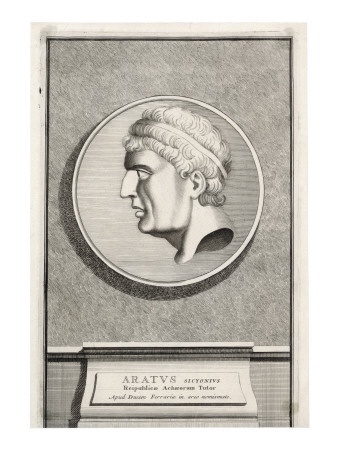
"1 There is an ancient proverb, Polycrates,1 which the philosopher Chrysippus puts not as it really is, but as he thought better:—
"Who will praise a father, except happy sons?"
But Dionysodorus of Troezen corrects him, and restores the true form thus:
"Who will praise a father, except unhappy sons?"
2 And he says that the proverb stops the mouths of those who, being worthless in themselves, take refuge in the virtues of certain ancestors and are forever praising them. But surely for a man in whom, to use Pindar's words, "the noble spirit naturally displayesº itself as inherited from sires," and who, like thee, patterns his life after the fairest examples in his family line, — for such men it will be good fortune to be reminded of their noblest progenitors, ever and anon hearing the story of them, or telling it themselves. 3 For it is not that they lack p5noble qualities of their own and make their reputation dependent on their praises of others, nay rather, they associate their own careers with the careers of their great ancestors, whom they hail both as founders of their line and as directors of their lives. And therefore, now that I have written the life of Aratus, who was thy countryman and forefather, and to whom thou thyself art no discredit in either reputation or influence, I send it to thee, not as though thou hadst not been at pains from the beginning to have the most precise knowledge of thy great ancestor's career, 4 but in order that thy sons Polycrates and Pythocles may be reared, now by hearing and now by reading, after examples found in their own family line — examples which it well becomes them to imitate. For it is the lover of himself, and not the lover of goodness, who thinks himself always superior to others."
a most glorious feature...

"13 Titus now began a most honourable and righteous war, the war against Nabis, the most pernicious and lawless tyrant of Sparta, but in the end he disappointed the hopes of Greece. For though it was in his power to capture the tyrant, he refused to do so, and made peace with him, thus leaving Sparta to the fate of an unworthy servitude. He was led to this step either by his fear that a protraction of the war would bring another general from Rome p361to succeed him and rob him of his glory, or by his jealous displeasure at the honours paid to Philopoemen. 2 For in all other matters Philopoemen was a most capable man among the Greeks, and in that war particularly he displayed astonishing deeds of ability and daring, so that he was extolled by the Achaeans as much as Titus, and equally honoured in their theatres. This annoyed Titus, who thought it out of keeping that a man of Arcadia, who had held command in small border wars, should receive just as much admiration from the Achaeans as a Roman consul, who was waging war in behalf of Greece.14 3 However, Titus himself had this to say in defence of his course, namely, that he put an end to the war when he saw that the destruction of the tyrant would involve the rest of the Spartans also in serious disaster.15
The Achaeans voted Titus many honours, none of which seemed commensurate with his benefactions except one gift, and this caused him as much satisfaction as all the rest put together. 4 And this was the gift: The Romans who were unhappily taken prisoners in the war with Hannibal had been sold about hither and thither, and were serving as slaves. In Greece there were as many as twelve hundred of them. The change in their lot made them pitiful objects always, but then even more than ever, naturally, when they fell in with sons, or brothers, or familiar friends, as the case might be, slaves with freemen and captives with victors. 5 These men Titus would not take away from their owners, although he was distressed at their condition, but the Achaeans p363ransomed them all at five minas16 the man, collected them together, and made a present of them to Titus just as he was about to embark, so that he sailed for home with a glad heart; his noble deeds had brought him a noble recompense, and one befitting a great man who loved his fellow citizens. 6 This appears to have furnished his triumph with its most glorious feature. For these men shaved their heads and wore felt caps, as it is customary for slaves to do when they are set free, and in this habit followed the triumphal car of Titus."
honor from the good...
from the life of Philopoemen (after his death)
"He was buried, then, as was fitting, with conspicuous honours, and at his tomb the captive Messenians were stoned to death. Many statues of him were erected and many honours decreed him by the cities. All these a Roman, in the disastrous days of Greece following the fall of Corinth,32 attempted to have removed, and he attacked the memory of Philopoemen himself, accusing him, as if still alive, of having been a malevolent enemy of the Romans. 6 After the proposal had been discussed and Polybius had spoken in opposition to Philopoemen's detractor, neither Mummius nor the members of the commission33 would consent that the honours paid to an illustrious man should be obliterated, although he had made no little opposition to Flamininus and Manius. These judges distinguished, as it would appear, between virtue and necessity, between honour and advantage. They rightly and fitly considered that benefactors ought always to receive reward and gratitude from their beneficiaries, and good men honour from the good."
"He was buried, then, as was fitting, with conspicuous honours, and at his tomb the captive Messenians were stoned to death. Many statues of him were erected and many honours decreed him by the cities. All these a Roman, in the disastrous days of Greece following the fall of Corinth,32 attempted to have removed, and he attacked the memory of Philopoemen himself, accusing him, as if still alive, of having been a malevolent enemy of the Romans. 6 After the proposal had been discussed and Polybius had spoken in opposition to Philopoemen's detractor, neither Mummius nor the members of the commission33 would consent that the honours paid to an illustrious man should be obliterated, although he had made no little opposition to Flamininus and Manius. These judges distinguished, as it would appear, between virtue and necessity, between honour and advantage. They rightly and fitly considered that benefactors ought always to receive reward and gratitude from their beneficiaries, and good men honour from the good."
splendid spirit...

"2 After this Flamininus made peace with Nabis,20 and Nabis was treacherously put to death by the Aetolians.21 Sparta was therefore in a state of confusion, and Philopoemen, seizing his opportunity, fell upon the city with an armed force, and partly by compulsion, partly by persuasion, brought it over to his purposes and made it a member of the Achaean league. 3 This achievement brought him an amazing repute among the Achaeans, since through his efforts they had acquired a city of so great dignity and power (and indeed it was no slight matter that Sparta had become a member of the Achaean league); moreover, Philopoemen carried with him the principal men among the Spartans, who hoped to have in him a guardian of their liberties. 4 Therefore, after they had confiscated the house and property of Nabis and obtained thereby a p299hundred and twenty talents, they voted to make a present of the money to Philopoemen, and to send an embassy to Megalopolis on the matter. Here, indeed, it became perfectly clear that Philopoemen not only seemed to be, but actually was, a most excellent man.22 For, to begin with, no Spartan was willing to confer with a man of his character about the acceptance of a gift, but they were all so reluctant and afraid to do it that they entrusted the business to a guest-friend of his, Timolaüs. 5 And in the second place, Timolaüs himself, when he came to Megalopolis, having been entertained at the house of Philopoemen, and having learned thoroughly how dignified he was in his converse with others, how simple his ways of living, and how his character was nowhere to be approached and much less easy to be overcome by bribes, held his peace about the gift of money, and after giving some other excuse for his visit to him, went back home. And when he was sent a second time on the same errand, he did as before. 6 On his third visit, however, he at last got so far as to acquaint Philopoemen with the earnest desire of his city. Then Philopoemen, who was pleased by what he heard, went in person to Sparta, and counselled the people there not to try to bribe good men who were their friends, and by whose virtues they could profit without payment of money, but rather to buy up and corrupt the bad men who were ruining the city by their factious conduct in the assembly, to the end that such might have their mouths stopped in consequence of their venality, and so be less annoying to their fellow-citizens; for it was better, he said, to take away freedom of speech from their enemies rather than p301from their friends. Such was his splendid spirit in matters of money."
deeds of prowess...
from the Life of Philopoemen...
"a great mistake the enemy had made by going off in pursuit, thus breaking away from his phalanx and leaving a vacant space there, did not oppose or resist their chase after the fugitives, 4 but let them pass him by and make a great gap. Then he led straight against the Lacedaemonian heavy-armed, seeing that their phalanx had been left exposed, and fell upon them in a flank attack, while their commander was away and they were not expecting to fight; for they thought they were victorious and getting the upper hand altogether, since they saw Machanidas pursuing. 5 After Philopoemen had routed these with great slaughter (more than four thousand of them are said to have fallen), he set out against Machanidas, who was returning with his mercenaries from the pursuit. But a broad and deep ditch stretched between them, along which the two leaders rode opposite each other, one wishing to get across and escape, the other to prevent this. 6 The spectacle was not that of two commanders fighting, but that of a powerful hunter attacking a wild beast that has been forced to turn at bay, and Philopoemen was the hunter. And now the tyrant's horse, which was vigorous and high-spirited and felt the bloody spurs in his sides, essayed to make the leap across, and striking against edge of the ditch with his breast, was struggling with his fore-feet to extricate himself. 7 At this point Simmias and Polyaenus, who were always at Philopoemen's side when he was fighting and protected him with their shields, rode up both at the same time and levelled their spears at the horse. But Philopoemen was before them in attacking Machanidas, and seeing that the tyrant's horse was lifting its head up in front of its rider's body, he p285gave his own horse a little swerve to one side, and then, clasping his spear firmly in the middle, pushed it home with all his weight and overturned his enemy. 8 This is the attitude in which he is represented by a bronze statue set up at Delphi by the Achaeans, who admired especially both his deed of prowess and his generalship on that day."
"a great mistake the enemy had made by going off in pursuit, thus breaking away from his phalanx and leaving a vacant space there, did not oppose or resist their chase after the fugitives, 4 but let them pass him by and make a great gap. Then he led straight against the Lacedaemonian heavy-armed, seeing that their phalanx had been left exposed, and fell upon them in a flank attack, while their commander was away and they were not expecting to fight; for they thought they were victorious and getting the upper hand altogether, since they saw Machanidas pursuing. 5 After Philopoemen had routed these with great slaughter (more than four thousand of them are said to have fallen), he set out against Machanidas, who was returning with his mercenaries from the pursuit. But a broad and deep ditch stretched between them, along which the two leaders rode opposite each other, one wishing to get across and escape, the other to prevent this. 6 The spectacle was not that of two commanders fighting, but that of a powerful hunter attacking a wild beast that has been forced to turn at bay, and Philopoemen was the hunter. And now the tyrant's horse, which was vigorous and high-spirited and felt the bloody spurs in his sides, essayed to make the leap across, and striking against edge of the ditch with his breast, was struggling with his fore-feet to extricate himself. 7 At this point Simmias and Polyaenus, who were always at Philopoemen's side when he was fighting and protected him with their shields, rode up both at the same time and levelled their spears at the horse. But Philopoemen was before them in attacking Machanidas, and seeing that the tyrant's horse was lifting its head up in front of its rider's body, he p285gave his own horse a little swerve to one side, and then, clasping his spear firmly in the middle, pushed it home with all his weight and overturned his enemy. 8 This is the attitude in which he is represented by a bronze statue set up at Delphi by the Achaeans, who admired especially both his deed of prowess and his generalship on that day."
roused the spirit of ambition...
from the life of Philopomoen...
"7 This naturally brought Philopoemen into high repute. Antigonus was eager that he should take service under him, and offered him command and pay. These Philopoemen declined, chiefly because he well knew that it was naturally unpleasant and hard for him to be under another man's orders. Not wishing, however, to be inactive and idle, for the sake of training and practice in war he sailed to Crete in search of military service. 2 In Crete he practised p273himself for a long time among men who were not only warlike and versed in many kinds of warfare, but also still moderate and restrained in their ways of living, and he came back to the Achaeans with such distinction that they at once made him commander of their cavalry.8 3 But he found that the horsemen whom he was to command used worthless animals acquired at random, whenever a campaign was to be undertaken; that they shirked most campaigns themselves, and sent others out in their places; that they were all characterized by a shocking lack of experience, together with its resultant cowardice; and that their commanders always overlooked these things because the knights had the greatest power and influence among the Achaeans and the chief voice in the assignment of rewards and punishments. 4 Philopoemen, however, did not yield or give way to them. He went round to the different cities and roused the spirit of ambition in each young man individually, punished those who needed compulsion, introduced drills, parades, and competitive contests in places where there would be large bodies of spectators and thus in a short time inspired them all with an astonishing vigour and zeal, 5 and, what is of the greatest importance in tactics, rendered them agile and swift in wheeling and deploying by squadrons, and in wheeling and turning by single trooper, making the dexterity shown by the whole mass in its evolutions to be like that of a single person moved by an impulse from within."
"7 This naturally brought Philopoemen into high repute. Antigonus was eager that he should take service under him, and offered him command and pay. These Philopoemen declined, chiefly because he well knew that it was naturally unpleasant and hard for him to be under another man's orders. Not wishing, however, to be inactive and idle, for the sake of training and practice in war he sailed to Crete in search of military service. 2 In Crete he practised p273himself for a long time among men who were not only warlike and versed in many kinds of warfare, but also still moderate and restrained in their ways of living, and he came back to the Achaeans with such distinction that they at once made him commander of their cavalry.8 3 But he found that the horsemen whom he was to command used worthless animals acquired at random, whenever a campaign was to be undertaken; that they shirked most campaigns themselves, and sent others out in their places; that they were all characterized by a shocking lack of experience, together with its resultant cowardice; and that their commanders always overlooked these things because the knights had the greatest power and influence among the Achaeans and the chief voice in the assignment of rewards and punishments. 4 Philopoemen, however, did not yield or give way to them. He went round to the different cities and roused the spirit of ambition in each young man individually, punished those who needed compulsion, introduced drills, parades, and competitive contests in places where there would be large bodies of spectators and thus in a short time inspired them all with an astonishing vigour and zeal, 5 and, what is of the greatest importance in tactics, rendered them agile and swift in wheeling and deploying by squadrons, and in wheeling and turning by single trooper, making the dexterity shown by the whole mass in its evolutions to be like that of a single person moved by an impulse from within."
a great commander...

"3 These orders were carried out, and the light-armed troops were driving the Illyrians before them in confusion, when Philopoemen perceived that it would be no great task to attack the light-armed troops, and that the occasion prompted this step. At first he pointed this out to the king's officers. Then, when they were not to be persuaded by him, but looked down upon him as a madman (since his reputation was not yet great enough to justify his being entrusted with so important a manoeuvre), he took matters into his own hands, formed his fellow-citizens into a wedge, and charged upon the enemy. 4 At first the light-armed troops were thrown into confusion, then put to rout with great slaughter. And now Philopoemen, wishing to encourage still further the king's troops and bring them swiftly upon the enemy thus thrown into disorder, quitted his horse, and with grievous difficulty forced his way along on foot, in his horseman's breastplate and heavy equipment, towards ground that was irregular and full of water-courses and ravines. Here he had both his thighs pierced p271through by a thonged javelin. The wound was not fatal, though severe, and the head of the weapon came out on the other side. 5 At first, then, he was held fast as by a fetter, and was altogether helpless; for the fastening of the thong made it difficult to draw the weapon back through the wound. But since those about him hesitated to attempt this, and since, now that the battle was at its hottest, the ardour of his ambition made him impatient to join in the struggle, by moving his legs backward and forward he broke the shaft of the weapon in two in the middle, and then ordered each fragment to be drawn out separately. 6 Thus set free, he drew his sword and made his way through the front ranks against the enemy, thereby greatly animating the combatants and inspiring them with a desire to emulate his valour. After his victory, therefore, Antigonus put the Macedonians to the question, and asked them why, without his orders, they had brought the cavalry into action. 7 They defended themselves by saying that they had been forced against their will to attack the enemy, because a young man of Megalopolis had first led a charge against them. At this, Antigonus gave a laugh and said: "Well, then, that young man behaved like a great commander."
virtue and war...

"As for what he got from his campaigning, he used to spend it on horses, or armour, or the ransoming of captives; but his own property he sought to increase by agriculture, which is the justest way to make money. Nor did he practise agriculture merely as a side issue, but he held that the man who purposed to p265keep his hands from the property of others ought by all means to have property of his own. He also listened to the discourses and applied himself to the writings of philosophers — not all of them, but those whom he thought helpful to him in his progress towards virtue. 4 And as for the poems of Homer, whatever in them was thought by him to rouse and stimulate the activities of the soul which made for valour, to this he would apply himself. Among other writings, however, he was most of all devoted to the "Tactics" of Evangelus, and was familiar with the histories of Alexander, thinking that literature was conducive to action, unless it were prosecuted merely to while away the time and afford themes for fruitless small talk. 5 Indeed, he would ignore the charts and diagrams for the illustration of tactical principles, and get his proofs and make his studies on the ground itself. The ways in which places slope to meet one another, and level plains come to an abrupt end, and all the vicissitudes and shapes of a phalanx when it is elongated and contracted again in the vicinity of ravines or ditches or narrow defiles, these he would investigate by himself as he wandered about, and discuss them with his companions. 6 For it would seem that he brought more zeal than was necessary to the study of military science, setting his affections on war as affording a most manifold basis for the practice of virtue, and despising as unsuccessful men those who left it to others."
a penalty for my ill looks...

"1 Cleander was a man of the highest lineage and greatest influence among the citizens of Mantineia, but he met with reverses and was exiled from his native city. He then betook himself to Megalopolis, chiefly because of Craugis, the father of Philopoemen, a man in every way illustrious, and attached to him by ties of personal friendship. 2 As long as Craugis lived, Cleander's wants were all supplied, and when Craugis died, Cleander, wishing to requite him for his hospitality, undertook the rearing of his orphan son, just as Homer says that Achilles was reared by Phoenix,1 so that the boy's character took on from the very outset a noble and kingly mould and growth. But as soon as Philopoemen had ceased to be a boy, Ecdemus and Megalophanes, of Megalopolis, were put in charge of him.2 They had been comrades of Arcesilaüs at the Academy, and beyond all men of their day had brought philosophy to bear upon political action and affairs of state.a 3 They freed their own native city from tyranny, by secretly procuring men to kill Aristodemus; they joined with Aratus in expelling Nicocles the tyrant of Sicyon;3 and at the request of the people of Cyrene, whose city was full p259of confusion and political distemper, they sallied thither, introduced law and order, and arranged matters in the city most happily. 4 They themselves, however, counted the education of Philopoemen also among their many achievements, believing that their philosophical teachings had made him a common benefit to Greece. For since he was the child, as it were, of her late old age and succeeded to the virtues of her ancient commanders, Greece loved him surpassingly, and as his reputation grew, increased his power. And a certain Roman, in praising him, called him the last of the Greeks,4 implying that Greece produced no great man after him, nor one worthy of her.
2 In looks he was not, as some suppose, ill-favoured; for a statue of him is still to be seen at Delphi; and the mistake of his Megarian hostess was due, as we are told, to a certain indifference and simplicity on his part. This woman, learning that the general of the Achaeans was coming to her house, in great confusion set about preparing supper; besides, her husband chanced to be away from home. 2 Just then Philopoemen came in, wearing a simple soldier's cloak, and the woman, thinking him to be one of his servants who had been sent on in advance, invited him to help her in her housework. So Philopoemen at once threw off his cloak and fell to splitting wood. Then his host came in, and seeing him thus employed, said: "What does this mean, Philopoemen?" "What else," said Philopoemen in broad Doric, "than that I am paying a penalty for my ill looks?" 3 And once Titus Flamininus, making fun of certain parts of his figure, said: "Philopoemen, what fine arms and legs thou hast; but belly thou hast not"; for Philopoemen was quite slender at the waist. This piece of fun, however, was aimed the rather at his resources. For though he had excellent men-at‑arms and horsemen, he was often at a loss for money. However, these stories are told of Philopoemen in the schools of philosophy."
the practice of virtue...

"Now that I have brought this story of the Gracchi also to an end, it remains for me to take a survey of all four lives in parallel. As for the Gracchi, then, not even those who utterly revile and hate them on other grounds have ventured to deny that of all Romans they were best equipped by nature for the practice of virtue, and enjoyed a rearing and training which were preëminent; 2 but Agis and Cleomenes would appear to have had even sturdier natural gifts than theirs, in so far as, though they did not receive a correct training, and were reared in those customs and ways of living by which their elders had long ago been corrupted, they nevertheless made themselves leaders in simplicity and self-restraint. 3 And further, the Gracchi, at a time when Rome had her greatest and most splendid repute and an ardour for noble deeds, were prevented by a sense of shame from abandoning what was like an inheritance of virtue from ancestors near and remote; Agis and Cleomenes, on the other hand, though they were sons of fathers who had adopted opposite principles to theirs, and found their country in a wretched plight and full of distempers, did not suffer these things to blunt the edge of their zeal for what was noble. 4 Moreover, the chief proof that the Gracchi scorned wealth and were superior to money lies in the fact that they kept themselves clear from unrighteous gains during their official and political life; whereas Agis would have been incensed to receive praise for not taking anything that was another's, since he freely gave to his fellow citizens his own property, which amounted to six hundred talents in ready money alone, to say nothing of other valuables. How great a baseness, then, would unlawful gain have been held to be by one in whose eyes even the lawful possession of more than another was rapacity?"
fortune and virtue...

"An further, Cornelia is said to have borne all her misfortunes in a noble and magnanimous spirit, and to have said of the sacred places where her sons had been slain that they were tombs worthy of the dead which occupied them. She resided on the promontory called Misenum, and made no change in her customary way of living. 2 She had many friends, and kept a good table that she might show hospitality, for she always had Greeks and other literary men about her, and all the reigning kings interchanged gifts with her. She was indeed very agreeable to her visitors and associates when she discoursed to them about the life and habits of her father Africanus, but most admirable when she spoke of her sons without grief or tears, and narrated their achievements and their fate to all enquirers as if she were speaking of men of the early days of Rome. 3 Some were therefore led to think that old age or the greatness of her sorrows had impaired her mind and made her insensible to her misfortunes, whereas, really, such persons themselves were insensible how much help in the banishment of grief mankind derives from a noble nature and from honourable birth and rearing, as well as of the fact that while fortune often prevails over virtue when it endeavours to ward off evils, she cannot rob virtue of the power to endure those evils with calm assurance."
a work of mad discord...
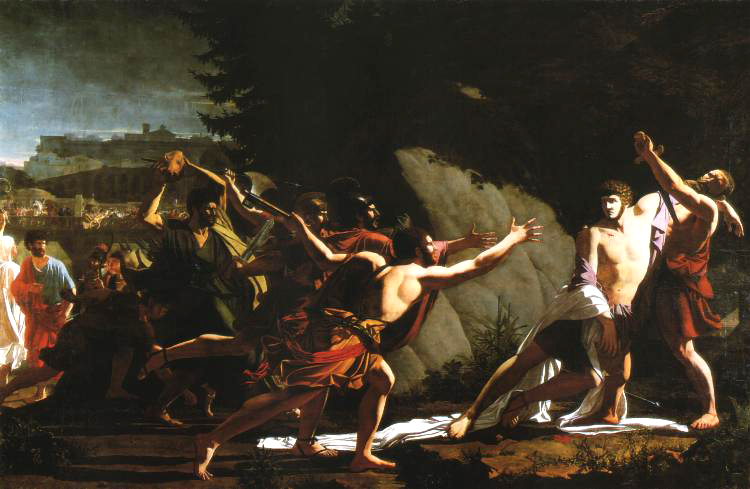
"17 So then, as Caius fled, his foes pressed hard upon him and were overtaking him at the wooden bridge over the Tiber, but his two friends bade him go on, while they themselves withstood his pursuers, and, fighting there at the head of the bridge, would suffer no man to pass, until they were killed. 2 Caius had with him in his flight a single servant, by name p237Philocrates; and though all the spectators, as at a race, urged Caius on to greater speed, not a man came to his aid, or even consented to furnish him with a horse when he asked for one, for his pursuers were pressing close upon him. He barely succeeded in escaping into a sacred grove of the Furies, and there fell by the hand of Philocrates, who then slew himself upon his master. 3 According to some writers, however, both were taken alive by the enemy, and because the servant had thrown his arms about his master, no one was able to strike the master until the slave had first been dispatched by the blows of many. Someone cut off the head of Caius, we are told, and was carrying it along, but was robbed of it by a certain friend of Opimius, Septimuleius; for proclamation had been made at the beginning of the battle that an equal weight of gold would be paid the men who brought the head of Caius or Fulvius. 4 So Septimuleius stuck the head of Caius on a spear and brought it to Opimius, and when it was placed in a balance it weighed seventeen pounds and two thirds, since it Septimuleius, besides showing himself to be a scoundrel, had also perpetrated a fraud; for he had taken out the brain and poured melted lead in its place. But those who brought the head of Fulvius were of the obscurer sort, and therefore got nothing. 5 The bodies of Caius and Fulvius and of the other slain were thrown into the Tiber, and they numbered three thousand; their property was sold and the proceeds paid into the public treasury. Moreover, their wives were forbidden to go into mourning, and Licinia, the wife of Caius, was also deprived of her marriage portion.a Most cruel of all, however, was the treatment of the younger son of Fulvius, who had neither lifted a hand p239against the nobles nor been present at the fighting, but had come to effect a truce before the battle and had been arrested; after the battle he was slain. 6 However, what vexed the people more than this or anything else was the erection of a temple of Concord by Opimius;12 for it was felt that he was priding himself and exulting and in a manner celebrating a triumph in view of all this slaughter of citizens. Therefore at night, beneath the inscription on the temple, somebody carved this verse:— "A work of mad discord produces a temple of Concord."
Subscribe to:
Posts (Atom)