Showing posts with label greed. Show all posts

Thursday, September 29, 2011

punished by his fear...and a little more...

from the life of Otho...

"But nothing so gladdened all Romans alike, and won their allegiance to the new emperor so much, as his treatment of Tigellinus. Men were not aware that Tigellinus was already punished by his very fear of that punishment which the city was demanding as a debt due to the public, 2 and also by incurable bodily diseases; and besides, there were those unhallowed and unspeakable grovellings of his among the vilest harlots, for which his lustful nature still panted, clutching after them as his life painfully ebbed away; these were looked upon by reasonable men as extremest punishment and an equivalent of many deaths. Nevertheless it vexed the common people that he should see the light of day after so many good men had been robbed of that light by him. 3 Accordingly, Otho sent a messenger to fetch him from his country estate at Sinuessa; for he was staying there, where vessels lay at anchor, that he might fly to more distant parts. He tried to bribe the messenger with a large sum of money to let him go, but failing in this, he made him gifts nevertheless, and begged him to wait till he had shaved; and taking the razor he cut his own throat"

a slave of money

from the life of Galba...

"Now Vinius was to the last degree and beyond all compare a slave of money, and was also addicted to loose conduct with women. For when he was still a young man and was serving his first campaign, under Calvisius Sabinus, he brought his commander's wife, an unchaste woman, by night into the camp in the garb of a soldier, and had commerce with her in the general's quarters (the Romans call them "principia"). 2 For this offence Caius Caesar put him in prison; but on the death of the emperor he had the good fortune to be released. While he was at supper with Claudius Caesar, he purloined a drinking-cup, and Caesar, learning of it, invited him to supper again the next day, and when he came, ordered the attendants to set before him no silver plate at all, but only earthenware. 3 This misdeed, it is true, owing to the comic turn which Caesar's moderation took, was thought worthy of laughter, not of anger; but what he did when he had p231Galba under his control and was most influential with him in financial matters, was partly a cause and partly a pretext for tragic events and great calamities."

Thursday, September 15, 2011

splendid spirit...

from the Life of Philopoemen...

"2 After this Flamininus made peace with Nabis,20 and Nabis was treacherously put to death by the Aetolians.21 Sparta was therefore in a state of confusion, and Philopoemen, seizing his opportunity, fell upon the city with an armed force, and partly by compulsion, partly by persuasion, brought it over to his purposes and made it a member of the Achaean league. 3 This achievement brought him an amazing repute among the Achaeans, since through his efforts they had acquired a city of so great dignity and power (and indeed it was no slight matter that Sparta had become a member of the Achaean league); moreover, Philopoemen carried with him the principal men among the Spartans, who hoped to have in him a guardian of their liberties. 4 Therefore, after they had confiscated the house and property of Nabis and obtained thereby a p299hundred and twenty talents, they voted to make a present of the money to Philopoemen, and to send an embassy to Megalopolis on the matter. Here, indeed, it became perfectly clear that Philopoemen not only seemed to be, but actually was, a most excellent man.22 For, to begin with, no Spartan was willing to confer with a man of his character about the acceptance of a gift, but they were all so reluctant and afraid to do it that they entrusted the business to a guest-friend of his, Timolaüs. 5 And in the second place, Timolaüs himself, when he came to Megalopolis, having been entertained at the house of Philopoemen, and having learned thoroughly how dignified he was in his converse with others, how simple his ways of living, and how his character was nowhere to be approached and much less easy to be overcome by bribes, held his peace about the gift of money, and after giving some other excuse for his visit to him, went back home. And when he was sent a second time on the same errand, he did as before. 6 On his third visit, however, he at last got so far as to acquaint Philopoemen with the earnest desire of his city. Then Philopoemen, who was pleased by what he heard, went in person to Sparta, and counselled the people there not to try to bribe good men who were their friends, and by whose virtues they could profit without payment of money, but rather to buy up and corrupt the bad men who were ruining the city by their factious conduct in the assembly, to the end that such might have their mouths stopped in consequence of their venality, and so be less annoying to their fellow-citizens; for it was better, he said, to take away freedom of speech from their enemies rather than p301from their friends. Such was his splendid spirit in matters of money."

Sunday, September 4, 2011

the party of the rich...

from the Life of Tiberius Graachus...

"Tiberius ordered the crowd to part for Flavius, who made his way up to him with difficulty, and told him that at a session of the senate the party of the rich, since they could not prevail upon the consul to do so, were purposing to kill Tiberius themselves, and for this purpose had under arms a multitude of their friends and slaves.

19 Tiberius, accordingly, reported this to those who stood about him, and they at once girded up their togas, and breaking in pieces the spear-shafts with which the officers keep back the crowd, distributed the fragments among themselves, that they might defend themselves against their assailants. 2 Those who were farther off, however, wondered at what was going on and asked what it meant. Whereupon Tiberius put his hand to his head, making this visible sign that his life was in danger, since the questioners could not hear his voice. But his opponents, on seeing this, ran to the senate and told that body that Tiberius was asking for a crown; and that his putting his hand to his head was a sign having that meaning. 3 All the senators, of course, were greatly disturbed, and Nasica demanded that the consul should come to the rescue of the state and put down the tyrant. The consul replied with mildness that he would resort to no violence and would put no citizen to death without a trial; if, however, the people, under persuasion or compulsion from Tiberius, should vote anything that was unlawful, he would not regard this vote as binding. Thereupon Nasica sprang to his feet and said: "Since, then, the chief magistrate betrays the state, do ye p191who wish to succour the laws follow me." 4 With these words he covered his head with the skirt of his toga and set out for the Capitol. All the senators who followed him wrapped their togas about their left arms and pushed aside those who stood in their path, no man opposing them, in view of their dignity, but all taking to flight and trampling upon one another.

5 Now, the attendants of the senators carried clubs and staves which they had brought from home; but the senators themselves seized the fragments and legs of the benches that were shattered by the crowd in its flight, and went up against Tiberius, at the same time smiting those who were drawn up to protect him. Of these there was a rout and a slaughter, and as Tiberius himself turned to fly, someone laid hold of his garments. 6 So he let his toga go and fled in his tunic. But he stumbled and fell to the ground among some bodies that lay in front of him. As he strove to rise to his feet, he received his first blow, as everybody admits, from Publius Satyreius, one of his colleagues, who smote him on the head with the leg of a bench; to the second blow claim was made by Lucius Rufus, who plumed himself upon it as upon some noble deed. And of the rest more than three hundred were slain by blows from sticks and stones, but not one by the sword."

Sunday, August 28, 2011

the ancient discipline...

From the Life of Cleomenes...

"If, then, it had been possible without bloodshed to rid Sparta of her imported curses, namely luxury and extravagance, and debts and usury, and those elder evils than these, namely, poverty and wealth, he would have thought himself the most fortunate king in the world to have cured the disease of his country like a wise physician, without pain; but as it was, he said, in support of the necessity that had been laid upon him, he could cite Lycurgus, who, though he was neither king nor magistrate, but a private person attempting to act as king, proceeded with an armed retinue into the market-place, so that Charillus the king took fright and fled for refuge to an altar. 5 That king, however, Cleomenes said, since he was an excellent man and a lover of his country, speedily concurred in the measures of Lycurgus and accepted p73the change of constitution; still, as a matter of fact Lycurgus by his own acts bore witness to the difficulty of changing a constitution without violence and fear. To these, Cleomenes said, he had himself resorted with the greatest moderation, for he had but put out of the way the men who were opposed to the salvation of Sparta. 6 For all the rest, he said, the whole land should be common property, debtors should be set free from their debts, and foreigners should be examined and rated, in order that the strongest of them might be made Spartan citizens and help to preserve the state by their arms. "In this way," he said, "we shall cease to behold Sparta the booty of Aetolians and Illyrians through lack of men to defend her."

11 After this, to begin with, Cleomenes himself placed his property in the common stock, as did Megistonoüs his step-father and every one of his friends besides; next, all the rest of the citizens did the same, and the land was parcelled out. Cleomenes also assigned a portion of land to each man who had been exiled by him, and promised to bring them all home after matters had become quiet. 2 Then he filled up the body of citizens with the most promising of the free provincials, and thus raised a body of four thousand men-at‑arms, whom he taught to use a long pike, held in both hands, instead of a short spear, and to carry their shields by a strap instead of by a fixed handle. Next he devoted himself to the training of the young men and to the "agoge," or ancient discipline, most of the details of which Sphaerus, who was then in Sparta, helped him in arranging. And quickly was the proper system of bodily training and public messes resumed, a few out of necessity, but most with a willing spirit, subjecting themselves to the old Spartan regime with all its simplicity. 3 And yet, desiring to give the name of absolute power a less offensive sound, he associated with himself in royal power his brother Eucleidas. And this was the only time when the Spartans had two kings from the same house.

idleness and pleasure...

From the Life of Cleomenes...

" Of course, then, the condition of the city was not pleasing to him. The citizens had been lulled to sleep by idleness and pleasure; the king was willing to let all public business go, provided that no one thwarted his desire for luxurious living in the midst of his wealth; the public interests were neglected, while every man was eagerly intent upon his own private gain; and as for practice in arms, self-restraint of the young, hardiness, and equality, it was even dangerous to speak of these now that Agis was dead and gone.

2 It is said also that Cleomenes studied philosophy when he was still a stripling, after Sphaerus of Borysthenis had made a voyage to Sparta and busied himself sedulously there with the youth and young men. Sphaerus had become one of the leading disciples of Zeno of Citium, and it would appear that he admired the manly nature of Cleomenes and increased the fires of his high ambition. 3 For Leonidas of old, as we are told, when asked what manner of poet he thought Tyrtaeus to be, replied; "A good one to inflame the souls of young men." And indeed they were filled with divine inspiration by his poems, and in battle were prodigal of their lives. However, for great and impetuous natures the Stoic doctrines are somewhat misleading and dangerous, although when they permeate a deep and gentle character, they redound most to its proper good.

3 But at the death of Leonidas2 Cleomenes came to the throne, and saw that the citizens were by that time altogether degenerate. The rich neglected the common interests for their own private p55pleasure and aggrandizement; the common people, because of their wretched state at home, had lost all readiness for war and all ambition to maintain the ancient Spartan discipline; and he himself, Cleomenes, was king only in name, 2 while the whole power was in the hands of the ephors. He therefore at once determined to stir up and change the existing order of things, and as he had a friend, Xenares, who had been his lover (or inspirer, as the Spartans say), he would make trial of his sentiments by inquiring in detail what sort of a king Agis had been, and in what way and with what assistants he had entered upon the course of action so fatal to him. At first Xenares was quite glad to recall those matters, 806and rehearsed the events at length and in detail; 3 but when it was apparent that Cleomenes took an unusual interest in the story, and was profoundly stirred by the innovations of Agis, and wished to hear about him over and over again, Xenares rebuked him angrily, calling him unsound in mind, and finally stopped visiting and conversing with him. To no one, however, did he tell the reason of their variance, but merely said that Cleomenes understood it."

Saturday, August 27, 2011

avarice...

from the Life of Agis...

"Thus the enterprise of the kings was making good progress and no one tried to oppose or hinder them, when one man, Agesilaüs, upset and ruined everything. He allowed a most shameful disease of avarice to wreck a most noble and most truly Spartan plan. 2 For since he was an exceedingly large owner of valuable land, but owed huge sums of money, being unable to pay his debts and unwilling to give up his lands, he persuaded Agis that if both his projects should be carried through at the same time the resulting convulsion in the state would be great; but that if the men of property should first be won over by a remission of their debts, they would afterwards accept the distribution of land contentedly and quietly. 3 This was also the opinion of Lysander, who was deceived in like manner by Agesilaüs. So they caused mortgages (the Spartans call them "klaria," or allotment pledges) to be brought into the market-place, heaped them altogether, and set fire to them. As the flames rose, the men of wealth and the lenders of money went away with heavy hearts; but Agesilaüs, as if in mockery of them, declared that his eyes had never seen a brighter or purer flame than that.

4 And now the multitude demanded also that the land should at once be divided, and the kings gave orders that this should be done; but Agesilaüs would always interpose some obstacle or make some excuse, and so consumed time until it became the duty of Agis to head a military expedition, when the Achaeans, who were their allies, sent p33for aid from Sparta. For the Aetolians were expected to invade Peloponnesus by way of Megara; and Aratus, the general of the Achaeans, in an effort to prevent this, was assembling a force and wrote a letter to the ephors.

14 These at once sent out Agis, who was exalted in spirit by the ambition and ardour of the soldiers under him. For being young men for the most part and poor, and having now immunity from their debts and absolution, and expecting that they would receive allotments of land if they returned from the expedition, their devotion to Agis was astonishing. 2 And they were a spectacle to the cities as they marched through the Peloponnesus without doing any injury, without rudeness, and almost without noise, so that the other Greeks were amazed and asked themselves what must have been the discipline of a Spartan army under the command of the great Agesilaüs, or the famous Lysander, or Leonidas of old, since towards a stripling who was almost the youngest of the whole army so great reverence and fear were felt by his soldiers. 3 And indeed the young man himself, owing to his simplicity, his love of hardships, and the pride he took in clothing and arming himself with no more splendour than a common soldier, won the admiration and devotion of the multitudes; for to the rich, certainly, his innovating ways were not pleasing, owing to a fear that they might prove a disturbing force and set a bad example among the common people everywhere."

greed and ambition...

from the Life of Gaius Marius...

"But when the Italians had at last made their submission, and many persons at Rome were suing for the command in the Mithridatic war, with the aid of the popular leaders, contrary to all expectation the tribune Sulpicius, a most audacious man, brought Marius forward and proposed to make him pro-consul in command against Mithridates. The people were divided in opinion, some preferring Marius, and others called for Sulla and bidding Marius go to the warm baths at Baiae and look out for his health, since he was worn out with old age and rheums, as he himself said. 2 For at Baiae, near Cape Misenum, Marius owned an expensive house, which had appointments more luxurious and effeminate p557than became a man who had taken active part in so many wars and campaigns. This house, we are told, Cornelia bought for seventy-five thousand drachmas and not long afterwards Lucius Lucullus purchased it for two million five hundred thousand. So quickly did lavish expenditure spring up, and so great an increase in luxury did life in the city take on. 3 Marius, however, showing a spirit of keen emulation that might have characterized a youth, shook off old age and infirmity and went down daily into the Campus Martius, where he exercised himself with the young men and showed that he was still agile in arms and capable of feats of horsemanship, although his bulk was not well set up in his old age, but ran to corpulence and weight.

4 Some, then, were pleased to have him thus engaged, and would go down into the Campus and witness his emulation in competitive contests; but the better part were moved to pity at the sight of his greed and ambition, because, though he had risen from poverty to the greatest wealth and from obscurity to the highest place, he knew not how to set bounds to his good fortune, and was not content to be admired and enjoy quietly what he had, but as if in need of all things, and after winning triumphs and fame, 5 was setting out, with all his years upon him, for Cappadocia and the Euxine sea, to fight it out with Archelaüs and Neoptolemus, the satraps of Mithridates. And the justification for this which Marius offered was thought to be altogether silly; he said, namely, that he wished to take part personally in the campaign in order to give his son a military training."

Tuesday, July 26, 2011

the man who holds the cup...

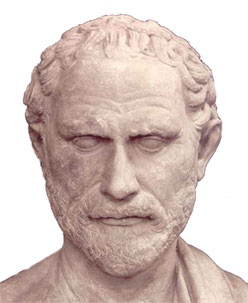
from the life of Demothenes...a hard worker but not immune to bribery...

" Not long afterwards Harpalus came out of Asia to Athens. He had run away from Alexander, because he was conscious that his prodigality had led him into criminal practices, and because he was afraid of his master, who was now become harsh to his friends. But after he had taken refuge with the Athenian people and put himself in their hands with his ships and his treasures, the other orators at once fixed their longing eyes upon his wealth, came to his aid, and tried to persuade the Athenians to receive and save the suppliant. But Demosthenes, in the beginning, counselled them to drive Harpalus away, and to beware lest they plunge the city into war upon an unnecessary and unjust ground; a few days afterwards, however, while they were making an inventory of the treasure, Harpalus saw that Demosthenes was eyeing with pleasure a cup of barbarian make, with a keen appreciation of its fashion and of the ornamental work upon it. He therefore bade him poise it in his hand and see how heavy the gold was. And when Demosthenes was amazed at its weight and asked how much it would amount to, Harpalus smiled and said, "For you it will amount to twenty talents;" and as soon as night was come he sent him the cup with the twenty talents. Now, Harpalus was skilful in detecting the character of a man who had a passion for gold, by means of the look that spread over his face and the glances of his eyes. For Demosthenes could not resist, but was overcome by the p63bribe, and now that he had, as it were, admitted a garrison into his house, promptly went over to the side of Harpalus. Next day, after swathing his neck carefully in woollen bandages, he went forth into the assembly; and when he was urged to rise and speak, he made signs that his voice was ruined. The wits, however, by way of raillery, declared that the orator had been seized overnight, not with an ordinary quinsy, but with a silver quinsy. And afterwards, when the whole people learned that he had been bribed, and would not permit him, when he wished it, to have a hearing and make his defence, but were angry and raised a tumult against him, someone rose and said jokingly: "Men of Athens, will you not listen to the man who holds the cup?"
from the "Comparison of Timoleon and Aemilius...

"It is, however, worthy of admiration in Aemilius that, although he had subdued so great a kingdom, he did not add one drachma to his substance, nor would he touch or even look upon the conquered treasure; and yet he made many liberal gifts to others."

Monday, July 18, 2011

left behind...

From life of Pompey (see Mithridates Mule for similar event)
" But Pompey, who was on horseback, was attacked by a tall man who fought on foot; when they came to close quarters and were at grips, the strokes fell upon each other's hands, but not with like result, for Pompey was merely wounded, whereas he lopped off the hand of his opponent. Then, when more foes rushed upon him together, his troops being now routed, he made his escape, contrary to all expectation, by abandoning to the enemy his horse, which had golden head-gear and ornamented trappings of great value. They fought with one another over the division of these spoils, and so were left behind in the pursuit."