Showing posts with label misc. Show all posts

Saturday, August 27, 2011

Gaius on the run...

From the Life of Gaius Marius (Gaius on the run)

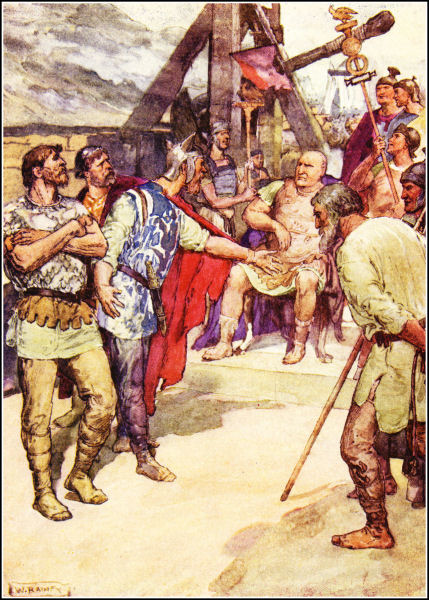
"The Roman governor of Africa at this time was Sextilius, a man who had received neither good nor ill at the hands of Marius, but whom, as it was expected, pity alone would move to give him aid. Hardly, however, had Marius landed with a few companions, p577when an official met him, stood directly in front of him, and said: "Sextilius the governor forbids thee, Marius, to set foot in Africa; and if thou disobeyest, he declares that he will uphold the decrees of the senate and treat thee as an enemy of Rome." 4 When he heard this, Marius was rendered speechless by grief and indignation, and for a long time kept quiet, looking sternly at the official. Then, when asked by him what he had to say, and what answer he would make to the governor, he answered with a deep groan: "Tell him, then, that thou hast seen Caius Marius a fugitive, seated amid the ruins of Carthage." And it was not inaptly that he compared the fate of that city with his own reversal of fortune.

"Meanwhile Iampsas the king of Numidia, hesitating which course to take, did indeed treat the younger Marius and his party with respect, but always had some excuse for detaining them when they wished to go away, and clearly had no good end in view in thus postponing their departure. However, something occurred which, though not at all extraordinary, led to their escape. The younger Marius, that is, being a handsome fellow, one of the concubines of the king was pained to see him treated unworthily, and this feeling of compassion ripened into love. 6 At first, then, Marius repelled the woman's advances; but when he saw that there was no other way of escape for him and his friends, and that her behaviour was based on a genuine affection, he accepted her favours, whereupon she helped him in getting off,º and he ran away with his friends and made his escape to his father. After father and son had embraced one another, they walked along the sea-shore, and there they saw some scorpions fighting, which the elder p579Marius regarded as a bad omen. 7 At once, therefore, they boarded a fishing-boat and crossed over to the island of Cercina, which was not far distant from the mainland;f and scarcely had they put out from land when horsemen sent by the king were seen riding towards the spot whence they had sailed. It would seem that Marius never escaped a greater peril than this."

dust...

from the LIfe of Gaius Marius...

"After the attack had begun, however, an experience befell Marius which signified the divine displeasure, according to Sulla. For an immense cloud of dust was raised, as was to be expected, and the two armies were hidden from one another by it, so that Marius, when he first led his forces to the attack, missed the enemy, passed by their lines of battle, and moved aimlessly up and down the plain for some time. Meanwhile, as chance would have it, the Barbarians engaged fiercely with Catulus, and he and his soldiers, among whom Sulla says he himself was posted, bore the brunt of the struggle. 4 The Romans were favoured in the struggle, Sulla says, by the heat, and by the sun, which shone in the faces of the Cimbri. For the Barbarians were well able to endure cold, and had been brought up in shady and chilly regions, as I have said.25 They were therefore undone by the heat; they sweated profusely, breathed with difficulty, and were forced to hold their shields before their faces. For the battle was fought after the summer solstice, which falls, by Roman reckoning, three days before the new moon of the month now called August,26 but then Sextilis. 5 Moreover, the dust, by hiding the enemy, helped to encourage the Romans. For they could not see from afar the great numbers of the foe, but each one of them fell at a run upon the man just over against him, and fought him hand to hand, without having been terrified by the sight of the rest of the host. And their bodies were so inured to toil and so thoroughly trained that not a Roman was observed to sweat or pant, in spite of the great heat and the run with which they p537came to the encounter. This is what Catulus is said to have written27 in extolling his soldiers."

Marian Mule...

From the Life of Gaius Marius...

"Setting out on the expedition, he laboured to perfect his army as it went along, practising the men in all kinds of running and in long marches, and compelling them to carry their own baggage and to prepare their own food. Hence, in after times, men who were fond of toil and did whatever was enjoined upon them contentedly and without a murmur, were called Marian mules. Some, however, think that this name had a different origin. 2 Namely, when Scipio was besieging Numantia,14 he wished to inspect p497not only the arms and the horses, but also the mules and the waggons, that every man might have them in readiness and good order. Marius, accordingly, brought out for inspection both a horse that had been most excellently taken care of by him, and a mule that for health, docility, and strength far surpassed all the rest. The commanding officer was naturally well pleased with the beasts of Marius and often spoke about them, so that in time those who wanted to bestow facetious praise on a persevering, patient, laborious man would call him a Marian mule."

Thursday, August 25, 2011

Timon...

From the Life of Anthody (on Timon)


" Now, Timon was an Athenian, and lived about the time of the Peloponnesian War, as may be gathered from the plays of Aristophanes and Plato. For he is represented in their comedies as peevish and misanthropical; but though he avoided and repelled all intercourse with men, he was glad to see Alcibiades, who was then young and headstrong, and showered kisses upon him. And when Apemantus was amazed at this and asked the reason for it, Timon said he loved the youth because he knew that he would be a cause of many ills to Athens. 2 This Apemantus alone of all men Timon would sometimes admit into his company, since Apemantus was like him and tried sometimes to imitate his mode of life; and once, at the festival of The Pitchers,55 the two were feasting by themselves, and Apemantus said: "Timon, what a fine symposium ours is!" "It would be," said Timon, "if thou wert not here." We are told also that once when the Athenians were holding an assembly, he ascended the bema, and the strangeness of the thing caused deep silence and great expectancy; then he said: 3 "I have a small building lot, men of Athens, and a fig-tree is growing in it, from which many of my fellow citizens have already hanged themselves. Accordingly, as I intend to build a house there, I wanted to give public notice to that effect, in order that all of you who desire to do so may hang yourselves before the fig-tree is cut down." After he had died and been buried at Halae near the sea, the shore in front of the tomb slipped away, and the water surrounded it and made it completely inaccessible to man. 4 The inscription on the tomb was:

"Here, after snapping the thread of a wretched life, I lie.
Ye shall not learn my name, but my curses shall follow you."
This inscription he is said to have composed p301himself, but that in general circulation is by Callimachus:

"Timon, hater of men, dwells here; so pass along;
Heap many curses on me, if thou wilt, only pass along."

prosper and victor...

from the Life of Antony (during the war in Egypt)

" During that day, then, and the three following days the sea was tossed up by a strong wind and prevented the battle; but on the fifth,51 the weather becoming fine and the sea calm, they came to an engagement. Antony had the right wing, with Publicola, Coelius the left, and in the centre were Marcus Octavius and Marcus Insteius. 2 Caesar posted Agrippa on the left, and reserved the right wing for himself. Of the land forces, that of Antony was commanded by Canidius, that of Caesar by Taurus, who drew them up along the sea and remained quiet. As for the leaders themselves, Antony visited all his ships in a row-boat, exhorting the soldiers, owing to the weight of their ships, to fight without changing their position, as if they were on land; 3 he also ordered the masters of the ships to receive the attacks of the enemy as if their ships were lying quietly at anchor, and to maintain their position at the mouth of the gulf, which was narrow and difficult. Caesar, we are told, who had left his tent while it was still dark and was going round to visit his ships, was met by a man driving an ass. Caesar asked the man his name, and he, recognizing Caesar, replied: "My name is Prosper, and my ass's name is Victor." Therefore, when Caesar afterwards decided the place with the beaks of ships, he set up bronze figures of an ass and a man"

wine the only remedy...

from the Life of Antony (during war with the Parthians)

"4 Famine also attacked the army, which could provide itself with little grain even by fighting, and was not well furnished with implements for grinding. These had been abandoned, for the most part, since some of the beasts of burden died, and the others p243had to carry the sick and wounded. It is said that one Atticº choenix42 of wheat brought fifty drachmas; and loaves of barley bread were sold for their weight in silver. 5 Resorting, therefore, to vegetables and roots, they could find few to which they were accustomed, and were compelled to make trial of some never tasted before. Thus it was that they partook of an herb which produced madness, and then death. He who ate of it had no memory, and no thought of anything else than the one task of moving or turning every stone, as if he were accomplishing something of great importance. 6 The plain was full of men stooping to the ground and digging around the stones or removing them; and finally they would vomit bile and die, since the only remedy, wine, was not to be had. Many perished thus, and the Parthians would not desist, and Antony, as we are told, would often cry: "O the Ten Thousand!" thereby expressing his admiration of Xenophon's army, which made an even longer march to the sea from Babylon, and fought with many times as many enemies, and yet came off safe."

Thursday, August 11, 2011

How to stay fit during a siege...

from the Life of Eumenes (how to stay fit during a siege)

"But most of all detrimental to his forces thus besieged was their narrow quarters, since their movements were confined to small houses and a place only •two furlongs in circumference, so that neither men nor horses could get exercise before eating or being fed. Therefore, wishing to remove the weakness and languor with which their inactivity afflicted them, and, more than that, to have them somehow or other in training for flight, if opportunity should offer, he assigned the men a house, the largest in the place, fourteen cubits long,a as a place to walk, ordering them little by little to increase their pace. And as for the horses, he had them all girt round the neck with great straps fastened to the roof, and raised them partly up into the air by means of pulleys, so, while with their hind legs they rested firmly upon the ground, they just touched it with the tips of their fore hoofs. Then, while they were thus suspended, the grooms would stand at their sides and stir them up with shouts and strokes of the goad; and the horses, full of rage and fury, would dance and leap about on their hind legs, while with their swinging fore feet they would strike the ground and try to get a footing there, thus exerting their whole bodies and covering themselves with sweat and foam, — no bad exercise either for speed or strength. Then their barley would be thrown to them boiled, that they might the sooner dispatch and the better digest it."

one-eyed men...

from the Life of Sertorius...

"It is perhaps not to be wondered at, since fortune is ever changing her course and time is infinite, that the same incidents should occur many times, spontaneously. For, if the multitude of elements is unlimited, fortune has in the abundance of her material an ample provider of coincidences; and if, on the other hand, there is a limited number of elements from which events are interwoven, the same things must happen many times, being brought to pass by the same agencies. Now, there are some who delight to collect, from reading and hearsay, such accidental happenings as look like works of calculation and forethought. They note, for example, that there were two celebrated persons called Attis, one a Syrian,1 the other an Arcadian, and that both were killed by a wild boar; that there were two Actaeons, one of whom was torn in pieces by his dogs, the other by his lovers; that there were two Scipios, by one of whom the Carthaginians were conquered in an earlier war, and by the other, in a later war, were destroyed root and branch; that Ilium was taken by Heracles on account of the horses of Laomedon, by Agamemnon by means of what is called the wooden p5horse, and a third time by Charidemus, because a horse fell in the gateway and prevented the Ilians from closing the gate quickly enough; that there are two cities which have the same name as the most fragrant plants, Ios and Smyrna, in one of which the poet Homer is said to have been born, and in the other to have died. I will therefore make this addition to their collection. The most warlike of generals, and those who achieved most by a mixture of craft and ability, have been one-eyed men,— Philip, Antigonus, Hannibal, and the subject of this Life, Sertorius; of whom one might say that he was more continent with women than Philip, more faithful to his friends than Antigonus, more merciful towards his enemies than Hannibal, and inferior to none of them in understanding, though in fortune to them all. Fortune he ever found harder to deal with than his open foes, and yet he made himself equal to the experience of Metellus, the daring of Pompey, the fortune of Sulla, and the power in Rome, though he was an exile and a stranger in command of Barbarians."