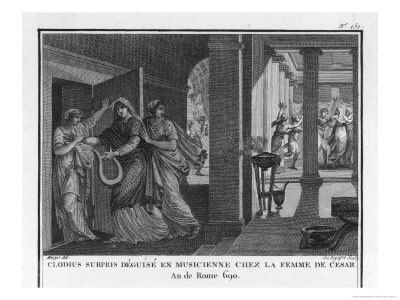
" However, there were no disturbances in consequence of Caesar's praetorship, but an unpleasant incident happened in his family. Publius Clodius was a man of patrician birth, and conspicuous for wealth and eloquence, but in insolence and effrontery he surpassed all the notorious scoundrels of his time. This man was in love with Pompeia the wife of Caesar, and she was not unwilling. But close watch was kept upon the women's apartments, and Aurelia, Caesar's mother, a woman of discretion, would never let the young wife out of her sight, and made it difficult and dangerous for the lovers to have an interview.
Now, the Romans have a goddess whom they call Bona, corresponding to the Greek Gynaeceia. The Phrygians claim this goddess as their own, and say that she was the mother of King Midas; the Romans say she was a Dryad nymph and the wife of Faunus; the Greeks that she was the unnameable one among the mothers of Dionysus. And this is the reason why the women cover their booths with vine-branches when they celebrate her festival, and why a sacred serpent is enthroned beside the goddess in conformity with the myth. It is not lawful for a man to attend the sacred ceremonies, nor even to be in the house when they are celebrated; but the women, apart by themselves, are said to perform many rites during their sacred service which are Orphic in their character. Accordingly, when the time for the festival is at hand, the consul or praetor at whose house it is to be held goes away, and every male with him, while his wife takes possession of the premises and puts them in due array. The most important rites are celebrated by night, when mirth attends the revels, and much music, too, is heard.
At the time of which I speak, Pompeia was celebrating this festival, and Clodius, who was still beardless and on this account thought to pass unnoticed, assumed the dress and implements of a lute-girl and went to the house, looking like a young woman. He found the door open, and was brought in safely by the maid-servant there, who was in the secret; but after she had run on ahead to tell Pompeia and some time had elapsed, Clodius had not the patience to wait where he had been left, and so, as he was wandering about in the house (a large one) and trying to avoid the lights, an attendant of Aurelia came upon him and asked him to play with her, as one woman would another, and when he refused, she dragged him forward and asked who he was and whence he came. Clodius answered that he was waiting for Pompeia's Abra (this was the very name by which the maid was called), and his voice betrayed him. The attendant of Aurelia at once sprang away with a scream to the lights and the throng, crying out that she had caught a man. The women were panic-stricken, and Aurelia put a stop to the mystic rites of the goddess and covered up the emblems. Then she ordered the doors to be closed and went about the house with torches, searching for Clodius. He was found where he had taken refuge, in the chamber of the girl who had let him into the house; and when they saw who he was, the women drove him out of doors. Then at once, and in the night, they went off and told the matter to their husbands, and when day came a report spread through the city that Clodius had committed sacrilege and owed satisfaction, not only to those whom he had insulted, but also to the city and to the gods. Accordingly, one of the tribunes of the people indicted Clodius for sacrilege, and the most influential senators leagued themselves together and bore witness against him that, among other shocking abominations, he had committed adultery with his sister, who was the wife of Lucullus. But against the eager efforts of these men the people arrayed themselves in defence of Clodius, and were of great assistance to him with the jurors in the case, who were terror-stricken and afraid of the multitude. Caesar divorced Pompeia at once, but when he was summoned to testify at the trial, he said he knew nothing about the matters with which Clodius was charged. His statement appeared strange, and the prosecutor therefore asked, "Why, then, didst thou divorce thy wife?" "Because," said Caesar, "I thought my wife ought not even to be under suspicion."
Some say that Caesar made this deposition honestly; but according to others it was made to gratify the people, who were determined to rescue Clodius. At any rate, Clodius was acquitted of the charge, the majority of the jurors giving their verdicts in illegible writing, in order that they might neither risk their lives with the populace by condemning him, nor get a bad name among the nobility by acquitting him.
