Saturday, July 9, 2011

the imaginative part of the soul...

From the Life of Coriolanus"

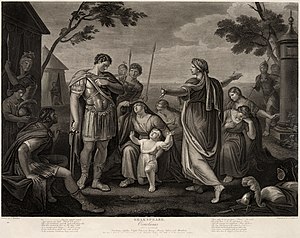
"But the Roman people showed more plainly, when they were set free from the war, the greatness of their fear and peril while it lasted. For as soon as those who manned the walls descried the Volscians drawing their forces off, every temple was thrown open, and the people crowned themselves with garlands and offered sacrifices as if for victory. But the joy of the city was most apparent in the honour and loving favour which both the senate and the whole people bestowed upon the women, declaring their belief that the city's salvation was manifestly due to them. When, however, the senate passed a decree that whatsoever they asked for themselves in the way of honour or favour, should be furnished and done for them by the magistrates, they asked for nothing else besides the erection of a temple of Women's Fortune, the expense of which they offered to contribute of themselves, if the city would undertake to perform, at the public charge, all the sacrifices and honours, such as are due to the gods. The senate commended their public spirit, and erected the temple and its image at the public charge, but they none the less contributed money themselves and set up a second image of the goddess, and this, the Romans say, as it was placed in the temple, uttered some such words as these: "Dear to the gods, O women, is your pious gift of me."

These words were actually uttered twice, as the story runs, which would have us believe what is difficult of belief and probably never happened. For that statues have appeared to sweat, and shed tears, and exude something like drops of blood, is not impossible; since wood and stone often contract a mould which is productive of moisture, and cover themselves with many colours, and receive tints from the atmosphere; and there is nothing in the way of believing that the Deity uses these phenomena sometimes as signs and portents. It is possible also that statues may emit a noise like a moan or a groan, by reason of a fracture or a rupture, which is more violent if it takes place in the interior. But that articulate speech, and language so clear and abundant and precise, should proceed from a lifeless thing, is altogether impossible; since not even the soul of man, or the Deity, without a body duly organized and fitted with vocal parts, has ever spoken and conversed. But where history forces our assent with numerous and credible witnesses, we must conclude that an experience different from that of sensation arises in the imaginative part of the soul, and persuades men to think it sensation; as, for instance, in sleep, when we think we see and hear, although we neither see nor hear. However, those who cherish strong feelings of good-will and affection for the Deity, and are therefore unable to reject or deny anything of this kind, have a strong argument for their faith in the wonderful and transcending character of the divine power. For the Deity has no resemblance whatever to man, either in nature, activity, skill, or strength; nor, if He does something that we cannot do, or contrives something that we cannot contrive, is this contrary to reason; but rather, since he differs from us in all points, in His works most of all is He unlike us and far removed from us. But most of the Deity's powers, as Heracleitus says, "escape our knowledge through incredulity."

Friday, July 8, 2011

softening of the nature...

Bits from the "Life of Coriolanus"

"Verily, among all the benefits which men derive from the favour of the Muses, none other is so great as that softening of the nature which is produced by culture and discipline, the nature being induced by culture to take on moderation and cast off excess"

and on the day following a battle in which Marcius had distinguished himself...

"On the following day, when Lartius had come up, and the rest of the army was assembled before the consul, Cominius mounted the rostra, and after rendering to the gods the praise that was their due for such great successes, addressed himself to Marcius. In the first place, he rehearsed with praise his astonishing exploits, some of which he had himself beheld in battle, while to others Lartius bore witness. Then, out of the abundant treasures and the many horses and prisoners that had been taken, he ordered him to choose out a tenth, before any distribution to the rest of the army; and besides all this, he presented him with a horse, duly caparisoned, as a prize of valour. After the Romans had applauded this speech, Marcius came forth and said that he accepted the horse, and was delighted p141with the praises of the consul, but that he declined the rest, holding it to be pay, not honour, and would be content with his single share of the booty.  "But I do ask one special favour," he said, "and beg that I may receive it. I had a guest-friend among the Volscians, a man of kindliness and probity. This man is now a prisoner, and from wealth and happiness is reduced to subjection. Since, then, many evils have befallen him, let me at least free him from one, that of being sold into bondage.
At such words as these still louder shouts greeted Marcius, and he found more admirers of his superiority to gain than of the bravery he had shown in war. 4 For the very ones who secretly felt a certain jealous envy of him for his conspicuous honours, now thought him worthy of great rewards because he would not take them; and they were more delighted with the virtue which led him to despise such great rewards, than with the exploits which made him worthy of them. For the right use of wealth is a fairer trait than excellence in arms; but not to need wealth is loftier than to use it."

Thursday, July 7, 2011

bold and caustic reasonings...

This from the Life of Alcibiades on the influence of Socrates:

"For there is no man whom Fortune so envelops and compasses about with the so‑called good things of life that he cannot be reached by the bold and caustic reasonings of philosophy, and pierced to the heart"

Wednesday, July 6, 2011

hay on the horns...

bits from the life of Crassus:

"Concealment is just what deeds of fear need, wheras light is an enemy to them.

"He made very many changes in his political views, and was neither a steadfast friend nor an implacable enemy, but readily abandoned both his favours and his resentments at the dictates of his interests, so that, frequently, within a short space of time, the same men and the same measures found in him both an advocate and an opponent. 9 And he had great influence, both from the favours which he bestowed and the fear which he inspired, but more from the fear. At any rate, Sicinnius, who gave the greatest annoyance to the magistrates and popular leaders of his day, when asked why Crassus was the only one whom he let alone and did not worry, said that the man had hay on his horn. Now the Romans used to coil hay about the horn of an ox that gored, so that those who encountered it might be on their guard"

Tuesday, July 5, 2011

reverence and good hope...

Life of Pericles (on what he learned from his teacher)

"These were not the only advantages Pericles had of his association with Anaxagoras. It appears that he was also lifted by him above superstition, that feeling which is produced by amazement at what happens in regions above us. It affects those who are ignorant of the causes of such things, and are crazed about divine intervention, and confounded through their inexperience in this domain; whereas the doctrines of natural philosophy remove such ignorance and inexperience, and substitute for timorous and inflamed superstition that unshaken reverence which is attended by a good hope"

Monday, July 4, 2011

aid from the Gods...

from the Life of Fabius Maximus...

After this, he began with the gods, which is the fairest of all beginnings, and showed the people that the recent disaster was due to the neglect and scorn with which their general had treated religious rites, and not to the cowardice of those who fought under him. He thus induced them, instead of fearing their enemies, to propitiate and honour the gods. It was not that he filled them with superstition, but rather that he emboldened their valour with piety, allaying and removing the fear which their enemies inspired, with hopes of aid from the gods...

By thus fixing the thoughts of the people upon their relations with Heaven, Fabius made them more cheerful regarding the future. But he himself put all his hopes of victory in himself, believing that Heaven bestowed success by reason of wisdom and valour, and turned his attentions to Hannibal"

acquiescence and optimism...

from the Life of Pericles...

"acquiesce in the present without fault-finding, remember the past with thankfulness, and meet the future without fear or suspicion, with their hopes cheerful and bright."