Thursday, September 29, 2011

never forget...

from the Life of Otho...

16 So he spake, and after resisting firmly those who tried to oppose and dissuade him, he ordered his friends to depart, as well as the men of senatorial rank who were present; to those who were absent he sent the same command, and wrote to the cities urging them to escort the travellers on their way with honour and in safety. 2 Then he sent for his nephew Cocceius, who was still a youth, and bade him be of good cheer and not fear Vitellius, whose mother and wife and children he had kept safe and cared for as though they were his own. He had desired, he said, to make him his son, but had put off the adoption, in order that the youth might share his power after he had prevailed, and not perish with him after he had failed. "And now, my boy," he said, "this is my last charge to thee; do not altogether p315forget, and do not too well remember, that thou hadst a Caesar for an uncle."...

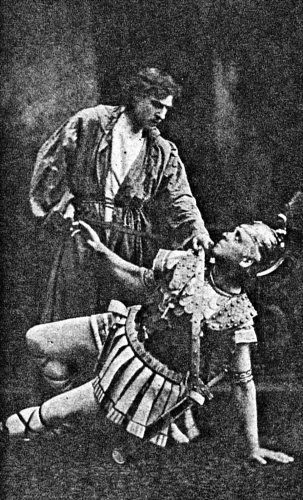
17 It was now evening, and being thirsty, he drank a little water. He had two swords, and after examining the blade of each for a long time, he laid one of them aside, but put the other under his arm, and then called his servants. These he addressed kindly, and distributed money to them, more to one and less to another, not as though lavish with what was no longer to be his, but with strict regard to moderation and the claims of merit. 2 After sending the servants away, he betook himself to rest for the remainder of the night, and slept so soundly that his chamberlains heard his heavy breathing. Just before dawn he called a freedman with whom he had arranged for the departure of the senators, and bade him learn how they fared. And when he was told that all of them had what was needful for their journey, "Go thou, then," he said to the freedman, "and show thyself to the soldiers, unless thou wishest them to put thee to a miserable death for helping me to die." 3 Then, when the man had gone out, with both hands he held his sword upright beneath him, and fell upon it, giving but a p317single groan as he felt the pang. The servants outside heard his groan and raised a wailing cry, and at once the whole camp and the city were filled with lamentation. The soldiers, with loud cries, burst in at the door, and then bewailed their emperor, full of anguish, and reviling themselves because they had not watched over him and prevented him from dying in their behalf. 4 Not one of his followers went away, although the enemy were near, but after attiring the body and preparing a funeral pyre for it, they escorted it thither with military honours, and full of exultation were those who won the privilege of carrying the bier. Of the rest, some embraced the emperor's body and kissed his wound, others grasped his hands, and others still made him their obeisance at a distance. There were some, too, who first put their torches to the pyre and then slew themselves, not, so far as could be known, because they were either indebted to the dead for favours, or fearful of punishment at the hands of the victor. 5 Nay, it would seem that no king or tyrant was ever possessed by so dire and frenzied a passion for ruling as was that of these soldiers for being ruled and commanded by Otho; not even after his death did their yearnings for him leave them, nay, it abode with them until it finally changed into an incurable hatred for Vitellius."

reasonable measures...

from the life of Otho...

"But as for their generals, neither Proculus nor Paulinus ventured to enter the camp with them, but turned aside through fear of the soldiers, who were already laying the blame for their defeat upon their commanders. But Annius Gallus received into the town the soldiers who gathered there out of the battle, and tried to encourage them. The battle had been nearly equal, he said, and in many parts of it they had overcome their enemies. 2 Marius Celsus, p307moreover, assembled the officers and urged them to consult the public good. In view of so great a calamity, he said, and the slaughter of so many citizens, not even Otho himself, if he were a good man, would wish to make further trial of his fortune, since even Cato and Scipio, by refusing to yield to a victorious Caesar after Pharsalus, had incurred the charge of needlessly squandering the lives of many brave men in Africa, although their struggle was in behalf of Roman freedom. 3 For in general all men alike are subject to the decrees of fortune, but of one thing she cannot rob a good man, and that is the privilege, in case of adversity, of taking reasonable measures to correct the situation that confronts him."

punished by his fear...and a little more...

from the life of Otho...

"But nothing so gladdened all Romans alike, and won their allegiance to the new emperor so much, as his treatment of Tigellinus. Men were not aware that Tigellinus was already punished by his very fear of that punishment which the city was demanding as a debt due to the public, 2 and also by incurable bodily diseases; and besides, there were those unhallowed and unspeakable grovellings of his among the vilest harlots, for which his lustful nature still panted, clutching after them as his life painfully ebbed away; these were looked upon by reasonable men as extremest punishment and an equivalent of many deaths. Nevertheless it vexed the common people that he should see the light of day after so many good men had been robbed of that light by him. 3 Accordingly, Otho sent a messenger to fetch him from his country estate at Sinuessa; for he was staying there, where vessels lay at anchor, that he might fly to more distant parts. He tried to bribe the messenger with a large sum of money to let him go, but failing in this, he made him gifts nevertheless, and begged him to wait till he had shaved; and taking the razor he cut his own throat"

the fortunes of Galba...

from the life of Galba...

"Such were the fortunes of Galba, a man surpassed by few Romans in lineage and wealth, and both in wealth and lineage the foremost of his time. During the reigns of five emperors he lived with honour and high repute, so that it was by his high repute, rather than by his military power, that he overthrew Nero. 2 For of his partners in the task, some were by all men deemed unworthy of the imperial dignity, and others deemed themselves unworthy. But to Galba the imperial title was offered and by him it was accepted; and by simply lending his name to the bold measures of Vindex, he gave to his revolt (as his rebellious agitation was called) the character of a civil war, because it had acquired a man who was worthy to rule. 3 Wherefore, in the belief that he was not seizing the conduct of affairs for himself, but rather giving himself for the conduct of affairs, he set out with the idea of commanding the petted creatures of Tigellinus and Nymphidius as Scipio and Fabricius and Camillus used to command the Romans of their time. 4 But being gradually weighed down by his years, in arms and camps, indeed, he was an "imperator" of a severe and ancient type; but just as Nero put himself in the hands of his most insatiate favourites, so Galba put himself in the hands of Vinius and Laco and their freedmen, and they made merchandise of everything, so that he left behind him no one who wished him still in power, but very many who were moved to pity at his death."

do your work...

from the life of Galba...

26 And now, as Galba purposed to go forth, and Vinius would not permit it, while Celsus and Laco urged it and vehemently chided Vinius, a rumour spread insistently that Otho had been slain in the camp; and after a little, Julius Atticus, a soldier of distinction among the guards, was seen rushing up with his sword drawn, and crying out that he had slain the enemy of Caesar; and forcing his way through the crowd about Galba, he showed him his sword all stained with blood. 2 Then Galba fixed his eyes upon him and said, "Who gave thee thy orders?" Whereupon the man replied that it was his fidelity and the oath that he had sworn, at p265which the multitude cried out that he had done well, and gave him their applause. Then Galba got into his litter and was carried forth, wishing to sacrifice to Jupiter and show himself to the citizens. But when he was come into the forum, there met him, like a change of wind, a report that Otho was master of the army. 3 Then, as might be expected in so great a crowd, some cried out to him to turn back, others to go forward; some bade him to be of good courage, others urged him to be cautious; and so, while his litter was swept hither and thither, as in a surging sea, and often threatened to capsize, there came into view, first horsemen, and then men-at‑arms, charging through the basilica of Paulus, and with one voice loudly ordering all private citizens out of their way. 4 The multitude, accordingly, took to their heels, not scattering in flight, but seeking the porticoes and eminences of the forum, as if to get a view of the spectacle. Hostilities began with the overthrow of a statue of Galba by Attilius Vergilio, and then the soldiers hurled javelins at the litter; and since they failed to strike it, they advanced upon it with their swords drawn. No one opposed them or tried to defend the emperor, except one man, and he was the only one, among all the thousands there on whom the sun looked down, who was worthy of the Roman empire. 5 This was Sempronius Densus, a centurion, and though he had received no special favours from Galba, yet in defence of honour and the law he took his stand in front of the litter. And first, lifting up the switch with which centurions punish soldiers deserving of stripes, he cried out to the assailants and ordered them to spare the emperor. Then, as they came to close quarters with him, he drew his sword, and fought them off a long time, until he fell with a wound in the groin.

27 The litter was upset at the place called Lacus Curtius, and there Galba tumbled out and lay in his corselet, while the soldiers ran up and struck at him. But he merely presented his neck to their swords, saying: "Do your work, if this is better for the Roman people." 2 So, then, after receiving many wounds in his legs and arms, he was slain, as most writers state, by a certain Camurius, of the fifteenth legion. Some, however, ascribe his death to Terentius, others to Lecanius, and others still to Fabius Fabulus, who, they say, cut off Galba's head and was carrying it wrapped in his cloak, since its baldness made it difficult to grasp; 3 then, since his companions would not suffer him to hide his deed of valour, but insisted on his displaying it to all eyes, he impaled on his spear and thrust on high the head of an aged man, who had been a temperate ruler, a high priest, and a consul, and ran with it, like a bacchanal,19 whirling about often, and brandishing the spear all dripping with blood.

a slave of money

from the life of Galba...

"Now Vinius was to the last degree and beyond all compare a slave of money, and was also addicted to loose conduct with women. For when he was still a young man and was serving his first campaign, under Calvisius Sabinus, he brought his commander's wife, an unchaste woman, by night into the camp in the garb of a soldier, and had commerce with her in the general's quarters (the Romans call them "principia"). 2 For this offence Caius Caesar put him in prison; but on the death of the emperor he had the good fortune to be released. While he was at supper with Claudius Caesar, he purloined a drinking-cup, and Caesar, learning of it, invited him to supper again the next day, and when he came, ordered the attendants to set before him no silver plate at all, but only earthenware. 3 This misdeed, it is true, owing to the comic turn which Caesar's moderation took, was thought worthy of laughter, not of anger; but what he did when he had p231Galba under his control and was most influential with him in financial matters, was partly a cause and partly a pretext for tragic events and great calamities."

Tuesday, September 27, 2011

his great age...

from the life of Galba...

"That Sulpicius Galba was the richest private person who ever came to the imperial throne, is generally admitted; moreover, his connection with the noble house of the Servii gave him great prestige, although he prided himself more on his relationship to Catulus, who was the foremost man in his time in virtue and reputation, even if he gladly left to others the exercise of greater power. 2 Galba was also somehow related to Livia, the wife of Augustus Caesar, and therefore, at the instance of Livia, he was made p213consul8 by the emperor. We are told also that he commanded an army in Germany with distinction, and that when he was pro-consul of Africa,9 he won such praise as few have done. But his simple and contented way of living, the sparing hand with which he dealt out money, always avoiding excess, were counted unto him, when he became emperor, as parsimony, so that the reputation which he bore for moderation and self-restraint was an insipid sort of thing. 3 By Nero he was sent out as governor of Spain,10 before Nero had yet learned to be afraid of citizens who were held in high esteem. Galba, however, was thought to be of a gentle nature, and his great age gave an added confidence that he would always act with caution."