From "How to Study Poetry"...
"But it is necessary and useful, if we are to be helped and not harmed by poetry, to know how the poets employ the names of the gods, and again the names of bad and of good things, and what they mean when they speak of Fortune or of Fate, and whether these belong to the class of words which in their writings are used in one sense only or in several senses, as the case is with many other words."
Tuesday, March 13, 2012

Friday, December 30, 2011
discreet and sensible...
From the "Moralia" vol. 1 "How the Young Man Should Study Poetry"...
"For, in the account of Aphrodite, he teaches those who will pay attention that vulgar music, coarse songs, and stories treating of vile themes, create licentious characters unmanly lives, and men that love luxury, soft living, intimacy with women...thus admirably indicating the duty of musicians and poets to take the subjects of their compositions from the lives of those who are discreet and sensible."
"For, in the account of Aphrodite, he teaches those who will pay attention that vulgar music, coarse songs, and stories treating of vile themes, create licentious characters unmanly lives, and men that love luxury, soft living, intimacy with women...thus admirably indicating the duty of musicians and poets to take the subjects of their compositions from the lives of those who are discreet and sensible."
Sunday, December 25, 2011
ears stopped with wax...

"in the art of poetry there is much that is pleasant and nourishing for the mind of a youth, but quite as much that is disturbing and misleading, unless in the hearing of it he have proper oversight.
It deserves therefore our consideration, whether we shall put young men into Epicurus’s boat, — wherein, having their ears stopped with wax, as those of the men of Ithaca were, they shall be obliged to sail by and not so much as touch at poetry, — or rather keep a guard on them, so as to oblige their judgments by principles of right reason to use it aright, and preserve them from being seduced to their hurt by that which affords them so much delight. For neither did Lycurgus, the valiant son of Dryas (as Homer /2/ calls him) act like a man of sound reason in the course which he took to reform his people that were much inclined to drunkenness, by travelling up and down to destroy all the vines in the country; whereas he should have ordered that every vine should have a well of water near it, that (as Plato saith) the drunken deity might be reduced to temperance by a sober one. For water mixed with wine takes away the hurtful spirits, while it leaves the useful ones in it. Neither should we cut down or destroy the Muses’ vine, poetry; but where we perceive it luxuriates and grows wild through an ungoverned appetite of applause, there ought we to prune away or keep under the fabulous and theatrical branches thereof; and where we find any of the Graces linked to any of the Muses, — that is, where the lusciousness and tempting charms of language are not altogether barren and unprofitable, — there let us bring in philosophy to incorporate with it."
sufficiently fortified...
"Wherefore we are not only to govern their appetites in the delights of eating and drinking, but also (and much more) to inure them to a like temperance in reading and hearing, that, while they make use of pleasure as a sauce, they may pursue that which is wholesome and profitable in those things which they read. For neither can a city be secure if but one gate be left open to receive the enemy, though all the rest be shut; nor a young man safe, though he be sufficiently fortified against the assaults of all other pleasures, whilst he is without any guard against those of the ear. Yea, the nearer the commerce is betwixt the delights of that sense and those of the mind and reason, by so much the more, when he lies open on that side, is he apt to be debauched and corrupted thereby. Seeing therefore we cannot (and perhaps would not if we could) debar young men of the size of my Soclarus and thy Cleander altogether from the reading of poets, yet let us keep the stricter guard upon them, as those who need a guide to direct them in their reading more than in their walks."
Saturday, October 22, 2011
base men...

" It should be the general rule to keep the young away from any association with base men; for they carry away something of their badness. This duty Pythagoras29 also has enjoined in the form of allegories which I shall now quote and explain. For they contribute no small influence towards the acquisition of virtue. For example:
E"Do not taste of black-tails;"30 that, "Do not spend your time with men of black character, because of their malevolence."
"Do not step over the beam of a balance"; that is, one should give greatest heed to justice and not transgress it.
"Do not sit on a peck measure"; as much as to say that we should avoid idleness and have forethought for providing our daily bread.
"Do not give your hand to everybody"; instead of, "Do not make friends too readily."
"Do not wear a tight ring"; means that one should live his life unhampered, and not subject it to any bond.
"Do not poke a fire with steel";31 instead of, p61"Do not provoke an angry man." Indeed, it is wrong to do so, and we should yield to men who are in a temper.
"Do not eat your heart"; as much as to say, "Do not injure your soul by wasting it with worries."
F"Abstain from beans"; means that a man should keep out of politics, for beans were used in earlier times for voting upon the removal of magistrates from office.32
"Do not put food into a slop-pail"; signifies that it is not fitting to put clever speech into a base mind. For speech is the food of thought, and baseness in men makes it unclean.
"Do not turn back on reaching the boundaries"; that is, when people are about to die and see the boundary of their life close at hand, they should bear all this with serenity and not be faint-hearted.
I return to the subject suggested at the beginning of the chapter. As I said there, the young should be kept away from every sort of base men, and most of all from flatterers. 13Let me repeat here what I say over and over again to many fathers: There is no class of persons more pernicious than flatterers, nor any that more surely and quickly gives youth a nasty tumble. They utterly ruin both fathers and sons, bringing to sorrow the old age of those and the youth of these, and dangling pleasure as an irresistible lure to get their advice taken. To sons who are to inherit wealth fathers commend sobriety, flatterers drinking to excess; fathers commend self-restraint, flatterers profligacy; fathers p63frugality, flatterers extravagance; fathers industry, flatterers indolence, Bsaying, "A life is but a moment. We must live, not merely exist.33 Why should we give a thought to your father's threats? He's an old twaddler with one foot already in the grave, and before long we'll take his coffin on our shoulders and carry him out." Another of them posts a drab in the young man's path, or prostitutes a married woman for him, and spoils and wastes the father's provision for old age. Detestable is their whole tribe, pretenders of friendship, without a vestige of honest speech, flatterers of the rich but despisers of the poor, addressing themselves with instinctive art to the young, grinning broadly when their patrons laugh, spurious claimants to any spirit, and bastard members of human life, subsisting at the beck and nod of the wealthy; Cfree-born by freak of fortune, but slaves by choice. Whenever they are not treated with insult, they feel themselves insulted because then they do not fulfil the purpose for which they are kept. So if any father is concerned for the good upbringing of his children, he must drive away these detestable creatures, and quite as much must he drive away schoolmates who show depravity, for these also are capable of corrupting the most likely natures."
a word is deeds shadow...

"Moreover, one's sons are to be kept from foul language; for, according to Democritus,21 "A word is a deed's shadow." 10Then, too, proper measures must be taken to ensure that they shall be tactful and courteous in their address; for nothing is so deservedly disliked as tactless characters. Besides, children may avoid getting themselves disliked by their associates if they do not prove totally unyielding in discussions. For it is a fine thing to understand, not only how to gain the victory, but also how to submit to defeat, in cases where victory is injurious; for there is really such a thing as a "Cadmean victory."22 As a witness of this I may quote Euripides the wise, who says:
BWhen of two speakers one is growing wroth,
Wise is he that yields in argument.
We must now lay down some rules of conduct which the young should follow no less but even more than those previously given. These are: To practise the simple life, to hold the tongue in check, to conquer anger, to control the hands. We must consider the importance of each of these; and they will be more intelligible if based on examples.
So, to begin with the last, some men by putting their hands to wrongful gains have upset the good repute of their earlier lives. CWitness the case of Gylippus,24 the Spartan, who was forced into exile because he had secretly unsewed the bags of money.
p49 Again, an unruffled temper is certainly the mark of a wise man. Thus Socrates once, when a bold and impudent youth had kicked him, observed that the bystanders were so indignant and so violently moved as to wish to foul up the offender; but he only said: "If an ass had kicked me, should you have thought it proper to kick him in return?" That youth, however, did not by any means get off scot-free, but as everybody jeered at him, and nicknamed him "Kicker," he ended by hanging himself.
And when Aristophanes brought out the Clouds, and heaped all manner of abuse upon Socrates in every possible way, one of those who had been present said to Socrates, "Are you not indignant, Socrates, that he used you as he did in the play?" D"No indeed," he replied; "when they break a jest upon me in the theatre I feel as if I were at a big party of good friends." What Archytas of Tarentum and Plato did will be seen to be closely akin to this. For Archytas, on his return from the war (where he had been general) found his land gone to waste. He summoned his overseer and said, "You should be sorry for this, if I were not in too great a temper." And Plato, provoked at a gluttonous and impudent slave, called his sister's son, Speusippus, and said as he withdrew, "Beat this fellow, for I am too much provoked." But it may be urged that such actions are difficult and hard to imitate. I know that myself. EBut the effort must be made, by employing the actions of such men as standards as far as possible, to abate a great part of our unbridled and furious temper; for in other respects also we are not comparable with them either in p51experience or magnanimous. Yet we, no less than they, feeling ourselves to be the high priests of God's mysteries and torch-bearers of wisdom, do attempt, so far as lies in our power, to imitate and to get a little taste of such conduct for ourselves.
The control of the tongue, then, still remains to be discussed of the topics I suggested. If anybody has the notion that this is a slight and insignificant matter, he is very far from the truth. For timely silence is a wise thing, and better than any speech. FAnd this is the reason, as it appears to me, why the men of olden time established the rites of initiation into the mysteries, that we, by becoming accustomed to keep silence there, may transfer that fear which we learned from the divine secrets to the safe keeping of the secrets of men. For, again, nobody was ever sorry because he kept silent, but hundreds because they talked. Again, the word unspoken cannot possibly be recalled. I have heard of countless men who have fallen into the greatest misfortunes through intemperate speech. 11Of these I shall mention one or two as typical and omit the rest. When Ptolemy Philadelphus married his sister Arsinoë, Sotades25 said,
'Tis wrong for you to try to spur that mare,
and thereafter he rotted in prison for many years; and so suffered condign punishment for his untimely talking, and to make other men laugh he sorrowed a long time himself. A story to match and couple with this, and much more dreadful, is what the sophist Theocritus said and suffered. Alexander p53had bidden the Greeks to make ready crimson robes Bso thatº on his return he might offer a sacrifice of thanksgiving for his victory in the war against the barbarians, and all the states had to pay a poll-tax in money, when Theocritus remarked, "Before this I used to be in doubt, but now I know for a certainty that this is Homer's 'Crimson Death.' "26 And thereby he made an enemy of Alexander. And Antigonus, king of the Macedonians, who was blind of one eye, he drove to immoderate anger by reproaching him with his disfigurement. For Antigonus sent his chief cook, Eutropion, who had been an officer in his army, to Theocritus, and insisted that Theocritus should come to him and engage in discussion. When Eutropion delivered his message to Theocritus, coming several times for the purpose, the latter said, "I know very well that you want to serve me up raw to your Cyclops," twitting the one for being disfigured and the other for being now a cook. "Then you shall not keep your head on," said Eutropion, "but you shall pay the penalty for this reckless talk and madness of yours." He thereupon reported the remark to the king, who sent and had Theocritus put to death.
But besides all this, we should, as a most sacred duty, accustom children to speak the truth. For lying is fit for slaves only, and deserves to be hated of all men, and even in decent slaves it is not to be condoned.
a storehouse of learning...

"Above all, the memory of children should be trained and exercised; for this is, as it were, a storehouse of learning; and it is for this reason that the mythologists have made Memory the mother of the Muses, thereby intimating by an allegory that there is nothing in the world like memory for creating and fostering. This, then, is to be trained in either case, whether one's children be naturally gifted with a good memory, or, on the contrary, forgetful. For we shall thus strengthen nature's generous endowment, and thus fill out her deficiency; and while the first class of children will excel others, the second class will excel their former selves. The saying of Hesiod20 is admirably put:
If even small upon the small you place
FAnd do this oft, the whole will soon be great.
Nor should parents forget that those branches of instruction which involve memory make no small contribution, not merely to education, but also to the practical activities of life; for the memory of past activities serves as a pattern of good counsel for the future."
rebukes and praises...

"This also I assert, that children ought to be led to honourable practices by means of encouragement and reasoning, and most certainly not by blows or ill-treatment, for it surely is agreed that these are fitting rather for slaves than for the free-born; for so they grow numb and shudder at their tasks, partly from the pain of the blows, partly from the degradation. Praise and reproof are more helpful for the free-born than any sort of ill-usage, 9since the praise incites them toward what is honourable, and reproof keeps them from what is disgraceful.
But rebukes and praises should be used alternately and in a variety of ways; it is well to choose some time when the children are full of confidence to put them to shame by rebuke, and then in turn to cheer them up by praises, and to imitate the nurses, who, when they have made their babies cry, in turn offer them the breast for comfort. Moreover in praising them it is essential not to excite and puff them up, for they are made conceited and spoiled by excess of praise."
Return
exercise of the body...

It is not proper, either, to overlook the exercise of the body, but we should send the children to the trainer's and cultivate adequately this side of education with all diligence, not merely for the sake of gracefulness of body but also with an eye to strength; for sturdiness of body in childhood is the foundation of a hale old age. Just as in fair weather, then, one ought to prepare for storm, so also in youth one should store up discipline and self-restraint as a provision for old age. DBut the amount of bodily exercise should be so limited as not to be a drain on the children and make them too tired to study; for, according to Plato,17 sleep and weariness are the enemies of learning. But why do I introduce this subject here? Just because I am anxious to say that which is of greater importance than all the rest: it is for the contests of war that boys must be practised, by exercising themselves in throwing the javelin, shooting with the bow, and in hunting. "For the goods of the vanquished" in battle "are prizes offered to the victors."18 War has no place for a bodily condition produced by an indoor life, and a slenderly built soldier accustomed to military exercises forces his way through the masses of fleshy athletes."
the middle course...

"I advise then (for I return now to my original theme) that, as one should always be careful to avoid the theatrical and melodramatic style, so, on the other hand, one should exercise the same caution to avoid triviality and vulgarity in style; for a turgid diction is unfitted for a man in public life, and a barren style is too unimpressive; Bbut as the body ought to be not merely healthy but also sturdy, so also speech should be not merely free from fault but vigorous too. For the cautious is merely commended, but the audacious is admired as well. It so happens that I entertain the same opinion also in regard to mental disposition. For a man should not be bold, on the one hand, or, on the other, pusillanimous and cowering, since the one resolves itself into impudence, and the other into servility. Always to pursue the middle course in everything is artistic and in good taste."
Blessings
Friday, October 7, 2011
Moralia...

I think it was Mark Twain who, when asked about the controversy over who really wrote the books attributed to Homer, said, "If Homer didnt write them, some other guy named Homer did" (that is, I think, a paraphrase.) The first essay in Plutarch's "Morals," "On the Education of Children" was probably not written by Plutarch but by some other guy named Plutarch. Excerpts...
"As a general statement, the same assertion may be made in regard to moral excellence that we p9are in the habit of making in regard to the arts and sciences, namely, that there must be a concurrence of three things in order to produce perfectly right action, and these are: nature, reason, and habit. By reason I mean the act of learning, and by habit constant practice. The first beginnings come from nature, advancement from learning, the practical use from continued repetition, band the culmination from all combined; but so far as any one of these is wanting, the moral excellence must, to this extent, be crippled. For nature without learning is a blind thing, and learning without nature is an imperfect thing, and practice without both is an ineffective thing. Just as in farming, first of all the soil must be good, secondly, the husbandman skilful, and thirdly, the seed sound, so, after the same manner, nature is like to the soil, the teacher to the farmer, and the verbal counsels and precepts like to the seed. cI should strenuously insist that all three qualities met together and formed a perfect union in the souls of those men who are celebrated among all mankind"
Now it is a fortunate thing and a token of divine love if ever a heavenly power has bestowed all these qualities on any one man; but if anybody imagines that those not endowed with natural gifts, who yet have the chance to learn and to apply themselves in the right way to the attaining of virtue, cannot repair the want of their nature and advance so far as in them lies, let him know that he is in great, or rather total, error. For indifference ruins a good natural endowment, but instruction amends a poor one; easy things escape the careless, but difficult p11things are conquered by careful application. dOne may understand how effective and how productive a thing is application and hard work, if he only direct his attention to many effects that are daily observed. For drops of water make hollows in rocks, steel and bronze are worn away by the touch of hands, and rims of chariot-wheels once bent by dint of labour, cannot, no matter what be done, recover their original lines.
But why discuss the matter at length? For character is habit long continued, and if one were to call the virtues of character the virtues of habit, he would not seem to go far astray.
Briefly, then, I say (an oracle one might properly call it, rather than advice) that, to sum up, the beginning, the middle, and end in all these matters is good education and proper training; and it is this, I say, which leads on and helps towards moral excellence and towards happiness. And, in comparison with this, all other advantages are human, and trivial, and not worth our serious concern. Good birth is a fine thing, but it is an advantage which must be credited to one's ancestors. Wealth is held in esteem, but it is a chattel of fortune, since oftentimes she takes it away from those who possess it, and brings and presents it to those who do not expect it. Besides, great wealth is the very mark for those who aim their shafts at the purse — rascally slaves and blackmailers; and above all, even the vilest may possess it. Repute, moreover, is imposing, but unstable. Beauty is highly prized, but short-lived. Health is a valued possession, but inconstant. Strength is much admired, but it falls an easy prey to disease and old age.
Two elements in man's nature are supreme over all — mind and reason. The mind exercises control over reason, and reason is servant of the mind, unassailable by disease, unimpaired by old age.
It so happens that I entertain the same opinion also in regard to mental disposition. For a man should not be bold, on the one hand, or, on the other, pusillanimous and cowering, since the one resolves itself into impudence, and the other into servility. Always to pursue the middle course in everything is artistic and in good taste.
"...we ought to make philosophy the chief of all our learning. For though, in order to the welfare of the body, the industry of men hath found out two arts, — medicine, which assists to the recovery of lost health and gymnastics, which help us to attain a sound constitution, — yet there is but one remedy for the distempers and diseases of the mind, and that is philosophy. For by the advice and assistance thereof it is that we come to understand what is honest, and what dishonest; what is just, and what unjust; in a word, what we are to seek, and what to avoid. We learn by it how we are to demean ourselves towards the Gods, towards our parents, our elders, the laws, strangers, governors, friends, wives, children, and servants. That is, we are to worship the Gods, to honor our parents, to reverence our elders, to be subject to the laws, to obey our governors, to love our friends, to use sobriety towards our wives, to be affectionate to our children, and not to treat our servants insolently; and (which is the chiefest lesson of all) not to be overjoyed in prosperity nor too much dejected in adversity; not to be dissolute in our pleasures, nor in our anger to be transported with brutish rage and fury. These things I account the principal advantages which we gain by philosophy. For to use prosperity generously is the part of a man; to manage it so as to decline envy, of a well governed man; to master our pleasures by reason is the property of wise men; and to moderate anger is the attainment only of extraordinary men. But those of all men I count most complete, who know how to mix and temper the managery of civil affairs with philosophy; seeing they are thereby masters of two of the greatest good things that are, — a life of public usefulness as statesmen, and a life of calm tranquillity as students of philosophy. For, whereas there are three sorts of lives, — the life of action, the life of contemplation, and the life of pleasure, — the man who is utterly abandoned and a slave to pleasure is brutish and mean-spirited; he that spends his time in contemplation without action is an unprofitable man; and he that lives in action and is destitute of philosophy is a rustical man, and commits many absurdities. Wherefore we are to apply our utmost endeavor to enable ourselves for both; that is, to manage public employments, and withal, at convenient seasons, to give ourselves to philosophical studies."
Monday, October 3, 2011
cannot be spared...
 Emerson on Plutarch in his essay, "Books."
"Plutarch cannot be spared from the smallest library; first, because he is so readable, which is much; then, that he is medicinal and invigorating. The lives of Cimon, Lycurgus, Alexander, Demosthenes, Phociou, Marcellus, and the rest, are what history has of best. But this book has taken care of itself, and the opinion of the world is expressed in the innumerable cheap editions, which make it as accessible as a newspaper. But Plutarch's "Morals" is less known, and seldom reprinted. Yet such a reader as I am writing to can as ill spare it as the "Lives." He will read in it the essays "On the Daemon of Socrates," "On lsis and Osiris," "On Progress in Virtue," "On Garrulity," "On Love," and thank anew the art of printing, and the cheerful domain of ancient thinking. Plutarch charms by the facility of his associations; so that it signifies little where you open his book, you find yourself at the Olympian tables. His memory is like the Isthmian Games, where all that was excellent in Greece was assembled, and you are stimulated and recruited by lyric verses, by philosophic sentiments, by the forms and behavior of heroes, by the worship of the gods, and by the passing of fillets, parsley and laurel wreaths, chariots, armor, sacred cups, and utensils of sacrifice. An inestimable trilogy of ancient social pictures are the three " Banquets" respectively of Plato, Xenophon, and Plutarch. Plutarch's has the least approach to historical accuracy; but the meeting of the Seven Wise Masters is a charming portraiture of ancient manners and discourse, and is as clear as the voice of a fife, and entertaining as a Freneli novel.
Thursday, September 29, 2011
never forget...

16 So he spake, and after resisting firmly those who tried to oppose and dissuade him, he ordered his friends to depart, as well as the men of senatorial rank who were present; to those who were absent he sent the same command, and wrote to the cities urging them to escort the travellers on their way with honour and in safety. 2 Then he sent for his nephew Cocceius, who was still a youth, and bade him be of good cheer and not fear Vitellius, whose mother and wife and children he had kept safe and cared for as though they were his own. He had desired, he said, to make him his son, but had put off the adoption, in order that the youth might share his power after he had prevailed, and not perish with him after he had failed. "And now, my boy," he said, "this is my last charge to thee; do not altogether p315forget, and do not too well remember, that thou hadst a Caesar for an uncle."...
17 It was now evening, and being thirsty, he drank a little water. He had two swords, and after examining the blade of each for a long time, he laid one of them aside, but put the other under his arm, and then called his servants. These he addressed kindly, and distributed money to them, more to one and less to another, not as though lavish with what was no longer to be his, but with strict regard to moderation and the claims of merit. 2 After sending the servants away, he betook himself to rest for the remainder of the night, and slept so soundly that his chamberlains heard his heavy breathing. Just before dawn he called a freedman with whom he had arranged for the departure of the senators, and bade him learn how they fared. And when he was told that all of them had what was needful for their journey, "Go thou, then," he said to the freedman, "and show thyself to the soldiers, unless thou wishest them to put thee to a miserable death for helping me to die." 3 Then, when the man had gone out, with both hands he held his sword upright beneath him, and fell upon it, giving but a p317single groan as he felt the pang. The servants outside heard his groan and raised a wailing cry, and at once the whole camp and the city were filled with lamentation. The soldiers, with loud cries, burst in at the door, and then bewailed their emperor, full of anguish, and reviling themselves because they had not watched over him and prevented him from dying in their behalf. 4 Not one of his followers went away, although the enemy were near, but after attiring the body and preparing a funeral pyre for it, they escorted it thither with military honours, and full of exultation were those who won the privilege of carrying the bier. Of the rest, some embraced the emperor's body and kissed his wound, others grasped his hands, and others still made him their obeisance at a distance. There were some, too, who first put their torches to the pyre and then slew themselves, not, so far as could be known, because they were either indebted to the dead for favours, or fearful of punishment at the hands of the victor. 5 Nay, it would seem that no king or tyrant was ever possessed by so dire and frenzied a passion for ruling as was that of these soldiers for being ruled and commanded by Otho; not even after his death did their yearnings for him leave them, nay, it abode with them until it finally changed into an incurable hatred for Vitellius."
reasonable measures...
from the life of Otho...
"But as for their generals, neither Proculus nor Paulinus ventured to enter the camp with them, but turned aside through fear of the soldiers, who were already laying the blame for their defeat upon their commanders. But Annius Gallus received into the town the soldiers who gathered there out of the battle, and tried to encourage them. The battle had been nearly equal, he said, and in many parts of it they had overcome their enemies. 2 Marius Celsus, p307moreover, assembled the officers and urged them to consult the public good. In view of so great a calamity, he said, and the slaughter of so many citizens, not even Otho himself, if he were a good man, would wish to make further trial of his fortune, since even Cato and Scipio, by refusing to yield to a victorious Caesar after Pharsalus, had incurred the charge of needlessly squandering the lives of many brave men in Africa, although their struggle was in behalf of Roman freedom. 3 For in general all men alike are subject to the decrees of fortune, but of one thing she cannot rob a good man, and that is the privilege, in case of adversity, of taking reasonable measures to correct the situation that confronts him."
"But as for their generals, neither Proculus nor Paulinus ventured to enter the camp with them, but turned aside through fear of the soldiers, who were already laying the blame for their defeat upon their commanders. But Annius Gallus received into the town the soldiers who gathered there out of the battle, and tried to encourage them. The battle had been nearly equal, he said, and in many parts of it they had overcome their enemies. 2 Marius Celsus, p307moreover, assembled the officers and urged them to consult the public good. In view of so great a calamity, he said, and the slaughter of so many citizens, not even Otho himself, if he were a good man, would wish to make further trial of his fortune, since even Cato and Scipio, by refusing to yield to a victorious Caesar after Pharsalus, had incurred the charge of needlessly squandering the lives of many brave men in Africa, although their struggle was in behalf of Roman freedom. 3 For in general all men alike are subject to the decrees of fortune, but of one thing she cannot rob a good man, and that is the privilege, in case of adversity, of taking reasonable measures to correct the situation that confronts him."
punished by his fear...and a little more...
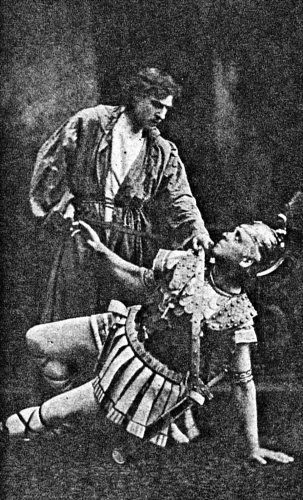
"But nothing so gladdened all Romans alike, and won their allegiance to the new emperor so much, as his treatment of Tigellinus. Men were not aware that Tigellinus was already punished by his very fear of that punishment which the city was demanding as a debt due to the public, 2 and also by incurable bodily diseases; and besides, there were those unhallowed and unspeakable grovellings of his among the vilest harlots, for which his lustful nature still panted, clutching after them as his life painfully ebbed away; these were looked upon by reasonable men as extremest punishment and an equivalent of many deaths. Nevertheless it vexed the common people that he should see the light of day after so many good men had been robbed of that light by him. 3 Accordingly, Otho sent a messenger to fetch him from his country estate at Sinuessa; for he was staying there, where vessels lay at anchor, that he might fly to more distant parts. He tried to bribe the messenger with a large sum of money to let him go, but failing in this, he made him gifts nevertheless, and begged him to wait till he had shaved; and taking the razor he cut his own throat"
the fortunes of Galba...
from the life of Galba...
"Such were the fortunes of Galba, a man surpassed by few Romans in lineage and wealth, and both in wealth and lineage the foremost of his time. During the reigns of five emperors he lived with honour and high repute, so that it was by his high repute, rather than by his military power, that he overthrew Nero. 2 For of his partners in the task, some were by all men deemed unworthy of the imperial dignity, and others deemed themselves unworthy. But to Galba the imperial title was offered and by him it was accepted; and by simply lending his name to the bold measures of Vindex, he gave to his revolt (as his rebellious agitation was called) the character of a civil war, because it had acquired a man who was worthy to rule. 3 Wherefore, in the belief that he was not seizing the conduct of affairs for himself, but rather giving himself for the conduct of affairs, he set out with the idea of commanding the petted creatures of Tigellinus and Nymphidius as Scipio and Fabricius and Camillus used to command the Romans of their time. 4 But being gradually weighed down by his years, in arms and camps, indeed, he was an "imperator" of a severe and ancient type; but just as Nero put himself in the hands of his most insatiate favourites, so Galba put himself in the hands of Vinius and Laco and their freedmen, and they made merchandise of everything, so that he left behind him no one who wished him still in power, but very many who were moved to pity at his death."
"Such were the fortunes of Galba, a man surpassed by few Romans in lineage and wealth, and both in wealth and lineage the foremost of his time. During the reigns of five emperors he lived with honour and high repute, so that it was by his high repute, rather than by his military power, that he overthrew Nero. 2 For of his partners in the task, some were by all men deemed unworthy of the imperial dignity, and others deemed themselves unworthy. But to Galba the imperial title was offered and by him it was accepted; and by simply lending his name to the bold measures of Vindex, he gave to his revolt (as his rebellious agitation was called) the character of a civil war, because it had acquired a man who was worthy to rule. 3 Wherefore, in the belief that he was not seizing the conduct of affairs for himself, but rather giving himself for the conduct of affairs, he set out with the idea of commanding the petted creatures of Tigellinus and Nymphidius as Scipio and Fabricius and Camillus used to command the Romans of their time. 4 But being gradually weighed down by his years, in arms and camps, indeed, he was an "imperator" of a severe and ancient type; but just as Nero put himself in the hands of his most insatiate favourites, so Galba put himself in the hands of Vinius and Laco and their freedmen, and they made merchandise of everything, so that he left behind him no one who wished him still in power, but very many who were moved to pity at his death."
do your work...

26 And now, as Galba purposed to go forth, and Vinius would not permit it, while Celsus and Laco urged it and vehemently chided Vinius, a rumour spread insistently that Otho had been slain in the camp; and after a little, Julius Atticus, a soldier of distinction among the guards, was seen rushing up with his sword drawn, and crying out that he had slain the enemy of Caesar; and forcing his way through the crowd about Galba, he showed him his sword all stained with blood. 2 Then Galba fixed his eyes upon him and said, "Who gave thee thy orders?" Whereupon the man replied that it was his fidelity and the oath that he had sworn, at p265which the multitude cried out that he had done well, and gave him their applause. Then Galba got into his litter and was carried forth, wishing to sacrifice to Jupiter and show himself to the citizens. But when he was come into the forum, there met him, like a change of wind, a report that Otho was master of the army. 3 Then, as might be expected in so great a crowd, some cried out to him to turn back, others to go forward; some bade him to be of good courage, others urged him to be cautious; and so, while his litter was swept hither and thither, as in a surging sea, and often threatened to capsize, there came into view, first horsemen, and then men-at‑arms, charging through the basilica of Paulus, and with one voice loudly ordering all private citizens out of their way. 4 The multitude, accordingly, took to their heels, not scattering in flight, but seeking the porticoes and eminences of the forum, as if to get a view of the spectacle. Hostilities began with the overthrow of a statue of Galba by Attilius Vergilio, and then the soldiers hurled javelins at the litter; and since they failed to strike it, they advanced upon it with their swords drawn. No one opposed them or tried to defend the emperor, except one man, and he was the only one, among all the thousands there on whom the sun looked down, who was worthy of the Roman empire. 5 This was Sempronius Densus, a centurion, and though he had received no special favours from Galba, yet in defence of honour and the law he took his stand in front of the litter. And first, lifting up the switch with which centurions punish soldiers deserving of stripes, he cried out to the assailants and ordered them to spare the emperor. Then, as they came to close quarters with him, he drew his sword, and fought them off a long time, until he fell with a wound in the groin.
27 The litter was upset at the place called Lacus Curtius, and there Galba tumbled out and lay in his corselet, while the soldiers ran up and struck at him. But he merely presented his neck to their swords, saying: "Do your work, if this is better for the Roman people." 2 So, then, after receiving many wounds in his legs and arms, he was slain, as most writers state, by a certain Camurius, of the fifteenth legion. Some, however, ascribe his death to Terentius, others to Lecanius, and others still to Fabius Fabulus, who, they say, cut off Galba's head and was carrying it wrapped in his cloak, since its baldness made it difficult to grasp; 3 then, since his companions would not suffer him to hide his deed of valour, but insisted on his displaying it to all eyes, he impaled on his spear and thrust on high the head of an aged man, who had been a temperate ruler, a high priest, and a consul, and ran with it, like a bacchanal,19 whirling about often, and brandishing the spear all dripping with blood.
a slave of money

"Now Vinius was to the last degree and beyond all compare a slave of money, and was also addicted to loose conduct with women. For when he was still a young man and was serving his first campaign, under Calvisius Sabinus, he brought his commander's wife, an unchaste woman, by night into the camp in the garb of a soldier, and had commerce with her in the general's quarters (the Romans call them "principia"). 2 For this offence Caius Caesar put him in prison; but on the death of the emperor he had the good fortune to be released. While he was at supper with Claudius Caesar, he purloined a drinking-cup, and Caesar, learning of it, invited him to supper again the next day, and when he came, ordered the attendants to set before him no silver plate at all, but only earthenware. 3 This misdeed, it is true, owing to the comic turn which Caesar's moderation took, was thought worthy of laughter, not of anger; but what he did when he had p231Galba under his control and was most influential with him in financial matters, was partly a cause and partly a pretext for tragic events and great calamities."
Tuesday, September 27, 2011
his great age...

"That Sulpicius Galba was the richest private person who ever came to the imperial throne, is generally admitted; moreover, his connection with the noble house of the Servii gave him great prestige, although he prided himself more on his relationship to Catulus, who was the foremost man in his time in virtue and reputation, even if he gladly left to others the exercise of greater power. 2 Galba was also somehow related to Livia, the wife of Augustus Caesar, and therefore, at the instance of Livia, he was made p213consul8 by the emperor. We are told also that he commanded an army in Germany with distinction, and that when he was pro-consul of Africa,9 he won such praise as few have done. But his simple and contented way of living, the sparing hand with which he dealt out money, always avoiding excess, were counted unto him, when he became emperor, as parsimony, so that the reputation which he bore for moderation and self-restraint was an insipid sort of thing. 3 By Nero he was sent out as governor of Spain,10 before Nero had yet learned to be afraid of citizens who were held in high esteem. Galba, however, was thought to be of a gentle nature, and his great age gave an added confidence that he would always act with caution."
unrestrained impulses...

"Iphicrates the Athenian used to think that the mercenary soldier might well be fond of wealth and fond of pleasure, in order that his quest for the means to gratify his desires might lead him to fight with greater recklessness; but most people think that a body of soldiers, just like a natural body in full vigour, ought to have no initiative of its own, but should follow that of its commander. 2 Wherefore Paulus Aemilius, as we are told, finding that the army which he had taken over in Macedonia was infected with loquacity and meddlesomeness, as though they were all generals, gave out word that each man was to have his hand ready and his sword sharp, but that he himself would look out for the rest.2 Moreover, Plato3 sees that a good commander or general can do nothing unless his army is amenable and loyal; and he thinks that the quality of obedience, like the quality characteristic of a king, requires a noble nature and a philosophic training, which, above all things, blends harmoniously the qualities of gentleness and humanity with those of high courage and aggressiveness. Many dire events, and particularly those which befell the Romans after the death of Nero, bear witness to this, and show plainly that an empire has nothing more fearful to show than a military force given over to untrained and unreasoning impulses."
Subscribe to:
Posts (Atom)