From life of Pompey (see Mithridates Mule for similar event)
" But Pompey, who was on horseback, was attacked by a tall man who fought on foot; when they came to close quarters and were at grips, the strokes fell upon each other's hands, but not with like result, for Pompey was merely wounded, whereas he lopped off the hand of his opponent. Then, when more foes rushed upon him together, his troops being now routed, he made his escape, contrary to all expectation, by abandoning to the enemy his horse, which had golden head-gear and ornamented trappings of great value. They fought with one another over the division of these spoils, and so were left behind in the pursuit."
...which is just a highfalutin way of saying, "bits I really like in reading Plutarch"
Monday, July 18, 2011
rising sun...
Young Pomey, desiring a Triumph at a young age speaks boldly to Sulla, who desires to keep it from happening. The boldness of the statement changed Sulla's mind...
"Pompey, however, was not cowed, but bade Sulla reflect that more worshipped the rising than the setting sun, intimating that his own power was on the increase, while that of Sulla was on the wane and fading away"
giving and receiving...
From the Life of Pompey...
Pompey was personally agreeable because he knew "the art of giving without arrogance and of receiving without loss of dignity.
the first of virtues...
from Agesilaus...
"...justice was the first of virtues; for valor was of no used unless justice attended it, and if all men should be just, there would be no need of valor."
and this:
"He lost still more reputation by offering to take a command under Tachos the Egyptian. For it was thought unworthy that man who had been judged noblest and best in Hellas, and who had filled the world with his fame, should furnish a rebel against the Great King, a mere Barbarian, with his person, his name, and his fame, and take money for him, rendering the service of a hired captain of mercenaries. For even if, now that he was past eighty years of age and his whole body was disfigured with wounds, he had taken up again his noble and conspicuous leadership in behalf of the freedom of the Hellenes, his ambition would not have been altogether blameless, as men thought. For honourable action has its fitting time and season; nay, rather, it is the observance of due bounds that constitutes an utter difference between honourable and base actions. 3 Agesilaüs, however, paid no heed to these considerations, nor did he think any public service beneath his dignity; it was more unworthy of him, in his opinion, to live an idle life in the city, and to sit down and wait for death. Therefore he collected mercenaries with the money which Tachos sent him, embarked them on transports, and put to sea, accompanied by thirty Spartan counsellors, as formerly."
Thursday, July 14, 2011
a little creative tension...
from the "Life of Agesilaus"
"Natural philosophers are of the opinion that, if strife and discord should be banished from the universe, the heavenly bodies would stand still, and all generation and motion would cease in consequence of the general harmony. And so the Spartan lawgiver seems to have introduced the spirit of ambition and contention into his civil polity as an incentive to virtue, desiring that good citizens should always be somewhat at variance and in conflict with one another, and deeming that complaisance which weakly yields without debate, which knows no effort and no struggle, to be wrongly called concord. And some think that Homer also was clearly of this mind; for he would not have represented Agamemnon as pleased when Odysseus and Achilles were carried away into abuse of one another with "frightful words," if he had not thought the general interests likely to profit by the mutual rivalry and quarrelling of the chieftains. This principle, however, must not be accepted without some reservations; for excessive rivalries are injurious to states, and productive of great perils."
Wednesday, July 13, 2011
melancholy...
"And Aristotle, when he sets forth that great natures, like those of Socrates and Plato and Heracles, have a tendency to melancholy, writes also that Lysander, not immediately, but when well on in years, was a prey to melancholy."
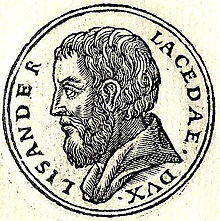
its all about the hair...
This from the "Life of Lysander"
"The treasury of the Acanthians at Delphi bears this inscription: "Brasidas and the Acanthians, with spoil from the Athenians."For this reason many think that the marble figure standing within the edifice, by the door, is a statue of Brasidas. But it really represents Lysander, with his hair very long, after the ancient custom, and growing a generous beard. For it is not true, as some state, that because the Argives, after their great defeat, shaved their heads for sorrow, the Spartans, in contrary fashion, let their hair grow long in exultation over their victory; nor was it because the Bacchiadae, when they fled from Corinth to Lacedaemon, looked mean and unsightly from having shaved their heads, that the Spartans, on their part, became eager to wear their hair long; but this custom also goes back to Lycurgus. And he is reported to have said that a fine head of hair makes the handsome more comely to look upon, and the ugly more terrible."
Subscribe to:
Posts (Atom)