From the Life of Caesar...
" Such spirit and ambition Caesar himself created and cultivated in his men, in the first place, because he showed, by his unsparing bestowal of rewards and honours, that he was not amassing wealth from his wars for his own luxury or for any life of ease, but that he treasured it up carefully as a common prize for deeds of valour, and had no greater share in the wealth than he offered to the deserving among his soldiers; and in the second place, by willingly undergoing every danger and refusing no toil. Now, at his love of danger his men were not astonished, knowing his ambition; but that he should undergo toils beyond his body's apparent powers of endurance amazed them, because he was of a spare habit, had a soft and white skin, suffered from distemper in the head, and was subject to epileptic fits, a trouble which first attacked him, we are told, in Corduba. Nevertheless, he did not make his feeble health an excuse for soft living, but rather his military service a cure for his feeble health, since by wearisome journeys, simple diet, continuously sleeping in the open air, and enduring hardships, he fought off his trouble and kept his body strong against its attacks. Most of his sleep, at least, he got in cars or litters, making his rest conduce to action, and in the day-time he would have himself conveyed to garrisons, cities, or camps, one slave who was accustomed to write from dictation as he travelled sitting by his side, and one soldier standing behind him with a sword. And he drove so rapidly that, on his first journey from Rome to Gaul, he reached the Rhone in seven days.
Horsemanship, moreover, had been easy for him from boyhood; for he was wont to put his hands behind his back and, holding them closely there, to ride his horse at full speed. And in the Gallic campaigns he practised dictating letters on horseback and keeping two scribes at once busy, or, as Oppius says, even more. We are told, moreover, that Caesar was the first to devise intercourse with his friends by letter, since he could not wait for personal interviews on urgent matters owing to the multitude of his occupations and the great size of the city. Of his indifference in regard to his diet the following circumstance also is brought in proof. When the host who was entertaining him in Mediolanum, Valerius Leo, served up asparagus dressed with myrrh instead of olive oil, Caesar ate of it without ado, and rebuked his friends when they showed displeasure. "Surely," said he, "it were enough not to eat what you don't like; but he who finds fault with ill-breeding like this is ill-bred himself." Once, too, upon a journey, he and his followers were driven by a storm into a poor man's hut, and when he found that it consisted of one room only, and that one barely able to accommodate a single person, he said to his friends that honours must be yielded to the strongest, but necessities to the weakest, and bade Oppius lie down there, while he himself with the rest of his company slept in the porch."
...which is just a highfalutin way of saying, "bits I really like in reading Plutarch"
Thursday, August 11, 2011
an unpleasant incident...
from the life of Caesar...
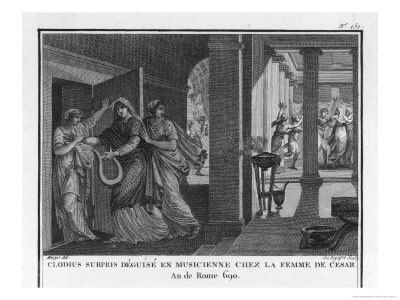
" However, there were no disturbances in consequence of Caesar's praetorship, but an unpleasant incident happened in his family. Publius Clodius was a man of patrician birth, and conspicuous for wealth and eloquence, but in insolence and effrontery he surpassed all the notorious scoundrels of his time. This man was in love with Pompeia the wife of Caesar, and she was not unwilling. But close watch was kept upon the women's apartments, and Aurelia, Caesar's mother, a woman of discretion, would never let the young wife out of her sight, and made it difficult and dangerous for the lovers to have an interview.
Now, the Romans have a goddess whom they call Bona, corresponding to the Greek Gynaeceia. The Phrygians claim this goddess as their own, and say that she was the mother of King Midas; the Romans say she was a Dryad nymph and the wife of Faunus; the Greeks that she was the unnameable one among the mothers of Dionysus. And this is the reason why the women cover their booths with vine-branches when they celebrate her festival, and why a sacred serpent is enthroned beside the goddess in conformity with the myth. It is not lawful for a man to attend the sacred ceremonies, nor even to be in the house when they are celebrated; but the women, apart by themselves, are said to perform many rites during their sacred service which are Orphic in their character. Accordingly, when the time for the festival is at hand, the consul or praetor at whose house it is to be held goes away, and every male with him, while his wife takes possession of the premises and puts them in due array. The most important rites are celebrated by night, when mirth attends the revels, and much music, too, is heard.
At the time of which I speak, Pompeia was celebrating this festival, and Clodius, who was still beardless and on this account thought to pass unnoticed, assumed the dress and implements of a lute-girl and went to the house, looking like a young woman. He found the door open, and was brought in safely by the maid-servant there, who was in the secret; but after she had run on ahead to tell Pompeia and some time had elapsed, Clodius had not the patience to wait where he had been left, and so, as he was wandering about in the house (a large one) and trying to avoid the lights, an attendant of Aurelia came upon him and asked him to play with her, as one woman would another, and when he refused, she dragged him forward and asked who he was and whence he came. Clodius answered that he was waiting for Pompeia's Abra (this was the very name by which the maid was called), and his voice betrayed him. The attendant of Aurelia at once sprang away with a scream to the lights and the throng, crying out that she had caught a man. The women were panic-stricken, and Aurelia put a stop to the mystic rites of the goddess and covered up the emblems. Then she ordered the doors to be closed and went about the house with torches, searching for Clodius. He was found where he had taken refuge, in the chamber of the girl who had let him into the house; and when they saw who he was, the women drove him out of doors. Then at once, and in the night, they went off and told the matter to their husbands, and when day came a report spread through the city that Clodius had committed sacrilege and owed satisfaction, not only to those whom he had insulted, but also to the city and to the gods. Accordingly, one of the tribunes of the people indicted Clodius for sacrilege, and the most influential senators leagued themselves together and bore witness against him that, among other shocking abominations, he had committed adultery with his sister, who was the wife of Lucullus. But against the eager efforts of these men the people arrayed themselves in defence of Clodius, and were of great assistance to him with the jurors in the case, who were terror-stricken and afraid of the multitude. Caesar divorced Pompeia at once, but when he was summoned to testify at the trial, he said he knew nothing about the matters with which Clodius was charged. His statement appeared strange, and the prosecutor therefore asked, "Why, then, didst thou divorce thy wife?" "Because," said Caesar, "I thought my wife ought not even to be under suspicion."
Some say that Caesar made this deposition honestly; but according to others it was made to gratify the people, who were determined to rescue Clodius. At any rate, Clodius was acquitted of the charge, the majority of the jurors giving their verdicts in illegible writing, in order that they might neither risk their lives with the populace by condemning him, nor get a bad name among the nobility by acquitting him.
the smiling surface of the sea...
From the Life of Caesar...
"After his return to Rome he impeached Dolabella for maladministration of his province, and many of the cities of Greece supplied him with testimony. Dolabella, it is true, was acquitted, but Caesar, in return for the zealous efforts of the Greeks in his behalf, served as their advocate when they prosecuted Publius Antonius for corruption before Marcus Lucullus, the praetor of Macedonia. And he was so effective that Antonius appealed to the tribunes at Rome, alleging that he could not have a fair trial in Greece against Greeks. At Rome, moreover, Caesar won a great and brilliant popularity by his eloquence as an advocate, and much good will from the common people for the friendliness of his manners in intercourse with them, since he was ingratiating beyond his years. He had also a large and gradually increasing political influence in consequence of his lavish hospitality and the general splendour of his mode of life. At first his enemies thought this influence would quickly vanish when his expenditures ceased, and therefore suffered it to thrive among the common people; but later on when it had become great and hard to subvert, and aimed directly at a complete revolution in the state, they perceived that no beginnings should be considered too small to be quickly made great by continuance, after contempt of them has left them unobstructed. At all events, the man who is thought to have been the first to see beneath the surface of Caesar's public policy and to fear it, as one might fear the smiling surface of the sea, and who comprehended the powerful character hidden beneath his kindly and cheerful exterior, namely Cicero, said that in most of Caesar's political plans and projects he saw a tyrannical purpose; "On the other hand," said he, "when I look at his hair, which is arranged with so much nicety, and see him scratching his head with one finger, I cannot think that this man would ever conceive of so great a crime as the overthrow of the Roman constitution." This, it is true, belongs to a later period."
an undisputed second rank...
From the life of Caesar...
"After this, Sulla's power being now on the wane, and Caesar's friends at home inviting him to return, Caesar sailed to Rhodes7 to study under Apollonius the son of Molon, an illustrious rhetorician with the reputation of a worthy character, of whom Cicero also was a pupil. It is said, too, that Caesar had the greatest natural talent for political oratory, and cultivated his talent most ambitiously, so that he had an undisputed second rank; the first rank, however, he renounced, because he devoted his efforts to being first as a statesman and commander rather, and did not achieve that effectiveness in oratory to which his natural talent directed him, in consequence of his campaigns and of his political activities, by means of which he acquired the supremacy. And so it was that, at a later time, in his reply to Cicero's "Cato," he himself deprecated comparison between the diction of a soldier and the eloquence of an orator who was gifted by nature and had plenty of leisure to pursue his studies."
Monday, August 8, 2011
a forcible omen...
From the Life of Alexander...
"As he was on his way to enter Babylon, Nearchus (who had joined him again after sailing through the ocean into the Euphrates) told the king that certain Chaldaeans had met him and advised that Alexander should keep away from Babylon. Alexander paid no heed to this, but continued on his march; and when he was arrived at the walls, he saw many ravens flying about and clawing one another, and some of them fell dead at his feet. Again, being informed that Apollodorus the commandant of Babylon had sacrificed to learn Alexander's fate, Alexander called Pythagoras the seer. Pythagoras did not deny the fact, whereupon Alexander asked him what was the character of the sacrifice. And when the seer told that the victim's liver had no lobe, "Ah me!" said Alexander, "a forcible omen!" and did Pythagoras no harm. He was sorry, too, that he had not obeyed Nearchus, and passed most of his time outside of Babylon, either living in his tent, or sailing about on the Euphrates. And he was troubled by many omens. For instance, the largest and handsomest lion in his menagerie was attacked by a tame ass and kicked to death. Again, he once took off his clothes for exercise and was playing ball, and when it was time to dress again, the young men who were playing with him beheld a man seated on the king's throne, in silence, wearing the royal diadem and robes. When the man was asked who he was, he was speechless for a long time; but at last he came to his senses and said that his name was Dionysius, and that he was a native of Messenia; in consequence of some charge brought against him, he said, he had been brought thither from the sea-board, and for a long time had been in chains; but just now the god Serapis had come to him and loosed his chains and brought him to this spot, bidding him put on the robe and diadem and sit on the throne and hold his peace.
On hearing of this, Alexander put the man out of the way, as the seers directed; but he began to be low-spirited, and was distrustful now of the favour of Heaven and suspicious of his friends. He was particularly afraid of Antipater and of his sons, one of whom, Iolas, was his chief cupbearer; the other, Cassander, had only recently come to Babylon, and when he saw some Barbarians doing obeisance to Alexander, since he had been reared as a Greek and had never seen such a sight as this before, he laughed boisterously. But Alexander was enraged, and clutching him fiercely by the hair with both hands dashed his head against the wall. And at another time, when Cassander would have said something in opposition to those who were bringing charges against Antipater, Alexander interrupted him, saying: "What meanest thou? Would men come so long a journey if they had not been wronged and were making false charges?" And when Cassander declared that this very fact of their coming a long distance away from the proofs showed that they were making false charges, Alexander burst out laughing and said: "These are the famous sophisms of Aristotle's disciples for either side of the question; but ye shall rue the day if it appear that ye have done these men even a slight wrong." And in general, as we are told, Cassander's spirit was deeply penetrated and imbued with a dreadful fear of Alexander, so that many years afterwards, when he was now king of Macedonia and master of Greece, as he was walking about and surveying the statues at Delphi, the sight of an image of Alexander smote him suddenly with a shuddering and trembling from which he could scarcely recover, and made his head swim.
Alexander, then, since he had now become sensitive to indications of the divine will and perturbed and apprehensive in his mind, converted every unusual and strange occurrence, were it never so insignificant, into a prodigy and portent; and sacrificers, purifiers, and diviners filled his palace. So, you see, while it is a dire thing to be incredulous towards indications of the divine will and to have contempt for them, superstition is likewise a dire thing, which, after the manner of water ever seeking the lower levels, filled with folly the Alexander who was now become a prey to his fears. Notwithstanding, in consequence of oracular responses regarding Hephaestion which were brought him, he laid aside his grief and betook himself once more to sacrifices and drinking-bouts. He gave a splendid entertainment to Nearchus, and then, although he had taken his customary bath before going to bed, at the request of Medius he went to hold high revel with him; and here, after drinking all the next day, he began to have a fever. This did not come upon him after he had quaffed a "bowl of Heracles," nor after he had been seized with a sudden pain in the back as though smitten with a spear; these particulars certain writers felt obliged to give, and so, as it were, invented in tragic fashion a moving finale for a great action. But Aristobulus says that he had a raging fever, and that when he got very thirsty he drank wine, whereupon he became delirious, and died on the thirtieth day of the month Daesius."
Philosophy under pressure...
From the life of Alexander...
"He captured ten of the Gymnosophists who had done most to get Sabbas to revolt, and had made the most trouble for the Macedonians. These philosophers were reputed to be clever and concise in answering questions, and Alexander therefore put difficult questions to them, declaring that he would put to death him who first made an incorrect answer, and then the rest, in an order determined in like manner; and he commanded one of them, the oldest, to be the judge in the contest. The first one, accordingly, being asked which, in his opinion, were more numerous, the living or the dead, said that the living were, since the dead no longer existed. The second, being asked whether the earth or the sea produced larger animals, said the earth did, since the sea was but a part of the earth. The third, being asked what animal was the most cunning, said: "That which up to this time man has not discovered." The fourth, when asked why he had induced Sabbas to revolt, replied: "Because I wished him either to live nobly or to die nobly." The fifth, being asked which, in his opinion, was older, day or night, replied: "Day, by one day"; and he added, upon the king expressing amazement, that hard questions must have hard answers. Passing on, then, to the sixth, Alexander asked how a man could be most loved; "If," said the philosopher, "he is most powerful, and yet does not inspire fear." Of the three remaining, he who was asked how one might become a god instead of man, replied: "By doing something which a man cannot do"; the one who was asked which was the stronger, life or death, answered: "Life, since it supports so many ills." And the last, asked how long it were well for a man to live, answered: "Until he does not regard death as better than life." So, then, turning to the judge, Alexander bade him give his opinion. The judge declared that they had answered one worse than another. "Well, then," said Alexander, "thou shalt die first for giving such a verdict." "That cannot be, O King," said the judge, "unless thou falsely saidst that thou wouldst put to death first him who answered worst."
These philosophers, then, he dismissed with gifts; but to those who were in the highest repute and lived quietly by themselves he sent Onesicritus, asking them to pay him a visit. Now, Onesicritus was a philosopher of the school of Diogenes the Cynic. And he tells us that Calanus very harshly and insolently bade him strip off his tunic and listen naked to what he had to say, otherwise he would not converse with him, not even if he came from Zeus; but he says that Dandamis was gentler, and that after hearing fully about Socrates, Pythagoras, and Diogenes, he remarked that the men appeared to him to have been of good natural parts but to have passed their lives in too much awe of the laws. Others, however, say that the only words uttered by Dandamis were these "Why did Alexander make such a long journey hither?" Calanus, nevertheless, was persuaded by Taxiles to pay a visit to Alexander. His real name was Sphines, but because he greeted those whom he met with "Cale," the Indian word of salutation, the Greeks called him Calanus. It was Calanus, as we are told, who laid before Alexander the famous illustration of government. It was this. He threw down upon the ground a dry and shrivelled hide, and set his foot upon the outer edge of it; the hide was pressed down in one place, but rose up in others. 7 He went all round the hide and showed that this was the result wherever he pressed the edge down, and then at last he stood in the middle of it, and lo! it was all held down firm and still. The similitude was designed to show that Alexander ought to put most constraint upon the middle of his empire and not wander far away from it."
such a king...
From the Life of Alexander..."Now, however, he marched out against Dareius, expecting to fight another battle; but when he heard that Dareius had been seized by Bessus, he sent his Thessalians home, after distributing among them a largess of two thousand talents over and above their pay. In consequence of the pursuit of Dareius, which was long and arduous (for in eleven days he rode thirty-three hundred furlongs), most of his horsemen gave out, and chiefly for lack of water. At this point some Macedonians met him who were carrying water from the river in skins upon their mules. And when they beheld Alexander, it being now midday, in a wretched plight from thirst, they quickly filled a helmet and brought it to him. To his enquiry for whom they were carrying the water, they replied: "For our own sons; but if thou livest, we can get other sons, even if we lose these." On hearing this he took the helmet into his hands, but when he looked around and saw the horsemen about him all stretching out their heads and gazing at the water, he handed it back without drinking any, but with praises for the men who had brought it; "For," said he, "if I should drink of it alone, these horsemen of mine will be out of heart." But they beheld his self-control and loftiness of spirit, and began to goad their horses on, declaring that they would not regard themselves as weary, or thirsty, or as mortals at all, so long as they had such a king."
Subscribe to:
Posts (Atom)