from the life of Philopoemen...
"3 These orders were carried out, and the light-armed troops were driving the Illyrians before them in confusion, when Philopoemen perceived that it would be no great task to attack the light-armed troops, and that the occasion prompted this step. At first he pointed this out to the king's officers. Then, when they were not to be persuaded by him, but looked down upon him as a madman (since his reputation was not yet great enough to justify his being entrusted with so important a manoeuvre), he took matters into his own hands, formed his fellow-citizens into a wedge, and charged upon the enemy. 4 At first the light-armed troops were thrown into confusion, then put to rout with great slaughter. And now Philopoemen, wishing to encourage still further the king's troops and bring them swiftly upon the enemy thus thrown into disorder, quitted his horse, and with grievous difficulty forced his way along on foot, in his horseman's breastplate and heavy equipment, towards ground that was irregular and full of water-courses and ravines. Here he had both his thighs pierced p271through by a thonged javelin. The wound was not fatal, though severe, and the head of the weapon came out on the other side. 5 At first, then, he was held fast as by a fetter, and was altogether helpless; for the fastening of the thong made it difficult to draw the weapon back through the wound. But since those about him hesitated to attempt this, and since, now that the battle was at its hottest, the ardour of his ambition made him impatient to join in the struggle, by moving his legs backward and forward he broke the shaft of the weapon in two in the middle, and then ordered each fragment to be drawn out separately. 6 Thus set free, he drew his sword and made his way through the front ranks against the enemy, thereby greatly animating the combatants and inspiring them with a desire to emulate his valour. After his victory, therefore, Antigonus put the Macedonians to the question, and asked them why, without his orders, they had brought the cavalry into action. 7 They defended themselves by saying that they had been forced against their will to attack the enemy, because a young man of Megalopolis had first led a charge against them. At this, Antigonus gave a laugh and said: "Well, then, that young man behaved like a great commander."
...which is just a highfalutin way of saying, "bits I really like in reading Plutarch"
Thursday, September 15, 2011
virtue and war...
from the Life of Philopoemen...
"As for what he got from his campaigning, he used to spend it on horses, or armour, or the ransoming of captives; but his own property he sought to increase by agriculture, which is the justest way to make money. Nor did he practise agriculture merely as a side issue, but he held that the man who purposed to p265keep his hands from the property of others ought by all means to have property of his own. He also listened to the discourses and applied himself to the writings of philosophers — not all of them, but those whom he thought helpful to him in his progress towards virtue. 4 And as for the poems of Homer, whatever in them was thought by him to rouse and stimulate the activities of the soul which made for valour, to this he would apply himself. Among other writings, however, he was most of all devoted to the "Tactics" of Evangelus, and was familiar with the histories of Alexander, thinking that literature was conducive to action, unless it were prosecuted merely to while away the time and afford themes for fruitless small talk. 5 Indeed, he would ignore the charts and diagrams for the illustration of tactical principles, and get his proofs and make his studies on the ground itself. The ways in which places slope to meet one another, and level plains come to an abrupt end, and all the vicissitudes and shapes of a phalanx when it is elongated and contracted again in the vicinity of ravines or ditches or narrow defiles, these he would investigate by himself as he wandered about, and discuss them with his companions. 6 For it would seem that he brought more zeal than was necessary to the study of military science, setting his affections on war as affording a most manifold basis for the practice of virtue, and despising as unsuccessful men those who left it to others."
a penalty for my ill looks...
from The Life of Philopoemen...
"1 Cleander was a man of the highest lineage and greatest influence among the citizens of Mantineia, but he met with reverses and was exiled from his native city. He then betook himself to Megalopolis, chiefly because of Craugis, the father of Philopoemen, a man in every way illustrious, and attached to him by ties of personal friendship. 2 As long as Craugis lived, Cleander's wants were all supplied, and when Craugis died, Cleander, wishing to requite him for his hospitality, undertook the rearing of his orphan son, just as Homer says that Achilles was reared by Phoenix,1 so that the boy's character took on from the very outset a noble and kingly mould and growth. But as soon as Philopoemen had ceased to be a boy, Ecdemus and Megalophanes, of Megalopolis, were put in charge of him.2 They had been comrades of Arcesilaüs at the Academy, and beyond all men of their day had brought philosophy to bear upon political action and affairs of state.a 3 They freed their own native city from tyranny, by secretly procuring men to kill Aristodemus; they joined with Aratus in expelling Nicocles the tyrant of Sicyon;3 and at the request of the people of Cyrene, whose city was full p259of confusion and political distemper, they sallied thither, introduced law and order, and arranged matters in the city most happily. 4 They themselves, however, counted the education of Philopoemen also among their many achievements, believing that their philosophical teachings had made him a common benefit to Greece. For since he was the child, as it were, of her late old age and succeeded to the virtues of her ancient commanders, Greece loved him surpassingly, and as his reputation grew, increased his power. And a certain Roman, in praising him, called him the last of the Greeks,4 implying that Greece produced no great man after him, nor one worthy of her.
2 In looks he was not, as some suppose, ill-favoured; for a statue of him is still to be seen at Delphi; and the mistake of his Megarian hostess was due, as we are told, to a certain indifference and simplicity on his part. This woman, learning that the general of the Achaeans was coming to her house, in great confusion set about preparing supper; besides, her husband chanced to be away from home. 2 Just then Philopoemen came in, wearing a simple soldier's cloak, and the woman, thinking him to be one of his servants who had been sent on in advance, invited him to help her in her housework. So Philopoemen at once threw off his cloak and fell to splitting wood. Then his host came in, and seeing him thus employed, said: "What does this mean, Philopoemen?" "What else," said Philopoemen in broad Doric, "than that I am paying a penalty for my ill looks?" 3 And once Titus Flamininus, making fun of certain parts of his figure, said: "Philopoemen, what fine arms and legs thou hast; but belly thou hast not"; for Philopoemen was quite slender at the waist. This piece of fun, however, was aimed the rather at his resources. For though he had excellent men-at‑arms and horsemen, he was often at a loss for money. However, these stories are told of Philopoemen in the schools of philosophy."
the practice of virtue...
from Agis and Cleomenes and the Gracchi Compared...
"Now that I have brought this story of the Gracchi also to an end, it remains for me to take a survey of all four lives in parallel. As for the Gracchi, then, not even those who utterly revile and hate them on other grounds have ventured to deny that of all Romans they were best equipped by nature for the practice of virtue, and enjoyed a rearing and training which were preƫminent; 2 but Agis and Cleomenes would appear to have had even sturdier natural gifts than theirs, in so far as, though they did not receive a correct training, and were reared in those customs and ways of living by which their elders had long ago been corrupted, they nevertheless made themselves leaders in simplicity and self-restraint. 3 And further, the Gracchi, at a time when Rome had her greatest and most splendid repute and an ardour for noble deeds, were prevented by a sense of shame from abandoning what was like an inheritance of virtue from ancestors near and remote; Agis and Cleomenes, on the other hand, though they were sons of fathers who had adopted opposite principles to theirs, and found their country in a wretched plight and full of distempers, did not suffer these things to blunt the edge of their zeal for what was noble. 4 Moreover, the chief proof that the Gracchi scorned wealth and were superior to money lies in the fact that they kept themselves clear from unrighteous gains during their official and political life; whereas Agis would have been incensed to receive praise for not taking anything that was another's, since he freely gave to his fellow citizens his own property, which amounted to six hundred talents in ready money alone, to say nothing of other valuables. How great a baseness, then, would unlawful gain have been held to be by one in whose eyes even the lawful possession of more than another was rapacity?"
fortune and virtue...
from the life of Caius Gracchus (on the Mother of Tiberius and Gaius...)
"An further, Cornelia is said to have borne all her misfortunes in a noble and magnanimous spirit, and to have said of the sacred places where her sons had been slain that they were tombs worthy of the dead which occupied them. She resided on the promontory called Misenum, and made no change in her customary way of living. 2 She had many friends, and kept a good table that she might show hospitality, for she always had Greeks and other literary men about her, and all the reigning kings interchanged gifts with her. She was indeed very agreeable to her visitors and associates when she discoursed to them about the life and habits of her father Africanus, but most admirable when she spoke of her sons without grief or tears, and narrated their achievements and their fate to all enquirers as if she were speaking of men of the early days of Rome. 3 Some were therefore led to think that old age or the greatness of her sorrows had impaired her mind and made her insensible to her misfortunes, whereas, really, such persons themselves were insensible how much help in the banishment of grief mankind derives from a noble nature and from honourable birth and rearing, as well as of the fact that while fortune often prevails over virtue when it endeavours to ward off evils, she cannot rob virtue of the power to endure those evils with calm assurance."
a work of mad discord...
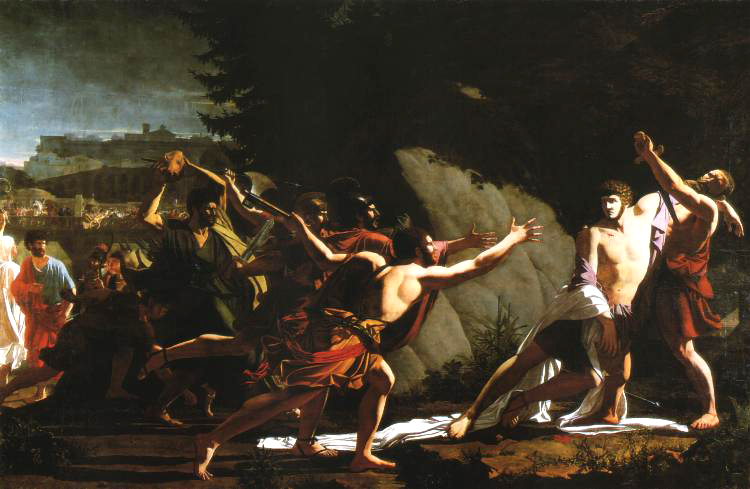
from the Life of Caius Gracchus (on his death)...
"17 So then, as Caius fled, his foes pressed hard upon him and were overtaking him at the wooden bridge over the Tiber, but his two friends bade him go on, while they themselves withstood his pursuers, and, fighting there at the head of the bridge, would suffer no man to pass, until they were killed. 2 Caius had with him in his flight a single servant, by name p237Philocrates; and though all the spectators, as at a race, urged Caius on to greater speed, not a man came to his aid, or even consented to furnish him with a horse when he asked for one, for his pursuers were pressing close upon him. He barely succeeded in escaping into a sacred grove of the Furies, and there fell by the hand of Philocrates, who then slew himself upon his master. 3 According to some writers, however, both were taken alive by the enemy, and because the servant had thrown his arms about his master, no one was able to strike the master until the slave had first been dispatched by the blows of many. Someone cut off the head of Caius, we are told, and was carrying it along, but was robbed of it by a certain friend of Opimius, Septimuleius; for proclamation had been made at the beginning of the battle that an equal weight of gold would be paid the men who brought the head of Caius or Fulvius. 4 So Septimuleius stuck the head of Caius on a spear and brought it to Opimius, and when it was placed in a balance it weighed seventeen pounds and two thirds, since it Septimuleius, besides showing himself to be a scoundrel, had also perpetrated a fraud; for he had taken out the brain and poured melted lead in its place. But those who brought the head of Fulvius were of the obscurer sort, and therefore got nothing. 5 The bodies of Caius and Fulvius and of the other slain were thrown into the Tiber, and they numbered three thousand; their property was sold and the proceeds paid into the public treasury. Moreover, their wives were forbidden to go into mourning, and Licinia, the wife of Caius, was also deprived of her marriage portion.a Most cruel of all, however, was the treatment of the younger son of Fulvius, who had neither lifted a hand p239against the nobles nor been present at the fighting, but had come to effect a truce before the battle and had been arrested; after the battle he was slain. 6 However, what vexed the people more than this or anything else was the erection of a temple of Concord by Opimius;12 for it was felt that he was priding himself and exulting and in a manner celebrating a triumph in view of all this slaughter of citizens. Therefore at night, beneath the inscription on the temple, somebody carved this verse:— "A work of mad discord produces a temple of Concord."
utility, grace and beauty...
from the life of Caius Gracchus...
"7 But he busied himself most earnestly with the construction of roads, laying stress upon utility, as well as upon that which conduced to grace and beauty. For his roads were carried straight through the country without deviation, and had pavements of quarried stone, and substructures of tight-rammed masses of sand. Depressions were filled up, all intersecting torrents or ravines were bridged over, and both sides of the roads were of equal and corresponding height, so that the work had everywhere an even and beautiful appearance. 2 In addition to all this, he measured off every road by miles (the Roman mile falls a little short of eight furlongs) and planted stone pillars in the ground to mark the distances. Other stones, too, he placed at smaller intervals from one another on both sides of the road, in order that equestrians might be able to mount their horses from them and have no need of assistance.
Since the people extolled him for all these services and were ready to show him any token whatsoever of their good will, he said to them once in a public harangue that he was going to ask a favour of them, which, if granted, he should value supremely, but if it were refused, he should find no fault with them. This utterance was thought to be a request for a consulship, and led everybody to expect that he would sue for a consulship and a tribuneship at the same time. 2 But when the consular elections were at hand and everybody was on the tip-toe of expectation, he was seen leading Caius Fannius down into the Campus Martius and joining in the canvass for p215him along with his friends. This turned the tide strongly in favour of Fannius. So Fannius was elected consul, and Caius tribune for the second time, though he was not a candidate and did not canvass for the office; but the people were eager to have it so."
Subscribe to:
Posts (Atom)