Thursday, September 15, 2011

greek prowess...

from the life of Aratus...

"Aratus restored eighty exiles who had been banished by Nicocles, and those also who had fled the city during the reign of former tyrants, to the number of five hundred. These had long been wanderers, yes, for close to fifty years. And now that they had come back, most of them in poverty, they laid claim to the property which they had formerly held, and by going to their farms and houses threw Aratus into great perplexity. For he saw that the city was plotted against by outsiders and eyed with jealousy by Antigonus because it had regained its freedom, while it was full of internal disturbances and faction.

4 Wherefore, as things stood, he thought it best to attach the city promptly to the Achaean League; and so, though the people of Sicyon were Dorians, they voluntarily assumed the name and civil polity of the Achaeans, who at that time had neither brilliant repute nor great strength. For most of them lived in small cities, owned land that was p23neither fertile nor extensive, and were neighbours to a sea that had no harbours and for the most part washed a precipitous and rocky shore. 5 But this people more than any other showed the world that Greek prowess was invincible, whenever it enjoyed good order, harmonious discipline, and a sensible leader. For though they had taken almost no part in the ancient glories of Greece, 6 and at this time, though counted all together, had not the power of a single considerable city, still, owing to their good counsels and their concord, and because they were able, in place of envying, to obey and follow the one who was pre-eminent among them for virtue, they not only preserved their own freedom in the midst of so great cities and powers and tyrannies, but also were continually saving and setting free very many of the other Greeks."

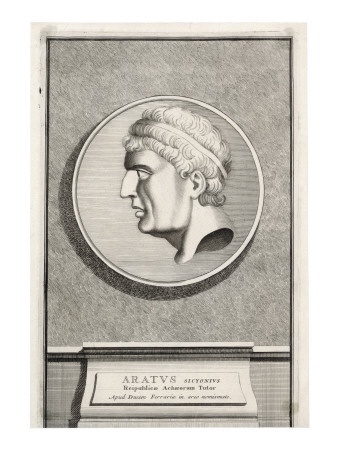
lover of himself...

from the life of Aratus...

"1 There is an ancient proverb, Polycrates,1 which the philosopher Chrysippus puts not as it really is, but as he thought better:—

"Who will praise a father, except happy sons?"
But Dionysodorus of Troezen corrects him, and restores the true form thus:

"Who will praise a father, except unhappy sons?"
2 And he says that the proverb stops the mouths of those who, being worthless in themselves, take refuge in the virtues of certain ancestors and are forever praising them. But surely for a man in whom, to use Pindar's words, "the noble spirit naturally displayesº itself as inherited from sires," and who, like thee, patterns his life after the fairest examples in his family line, — for such men it will be good fortune to be reminded of their noblest progenitors, ever and anon hearing the story of them, or telling it themselves. 3 For it is not that they lack p5noble qualities of their own and make their reputation dependent on their praises of others, nay rather, they associate their own careers with the careers of their great ancestors, whom they hail both as founders of their line and as directors of their lives. And therefore, now that I have written the life of Aratus, who was thy countryman and forefather, and to whom thou thyself art no discredit in either reputation or influence, I send it to thee, not as though thou hadst not been at pains from the beginning to have the most precise knowledge of thy great ancestor's career, 4 but in order that thy sons Polycrates and Pythocles may be reared, now by hearing and now by reading, after examples found in their own family line — examples which it well becomes them to imitate. For it is the lover of himself, and not the lover of goodness, who thinks himself always superior to others."

a most glorious feature...

from The Life of Titus Flamininus...

"13 Titus now began a most honourable and righteous war, the war against Nabis, the most pernicious and lawless tyrant of Sparta, but in the end he disappointed the hopes of Greece. For though it was in his power to capture the tyrant, he refused to do so, and made peace with him, thus leaving Sparta to the fate of an unworthy servitude. He was led to this step either by his fear that a protraction of the war would bring another general from Rome p361to succeed him and rob him of his glory, or by his jealous displeasure at the honours paid to Philopoemen. 2 For in all other matters Philopoemen was a most capable man among the Greeks, and in that war particularly he displayed astonishing deeds of ability and daring, so that he was extolled by the Achaeans as much as Titus, and equally honoured in their theatres. This annoyed Titus, who thought it out of keeping that a man of Arcadia, who had held command in small border wars, should receive just as much admiration from the Achaeans as a Roman consul, who was waging war in behalf of Greece.14 3 However, Titus himself had this to say in defence of his course, namely, that he put an end to the war when he saw that the destruction of the tyrant would involve the rest of the Spartans also in serious disaster.15

The Achaeans voted Titus many honours, none of which seemed commensurate with his benefactions except one gift, and this caused him as much satisfaction as all the rest put together. 4 And this was the gift: The Romans who were unhappily taken prisoners in the war with Hannibal had been sold about hither and thither, and were serving as slaves. In Greece there were as many as twelve hundred of them. The change in their lot made them pitiful objects always, but then even more than ever, naturally, when they fell in with sons, or brothers, or familiar friends, as the case might be, slaves with freemen and captives with victors. 5 These men Titus would not take away from their owners, although he was distressed at their condition, but the Achaeans p363ransomed them all at five minas16 the man, collected them together, and made a present of them to Titus just as he was about to embark, so that he sailed for home with a glad heart; his noble deeds had brought him a noble recompense, and one befitting a great man who loved his fellow citizens. 6 This appears to have furnished his triumph with its most glorious feature. For these men shaved their heads and wore felt caps, as it is customary for slaves to do when they are set free, and in this habit followed the triumphal car of Titus."

honor from the good...

from the life of Philopoemen (after his death)

"He was buried, then, as was fitting, with conspicuous honours, and at his tomb the captive Messenians were stoned to death. Many statues of him were erected and many honours decreed him by the cities. All these a Roman, in the disastrous days of Greece following the fall of Corinth,32 attempted to have removed, and he attacked the memory of Philopoemen himself, accusing him, as if still alive, of having been a malevolent enemy of the Romans. 6 After the proposal had been discussed and Polybius had spoken in opposition to Philopoemen's detractor, neither Mummius nor the members of the commission33 would consent that the honours paid to an illustrious man should be obliterated, although he had made no little opposition to Flamininus and Manius. These judges distinguished, as it would appear, between virtue and necessity, between honour and advantage. They rightly and fitly considered that benefactors ought always to receive reward and gratitude from their beneficiaries, and good men honour from the good."

splendid spirit...

from the Life of Philopoemen...

"2 After this Flamininus made peace with Nabis,20 and Nabis was treacherously put to death by the Aetolians.21 Sparta was therefore in a state of confusion, and Philopoemen, seizing his opportunity, fell upon the city with an armed force, and partly by compulsion, partly by persuasion, brought it over to his purposes and made it a member of the Achaean league. 3 This achievement brought him an amazing repute among the Achaeans, since through his efforts they had acquired a city of so great dignity and power (and indeed it was no slight matter that Sparta had become a member of the Achaean league); moreover, Philopoemen carried with him the principal men among the Spartans, who hoped to have in him a guardian of their liberties. 4 Therefore, after they had confiscated the house and property of Nabis and obtained thereby a p299hundred and twenty talents, they voted to make a present of the money to Philopoemen, and to send an embassy to Megalopolis on the matter. Here, indeed, it became perfectly clear that Philopoemen not only seemed to be, but actually was, a most excellent man.22 For, to begin with, no Spartan was willing to confer with a man of his character about the acceptance of a gift, but they were all so reluctant and afraid to do it that they entrusted the business to a guest-friend of his, Timolaüs. 5 And in the second place, Timolaüs himself, when he came to Megalopolis, having been entertained at the house of Philopoemen, and having learned thoroughly how dignified he was in his converse with others, how simple his ways of living, and how his character was nowhere to be approached and much less easy to be overcome by bribes, held his peace about the gift of money, and after giving some other excuse for his visit to him, went back home. And when he was sent a second time on the same errand, he did as before. 6 On his third visit, however, he at last got so far as to acquaint Philopoemen with the earnest desire of his city. Then Philopoemen, who was pleased by what he heard, went in person to Sparta, and counselled the people there not to try to bribe good men who were their friends, and by whose virtues they could profit without payment of money, but rather to buy up and corrupt the bad men who were ruining the city by their factious conduct in the assembly, to the end that such might have their mouths stopped in consequence of their venality, and so be less annoying to their fellow-citizens; for it was better, he said, to take away freedom of speech from their enemies rather than p301from their friends. Such was his splendid spirit in matters of money."

deeds of prowess...

from the Life of Philopoemen...

"a great mistake the enemy had made by going off in pursuit, thus breaking away from his phalanx and leaving a vacant space there, did not oppose or resist their chase after the fugitives, 4 but let them pass him by and make a great gap. Then he led straight against the Lacedaemonian heavy-armed, seeing that their phalanx had been left exposed, and fell upon them in a flank attack, while their commander was away and they were not expecting to fight; for they thought they were victorious and getting the upper hand altogether, since they saw Machanidas pursuing. 5 After Philopoemen had routed these with great slaughter (more than four thousand of them are said to have fallen), he set out against Machanidas, who was returning with his mercenaries from the pursuit. But a broad and deep ditch stretched between them, along which the two leaders rode opposite each other, one wishing to get across and escape, the other to prevent this. 6 The spectacle was not that of two commanders fighting, but that of a powerful hunter attacking a wild beast that has been forced to turn at bay, and Philopoemen was the hunter. And now the tyrant's horse, which was vigorous and high-spirited and felt the bloody spurs in his sides, essayed to make the leap across, and striking against edge of the ditch with his breast, was struggling with his fore-feet to extricate himself. 7 At this point Simmias and Polyaenus, who were always at Philopoemen's side when he was fighting and protected him with their shields, rode up both at the same time and levelled their spears at the horse. But Philopoemen was before them in attacking Machanidas, and seeing that the tyrant's horse was lifting its head up in front of its rider's body, he p285gave his own horse a little swerve to one side, and then, clasping his spear firmly in the middle, pushed it home with all his weight and overturned his enemy. 8 This is the attitude in which he is represented by a bronze statue set up at Delphi by the Achaeans, who admired especially both his deed of prowess and his generalship on that day."

roused the spirit of ambition...

from the life of Philopomoen...

"7 This naturally brought Philopoemen into high repute. Antigonus was eager that he should take service under him, and offered him command and pay. These Philopoemen declined, chiefly because he well knew that it was naturally unpleasant and hard for him to be under another man's orders. Not wishing, however, to be inactive and idle, for the sake of training and practice in war he sailed to Crete in search of military service. 2 In Crete he practised p273himself for a long time among men who were not only warlike and versed in many kinds of warfare, but also still moderate and restrained in their ways of living, and he came back to the Achaeans with such distinction that they at once made him commander of their cavalry.8 3 But he found that the horsemen whom he was to command used worthless animals acquired at random, whenever a campaign was to be undertaken; that they shirked most campaigns themselves, and sent others out in their places; that they were all characterized by a shocking lack of experience, together with its resultant cowardice; and that their commanders always overlooked these things because the knights had the greatest power and influence among the Achaeans and the chief voice in the assignment of rewards and punishments. 4 Philopoemen, however, did not yield or give way to them. He went round to the different cities and roused the spirit of ambition in each young man individually, punished those who needed compulsion, introduced drills, parades, and competitive contests in places where there would be large bodies of spectators and thus in a short time inspired them all with an astonishing vigour and zeal, 5 and, what is of the greatest importance in tactics, rendered them agile and swift in wheeling and deploying by squadrons, and in wheeling and turning by single trooper, making the dexterity shown by the whole mass in its evolutions to be like that of a single person moved by an impulse from within."