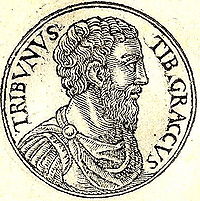
from the life of Caius Gracchus...
"Of the laws which he proposed by way of gratifying the people and overthrowing the senate, one was agrarian, and divided the public land among the poor citizens; another was military, and ordained that clothing should be furnished to the soldiers at p209the public cost, that nothing should be deducted from their pay to meet this charge, and that no one under seventeen should be enrolled as a soldier; another concerned the allies, and gave the Italians equal suffrage rights with Roman citizens; 2 another related to the supplies of grain, and lowered the market price to the poor; and another dealt with the appointment of judges. This last law most of all curtailed the power of the senators; for they alone could serve as judges in criminal cases, and this privilege made them formidable both to the common people and to the equestrian order. The law of Gracchus, however, added to the membership of the senate, which was three hundred, three hundred men from the equestrian order, and made service as judges a prerogative of the whole six hundred. 3 In his efforts to carry this law Caius is said to have shown remarkable earnestness in many ways, and especially in this, that whereas all popular orators before him had turned their faces towards the senate and that part of the forum called the "comitium," he now set a new example by turning towards the other part of the forum as he harangued the people, and continued to do this from that time on, thus by a slight deviation and change of attitude stirring up a great question, and to a certain extent changing the constitution from an aristocratic to a democratic form; for his implication was that speakers ought to address themselves to the people, and not to the senate."
...which is just a highfalutin way of saying, "bits I really like in reading Plutarch"
Thursday, September 15, 2011
Sunday, September 4, 2011
he was not going to remain quiet...
from the Life of Caius Gracchus...
"Caius Gracchus, at first, either because he feared his enemies, or because he wished to bring odium upon them, withdrew from the forum and lived quietly by himself, like one who was humbled for the present and for the future intended to live the same inactive life, so that some were actually led to denounce him for disliking and repudiating his brother's political measures. 2 And he was also quite a stripling, for he was nine years younger than his brother, and Tiberius was not yet thirty when he died. But as time went on he gradually showed a disposition that was averse to idleness, effeminacy, wine-bibbing, and money-making; and by preparing his oratory to waft him as on swift pinions to public life, he made it clear that he was not going to remain quiet; 3 and in defending Vettius, a friend of his who was under prosecution, he had the people about him inspired and frantic with sympathetic delight, and made the other orators appear to be no better than children. Once more, therefore, the nobles began to be alarmed, and there was much talk among them about not permitting Caius to be made tribune.
4 By accident, however, it happened that the lot fell on him to go to Sardinia as quaestor for Orestes the consul.1 This gave pleasure to his enemies, and did not annoy Caius. For he was fond of war, and quite as well trained for military service as for pleading in the courts. Moreover, he still shrank from public life and the rostra, but was unable to resist the calls to this career which came from the people and his friends. He was therefore altogether satisfied with this opportunity of leaving the city. 5 And yet a strong opinion prevails that he was a demagogue pure and simple, and far more eager than Tiberius to win the favour of the multitude. But this is not the truth; nay, it would appear that he was led by a certain necessity rather than by his own choice to engage in public matters. 6 And Cicero the orator also relates2 that Caius declined all office and had chosen to live a quiet life, but that his brother appeared to him in a dream and addressed him, saying: "Why, pray, dost p201thou hesitate, Caius? There is no escape; one life is fated for us both, and one death as champions of the people."
the party of the rich...
from the Life of Tiberius Graachus...
"Tiberius ordered the crowd to part for Flavius, who made his way up to him with difficulty, and told him that at a session of the senate the party of the rich, since they could not prevail upon the consul to do so, were purposing to kill Tiberius themselves, and for this purpose had under arms a multitude of their friends and slaves.
19 Tiberius, accordingly, reported this to those who stood about him, and they at once girded up their togas, and breaking in pieces the spear-shafts with which the officers keep back the crowd, distributed the fragments among themselves, that they might defend themselves against their assailants. 2 Those who were farther off, however, wondered at what was going on and asked what it meant. Whereupon Tiberius put his hand to his head, making this visible sign that his life was in danger, since the questioners could not hear his voice. But his opponents, on seeing this, ran to the senate and told that body that Tiberius was asking for a crown; and that his putting his hand to his head was a sign having that meaning. 3 All the senators, of course, were greatly disturbed, and Nasica demanded that the consul should come to the rescue of the state and put down the tyrant. The consul replied with mildness that he would resort to no violence and would put no citizen to death without a trial; if, however, the people, under persuasion or compulsion from Tiberius, should vote anything that was unlawful, he would not regard this vote as binding. Thereupon Nasica sprang to his feet and said: "Since, then, the chief magistrate betrays the state, do ye p191who wish to succour the laws follow me." 4 With these words he covered his head with the skirt of his toga and set out for the Capitol. All the senators who followed him wrapped their togas about their left arms and pushed aside those who stood in their path, no man opposing them, in view of their dignity, but all taking to flight and trampling upon one another.
5 Now, the attendants of the senators carried clubs and staves which they had brought from home; but the senators themselves seized the fragments and legs of the benches that were shattered by the crowd in its flight, and went up against Tiberius, at the same time smiting those who were drawn up to protect him. Of these there was a rout and a slaughter, and as Tiberius himself turned to fly, someone laid hold of his garments. 6 So he let his toga go and fled in his tunic. But he stumbled and fell to the ground among some bodies that lay in front of him. As he strove to rise to his feet, he received his first blow, as everybody admits, from Publius Satyreius, one of his colleagues, who smote him on the head with the leg of a bench; to the second blow claim was made by Lucius Rufus, who plumed himself upon it as upon some noble deed. And of the rest more than three hundred were slain by blows from sticks and stones, but not one by the sword."
the birds...
from the Life of Tiberius Gracchus...
"At break of day there came to the house the man who brought the birds with which auspices are taken, and threw food before them. But the birds would not come out of the cage, with the exception of one, though the keeper shook the cage right hard; and even the one that came out would not touch the food, but raised its left wing, stretched out its leg, and then ran back into the cage. This reminded Tiberius of an omen that had happened earlier. 2 He had a helmet which he wore in battle, exceptionally adorned and splendid; into this serpents crawled unnoticed, laid eggs there and hatched them out. For this reason Tiberius was all the more disturbed by the signs from the birds. But nevertheless he set out, on learning that the people were assembled on the Capitol; 3 and before he got out of the house, he stumbled against the threshold. The blow was so severe that the nail of his great toe p187was broken and the blood ran out through his shoe. He had gone but a little way when ravens were seen fighting on the roof of a house to his left hand; and though there were many people, as was natural, passing by, a stone dislodged by one of the ravens fell at the foot of Tiberius himself. This caused even the boldest of his followers to pause; 4 but Blossius of Cumae, who was present, said it would be a shame and a great disgrace if Tiberius, a son of Gracchus, a grandson of Scipio Africanus, and a champion of the Roman people, for fear of a raven should refuse to obey the summons of his fellow citizens; such shameful conduct, moreover, would not be made a mere matter of ridicule by his enemies, but they would decry him to the people as one who was at last giving himself the airs of a tyrant. 5 At the same time also many of his friends on the Capitol came running to Tiberius with urgent appeals to hasten thither, since matters there were going well. And in fact things turned out splendidly for Tiberius at first; as soon as he came into view the crowd raised a friendly shout, and as he came up the hill they gave him a cordial welcome and ranged themselves about him, that no stranger might approach.
18 But after Mucius began once more to summon the tribes to the vote, none of the customary forms could be observed because of the disturbance that arose on the outskirt of the throng, where there was crowding back and forth between the friends of Tiberius and their opponents, who were striving to force their way in and mingle with the rest. Moreover, at this juncture Fulvius Flaccus, a senator, posted himself in a conspicuous place, and since it was impossible to make his voice heard so p189far, indicated with his hand that he wished to tell Tiberius something meant for his ear alone. 2 Tiberius ordered the crowd to part for Flavius, who made his way up to him with difficulty, and told him that at a session of the senate the party of the rich, since they could not prevail upon the consul to do so, were purposing to kill Tiberius themselves, and for this purpose had under arms a multitude of their friends and slaves."
not a single clod of earth...
from the Life of Tiberius Gracchus...
"9 He did not, however, draw up his law by himself, but took counsel with the citizens who were foremost in virtue and reputation, among whom were Crassus the pontifex maximus, Mucius Scaevola the p165jurist, who was then consul, and Appius Claudius, his father-in‑law. 2 And it is thought that a law dealing with injustice and rapacity so great was never drawn up in milder and gentler terms. For men who ought to have been punished for their disobedience and to have surrendered with payment of a fine the land which they were illegally enjoying, these men it merely ordered to abandon their unjust acquisitions upon being paid the value, and to admit into ownership of them such citizens as needed assistance. 3 But although the rectification of the wrong was so considerate, the people were satisfied to let bygones be bygones if they could be secure from such wrong in the future; the men of wealth and substance, however, were led by their greed to hate the law, and by their wrath and contentiousness to hate the law-giver, and tried to dissuade the people by alleging that Tiberius was introducing a re-distribution of land for the confusion of the body politic, and was stirring up a general revolution.
4 But they accomplished nothing; for Tiberius, striving to support a measure which was honourable and just with an eloquence that would have adorned even a meaner cause, was formidable and invincible, whenever, with the people crowding around the rostra, he took his stand there and pleaded for the poor. "The wild beasts that roam over Italy," he would say, "have every one of them a cave or lair to lurk in; 5 but the men who fight and die for Italy enjoy the common air and light, indeed, but nothing else; houseless and homeless they wander about with their wives and children. And it is with lying lips that their imperators exhort the soldiers in their battles to defend sepulchres and shrines from the enemy; for not a man of them has an hereditary altar, not one of all these many Romans an ancestral tomb, but they fight and die to support others in wealth and luxury, and though they are styled masters of the world, they have not a single clod of earth that is their own."
Friday, September 2, 2011
vexed aristocrats...
From the Life of Tiberius Gracchus on land reform...
"After this the agrarian law was passed, and three men were chosen for the survey and distribution of the public land, Tiberius himself, Appius Claudius his father-in‑law, and Caius Gracchus his brother, who was not at Rome, but was serving under Scipio in the expedition against Numantia. 2 These measures were carried out by Tiberius quietly and without opposition, and, besides, he procured the election of a tribune in the place of Octavius. The new tribune was not a man of rank or note, but a certain Mucius, a client of Tiberius. The aristocrats, however, who were vexed at these proceedings and feared the growing power of Tiberius, heaped insult upon him in the senate. When he asked for the customary tent at public expense, for his use when dividing up the public land, 3 they would not give it, although other men had often obtained one for less important purposes; and they fixed his daily allowance for expenses at nine obols.16 These things were done on motion of Publius Nasica, who surrendered completely to his hatred of Tiberius. For he was a very large holder of public land, and bitterly resented his being forced to give it up.
4 But the people were all the more inflamed; and when a friend of Tiberius died suddenly and his body broke out all over with evil spots, they ran in throngs to the man's funeral, crying out that he had been poisoned to death, and they carried the bier themselves, p177and stood by at the last ceremonies. And their suspicions of poison were thought to be not without reason. 5 For the dead body burst open and a great quantity of corrupt humours gushed forth, so that the flame of the funeral pyre was extinguished. And when fresh fire was brought, again the body would not burn, until it was carried to another place, where, after much trouble, the fire at last took hold of it. Upon this, Tiberius, that he might exasperate the multitude still more, put on a garb of mourning, brought his children before the assembly, and begged the people to care for them and their mother, saying that he despaired of his own life."
lying lips
From the Life of Tiberius Gracchus,
"for Tiberius, striving to support a measure which was honourable and just with an eloquence that would have adorned even a meaner cause, was formidable and invincible, whenever, with the people crowding around the rostra, he took his stand there and pleaded for the poor. "The wild beasts that roam over Italy," he would say, "have every one of them a cave or lair to lurk in; 5 but the men who fight and die for Italy enjoy the common air and light, indeed, but nothing else; houseless and homeless they wander about with their wives and children. And it is with lying lips that their imperators exhort the soldiers in their battles to p167defend sepulchres and shrines from the enemy; for not a man of them has an hereditary altar, not one of all these many Romans an ancestral tomb, but they fight and die to support others in wealth and luxury, and though they are styled masters of the world, they have not a single clod of earth that is their own."
Subscribe to:
Posts (Atom)